

It's a humid Gold Coast morning, you're planning a swim after work, and your extensions still look good through the ends. But the beads feel lower than they did at your appointment, and you're wondering whether that itch is shampoo residue, damp roots or a sign that something needs adjusting.
Good micro bead hair extensions care means keeping the attachments clean, dry and free from unnecessary pull. It also means knowing which jobs belong at home and which need a stylist. A polished finish isn't proof that the hair underneath is comfortable.
Table of Contents
- Your Weekly Micro Bead Care Schedule
- Wash, Dry and Daily Product Care
- Common Problems and When to Stop Wearing Them
- What a Proper Refit Should Include
- Book a Gold Coast Check Before the Next Slip
Your Weekly Micro Bead Care Schedule
Micro beads are small metal rings clamped around sections of your natural hair to secure extension strands or support a weft. There's no glue or heat at the join, so your routine should protect that mechanical attachment without twisting, coating or pulling it.
Weekly micro bead care schedule
| Task | How often | Key rule |
|---|---|---|
| Wash scalp and extensions | 2–3 times a week | Gentle scalp cleanse, no scrubbing or twisting the beads |
| Condition | Every wash | Mid-lengths and ends only; keep product off the beads |
| Brush or comb | Morning and night, and before washing | Start at the ends and support the bead row |
| Dry the roots | After every wash, swim or heavy sweat | Roots fully dry before bed or tying hair up |
| Sleep | Every night | Loose braid or low ponytail on silk or satin |
| Swim, salt or chlorine | Each session | Tie hair up loosely and rinse the same day |
| Professional refit | Every 6–8 weeks | Sooner if pain, matting or thinning appears |
Build the routine around your actual week
Use the wash frequency as a starting schedule, not a reason to leave a sweaty scalp unwashed. If you've exercised before work or spent the afternoon in the surf, respond to how your scalp feels rather than trying to preserve yesterday's styling.
Condition whenever you wash, but keep it through the mid-lengths and ends. The extension lengths need slip for detangling; the bead line needs to stay free of a slippery coating.
Brush before you leave in the morning and before bed, with another gentle detangle before washing. Hold the hair above the section you're brushing so the movement doesn't travel straight into the attachments.
Practical rule: The ends can look dry while the hair underneath the bead rows is still damp. Check the roots with your fingers before putting your hair away for the night.
After a swim, rinse out salt or chlorine that day. If you've had a heavy sweat, cleanse or rinse as appropriate, then dry underneath the attachments rather than leaving them bundled in a wet ponytail.
Make bedtime and maintenance predictable
A loose braid or low ponytail helps prevent the lengths wrapping around each other while you sleep. Silk or satin reduces rubbing, but neither makes a tight hairstyle safe. Your scalp shouldn't feel pulled when you turn your head.
Book maintenance ahead rather than waiting until you can see a large gap below the roots. The condition of the reusable hair and the security of its attachment are separate questions, which our guide to how long extensions last helps explain.
At the end of the week, gently separate the rows and check what's changed. There shouldn't be odour along the bead line, itch that continues after drying, or attachments sliding independently down the hair. Gradual movement with natural growth is different from a bead that suddenly feels loose.
Wash, Dry and Daily Product Care
A useful wash cleans the scalp without disturbing the attachments. On the Gold Coast, the part people most easily miss is drying underneath the hair, especially after an evening shower when the bathroom and coastal air already feel humid.
Set out a wide-tooth comb or extension-safe brush, mild shampoo, light conditioner, a clean towel and your dryer before starting. That makes it easier to finish the job instead of leaving damp roots while you get ready for something else.
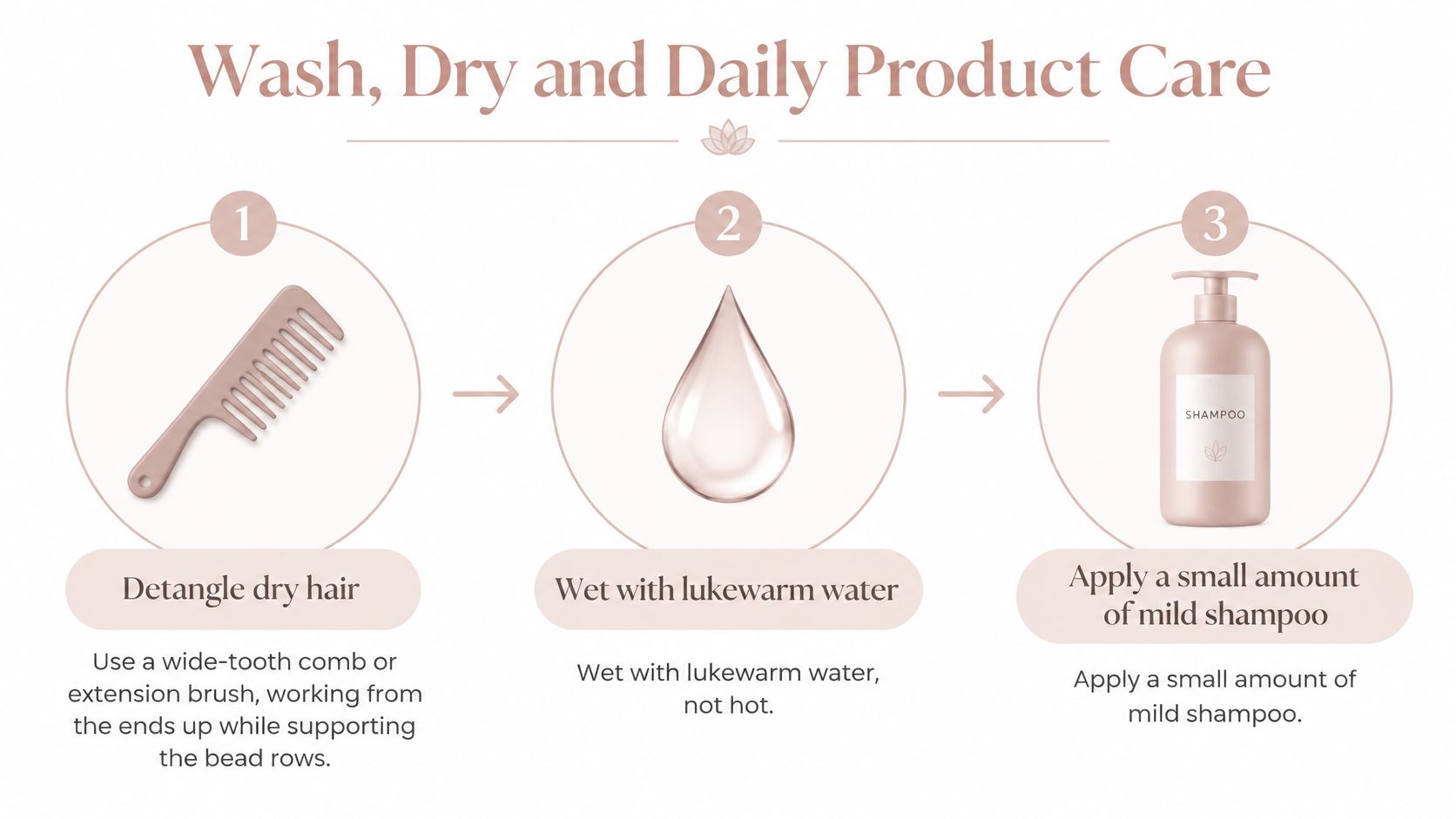
Follow the wash through to dry roots
- Detangle dry hair. Use a wide-tooth comb or extension brush, working from the ends up while supporting the bead rows. Clear the lengths first, rather than pushing a knot upwards until it catches at an attachment.
- Wet with lukewarm water, not hot. Let the hair hang in its usual direction under the shower. Don't flip it over and pile it onto the crown, where loose lengths can wind around the joins.
- Apply a small amount of mild shampoo. Use your fingertip pads to clean the scalp between the rows. Keep your nails out of the bead line and avoid circular scrubbing that twists neighbouring sections together.
- Rinse the attachment area carefully. Lift sections gently so water reaches underneath each row, then continue until the cleanser has rinsed away. A clear stream through the ends doesn't necessarily mean you've rinsed the hidden roots.
- Condition below the attachments. Start about a hand's width below the beads and smooth the product towards the ends. Keep it out of the scalp and attachment line, then rinse without rubbing the lengths together.
- Blot with a clean towel. Press moisture out rather than twisting the hair into a rope or rubbing it vigorously. A heavy towel wound tightly on top of your head can also pull at the rows.
- Dry the roots and bead area completely. Part the hair into manageable sections and use controlled airflow on a comfortable setting, keeping the dryer moving. Dry underneath the rows before finishing the lengths.
- Separate and inspect the attachments. With clean hands, gently check that neighbouring sections aren't joined by a tangle. Look for product crust or a snag, but don't scrape at the scalp or force anything apart.
The wash is finished when your scalp feels clean and the attachment area is dry, not when the visible hair looks smooth. For more help with shower positioning and rinsing, use our guide to washing your hair when you have hair extensions.
Choose products for your scalp as well as your extensions
A mild shampoo is one your scalp tolerates and that rinses away without leaving a heavy film. A sulphate-free label alone doesn't guarantee that a formula won't irritate you, and an expensive extension shampoo isn't a reason to keep using something that burns.
A 2022 review of hair-cosmetic exposure reports a pooled lifetime hand-eczema prevalence of 38.2% among hairdressers, and cites Australian patch-test data from 2001–2010 in which 292 of 4,297 patients, or 6.8%, tested positive to cocamidopropyl betaine. Those are occupational and clinical findings, not a prediction of an extension wearer's risk.
The useful takeaway is to judge products by your own scalp's response. Stop a product that causes itching, redness, burning or rash, and seek health advice if symptoms persist rather than trying to settle them with another cosmetic.
- Heavy oils and butters: Keep them away from the bead line. They can coat the attachments and make cleansing harder.
- Dry shampoo: Don't spray it directly onto the beads or use it to postpone washing an uncomfortable scalp.
- Leave-in sprays: Apply to the lengths where needed, not indiscriminately across the roots.
- Serum: A few drops smoothed through the ends can help manage friction without saturating the joins.
Say you've come home from the beach with rough-feeling ends and an itchy scalp. Treat those as separate needs: cleanse and rinse the scalp properly, then condition the lengths. Coating everything in oil won't remove salt or explain the itch.
Keep heat and brushing away from the joins
Use heat protectant on the lengths before tongs or straighteners, and let the hair dry before using hot styling tools. Keep the plates and barrel clear of the metal beads. Don't clamp an attachment because a root section won't sit flat.
Choose a brush designed to pass through extensions without catching the joins. A conventional paddle brush dragged from the roots can transfer the force of a knot straight to your natural hair.
A styling product can smooth frizz. It can't make a painful attachment suitable to keep wearing.
For humid mornings, work with a loose, comfortable style rather than pulling the rows taut to control flyaways. If a hairstyle only looks tidy when you pull hard, change the hairstyle, not the tension at the scalp.
Treat salon hygiene as part of aftercare
Under the Queensland personal-appearance-services legislation, the Public Health (Infection Control for Personal Appearance Services) Act 2003 and Regulation 2016 provide the infection-control framework for these services. A professional workflow should include hand hygiene, appropriately reprocessed reusable equipment and a scalp check before proceeding.
Ask how reusable combs, pliers and sectioning tools are cleaned and reprocessed between clients. Don't conceal a sore, broken or inflamed area with dry shampoo before your appointment, because the stylist needs to see the scalp to assess whether to proceed.
At home, clean trapped hair and product from your brush, wash suitable tools and let them dry properly. Keep your own combs and brushes rather than sharing them, and wash your hands before checking the rows.
Common Problems and When to Stop Wearing Them
Waiting for a booked refit while your scalp is already sore is a mistake. An attachment can look neat and still place too much load on the natural hair, so comfort matters more than whether the beads are visible.
Micro bead symptoms, likely causes and what to do
| Symptom | Likely cause | What to do |
|---|---|---|
| Mild itch that settles after washing and drying | Product residue or roots left damp | Rinse more thoroughly and dry the bead area fully |
| Redness, scaling, pustules, odour or weeping | Irritation or possible infection | Stop covering it with product and get professional assessment |
| One or two beads slipped down the hair | Normal growth or a loose crimp | Leave them; ask the stylist to reposition at refit if the scalp is comfortable |
| Soreness, constant tugging or a tight spot | Too much hair weight or a bead placed under tension | Stop normal wear on that area and have the attachment loosened |
| Short broken hairs or a thinning patch | Ongoing traction | Remove or loosen the pull promptly; don't wait for a routine refit |
| Matting right at the beads | Wet sleep, forced brushing or conditioner at the joins | Detangle from the ends only and book a check before it locks |
| Beads you want tighter at home | Growth being mistaken for a DIY fix | Don't pinch or glue them; book a refit |
Separate an adjustment from a warning sign
The table gives possible causes, not a diagnosis. Mild itch that disappears after a thorough wash and full dry can justify improving your routine and monitoring the area. Itch with inflamed skin, pustules, unusual odour or weeping needs assessment, potentially by a doctor.
A comfortable loose bead isn't the same problem as a tight bead. If an attachment has slipped but isn't pulling, avoid fiddling with it and contact the stylist for advice about timing. If it catches on neighbouring hair or starts dragging, bring the appointment forward.
Pain, persistent tenderness and short broken hairs deserve prompt action. The Australasian College of Dermatologists' guidance on traction alopecia identifies extensions as a source of continuous pulling and explains that prolonged traction can cause irreversible follicle loss.
Don't spend the week testing whether the area will settle under different hairstyles. Stop pulling it into a ponytail and arrange professional release of the tension as soon as possible.
Know where home care ends
Root matting isn't a knot to power through. Work only through the free lengths while supporting the hair, then leave the attachment area for professional assessment if it won't separate easily.
- Don't tighten beads yourself: Household pliers can crush an attachment or trap hair under uneven pressure.
- Don't cut around a bead: It's easy to cut your own supporting hair along with the extension.
- Don't force a root tangle: Pulling can break hair before the mat comes apart.
- Don't repeat the same sore placement: A recurring tender patch calls for a different assessment, not another identical installation.
Our guide to hair extensions without damage helps you consider suitability alongside everyday handling.
Pain, visible pulling, progressive thinning or a scalp that looks infected overrides the maintenance calendar.
Seek urgent medical advice for rapidly worsening redness, swelling, severe pain or feeling unwell. A stylist can assess the attachments, but shouldn't be your only contact for suspected infection.
What a Proper Refit Should Include
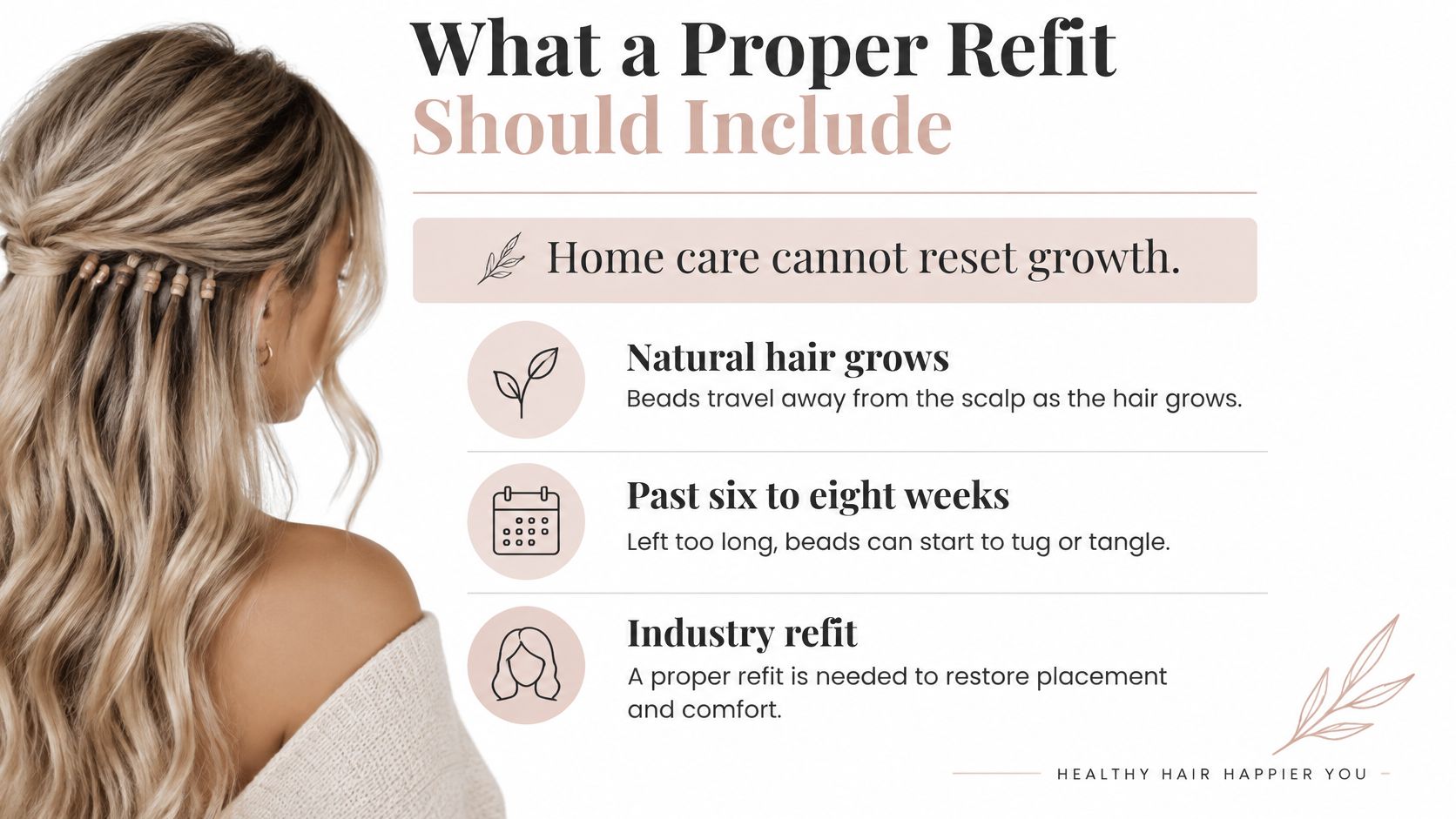
Home care cannot reset growth. Your natural hair carries the attachments farther from the scalp as it grows, changing how they sit and how freely the surrounding sections move. A refit restores suitable placement after checking whether the hair and scalp can safely support the set.
Understand the maintenance commitment
Published Australian market listings illustrate why ongoing maintenance belongs in your budget before installation. The micro-bead retightening price listing gives AUD $250 for a quarter head, $350 for a half head and $500 for a full head at 6–8-week intervals; a broader semi-permanent maintenance cost guide gives AUD $160–$850 every 6–8 weeks.
These are market examples, not Hair Extensions Full Stop's prices. They also cover different amounts of hair and service scopes, so don't assume every quote includes identical work.
Micro bead retightening and maintenance costs
| Service | Price (AUD) | Interval |
|---|---|---|
| Quarter head retightening | 250 | 6–8 weeks |
| Half head retightening | 350 | 6–8 weeks |
| Full head retightening | 500 | 6–8 weeks |
| Semi-permanent extension maintenance overall | 160–850 | Every 6–8 weeks |
Expect assessment, not simply tighter beads
A sound refit starts with the scalp and supporting hair. The stylist should check for tenderness, broken hairs, thinning, residue and matting before deciding which attachments or components can be reused.
They then remove or reposition attachments as appropriate, separate trapped shed hair and reassess the sectioning and weight distribution. Pinching a grown-out bead tighter doesn't restore its position or correct an overloaded section.
A standard micro bead grips hair; it doesn't enter the skin. Queensland Health's infection-control guidance distinguishes ordinary hairdressing from higher-risk procedures involving implantation into skin, so any proposed skin penetration needs a separate discussion.
The finished rows should be separated, the roots dry and the placement comfortable. If your natural hair can't support the current density, the right decision may be fewer attachments, a different method or a break from extensions.
Leave with a clear record
The ACCC personal-services guide explains that providers must use appropriate skill and care, avoid loss or damage, and provide services reasonably fit for the purpose the consumer has communicated. Safe wear is a shared responsibility, not something a stylist can hand entirely to the client.
Before committing or rebooking, retain:
- Hair details: The stated origin and type of hair, plus its care requirements.
- Attachment details: The bead type and method used.
- Maintenance timing: Your recommended return date and what could bring it forward.
- Early-removal signs: Symptoms that mean continued wear isn't appropriate.
- Correction arrangements: Who to contact if the installation feels unsuitable or unsafe.
Book a Gold Coast Check Before the Next Slip
If your set is comfortable, your scalp looks healthy and the rows separate easily, keep your routine consistent and diary the refit before the attachments become difficult to manage. You don't need to wait for an obvious slip to organise maintenance.
If you're already dealing with pain, root matting or hair that looks thinner around a join, make that the reason for an appointment. Styling over the area may hide it from view, but it doesn't tell you whether the supporting hair is coping.
Choose the appointment around your hair
At Hair Extensions Full Stop in Ashmore, we assess your natural hair, discuss your goals and recommend the most suitable extension option during consultation. Swimming, heat styling, scalp sensitivity and the time you can realistically spend on upkeep all belong in that conversation.
Our Micro Bead Extensions are applied without glue or heat and are a reusable, gentle option for many hair types. That doesn't make them the automatic choice for every head of hair, and the consultation should establish suitability before you commit.
For anyone comparing hair extensions on the Gold Coast, the useful question isn't just how the finished lengths will look. It's whether the application, maintenance commitment and weight suit the hair you have now.
Bring useful information to your check
Tell us when the discomfort started, whether it changes with styling, and which products you've used near the roots. Clear photos of the bead line can help you explain a concern when enquiring, although an in-person assessment may still be needed.
Our studio is at 2/24 Commercial Drive, Ashmore QLD 4214. Ask for a maintenance plan before your next installation, especially if your swimming or exercise routine has changed. A short check now is a better choice for your natural hair than weeks of avoidable tension.
Hair Extensions Full Stop offers personalised consultation, professional hair extension application and ongoing maintenance in Ashmore on the Gold Coast. Visit Hair Extensions Full Stop to enquire or find our contact details, and arrange a bead-line check or refit before discomfort becomes something you're trying to style around.
Recent Articles


