

What if the most important question about keratin bond hair extensions isn't how long they last, but whether your hair and scalp can comfortably carry them? A discreet attachment means little if it pulls at your temples or leaves your scalp irritated.
For Gold Coast clients wanting length or thickness, the useful starting point is density, tension and skin tolerance, not the longest wear window. Keratin bonds can deliver flexible, natural-looking placement, but they aren't the right fit for every head.
Table of Contents
- What Keratin Bond Hair Extensions Actually Are
- How Keratin Bonds Compare With Other Methods
- Which Hair Types Suit Keratin Bonds
- How a Keratin Bond Application Is Done
- Maintenance Windows and Safe Removal
- Irritation Tightness and When to Stop
- Book a Method Check on the Gold Coast
What Keratin Bond Hair Extensions Actually Are
Say you want longer hair through the back without a visible weft line when you move it. Keratin bond hair extensions use small, pre-tipped strands attached individually to sections of your natural hair. In a human-hair installation, each extension strand is human hair, while the tip is the separate bonding material.
The attachment has three parts: your natural section, the keratin tip and the sealed join. A stylist softens the tip with a bonding tool and forms it around the supporting hair. The finished join sits away from the scalp, not glued to your skin.
What individual placement changes
Strand-by-strand placement lets a stylist distribute colour and length selectively. Rather than adding a continuous row everywhere, they can build through areas with enough supporting density and leave vulnerable areas alone.
That flexibility can help with:
- Movement: Individual strands can move separately rather than as a single curtain of hair.
- Colour blending: Different shades can be distributed through the installation.
- Styling: Carefully positioned attachments can remain discreet when the hair changes direction.
- Targeted length: Extra hair can be concentrated where the natural base can support it.
A smooth, natural-looking hairline is a placement goal, not a reason to attach bonds to fragile edge hairs. If the shortest or finest sections can't support the desired result, the design needs to change.
What the method doesn't promise
Every bond adds weight. A small attachment isn't automatically a low-stress attachment, and the word keratin doesn't establish that the finished service will suit your scalp.
These extensions also aren't a keratin smoothing treatment. The service attaches additional hair; it doesn't straighten your own hair by coating it.
A useful consultation checks natural density, previous colour or bleach, everyday styling and the length you want before any tip is heated. The right outcome may be a conservative bond installation, another attachment method or postponing extensions while a scalp concern is assessed.
How Keratin Bonds Compare With Other Methods
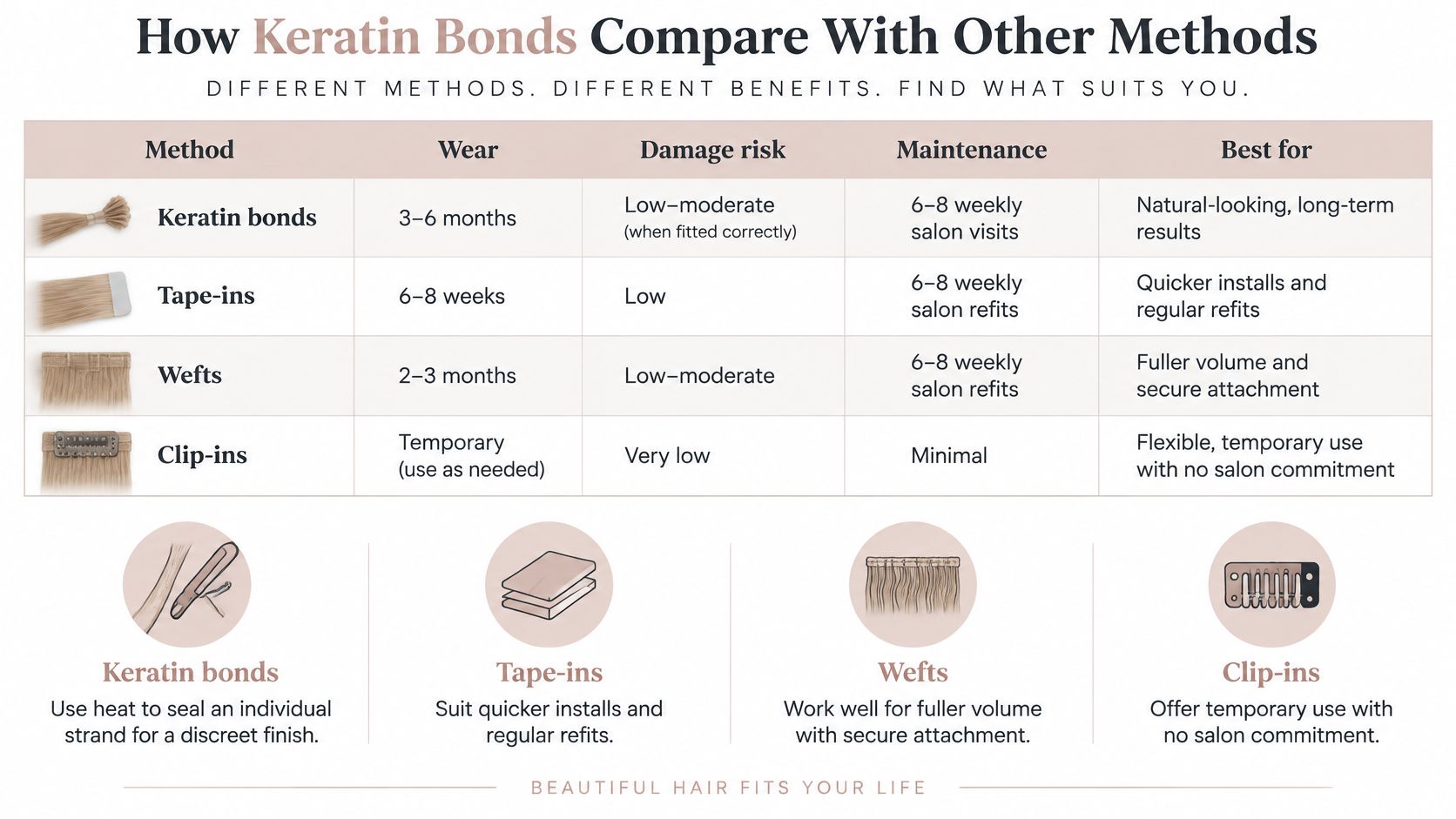
Keratin bonds beside bead and weft methods
| Method | Attachment | Heat or glue | Typical wear | Best suited to | Removal |
|---|---|---|---|---|---|
| Keratin bond | Individual strand fused at a keratin tip | Heat used to seal the tip | About 3–5 months, subject to assessment | Medium or denser hair wanting strand styling | Salon removal; bonds aren't pulled off |
| Micro bead | Small bead clamps a strand of extension hair | No glue and no heat | Refit when growth or attachment position requires it | Many hair types; reusable and adjustable | Bead opened and hair released at a refit |
| Nano bead | Smaller bead than a micro method | No glue and no heat | Refit when growth or attachment position requires it | Fine or delicate hair needing a discreet strand method | Bead released; smaller hardware than micro |
| Invisible weft | Flat weft row close to the scalp | No individual keratin bond | About 2–3 months, subject to assessment | Clients wanting maximum volume | Row released and repositioned |
| Butterfly weft | Lightweight, flexible weft | No keratin fusion | About 2–3 months, subject to assessment | Clients wanting movement with less weight | Weft moved up rather than bond-by-bond removal |
The approximate 3–5-month keratin and 2–3-month weft planning windows follow Hair Extensions Full Stop's maintenance guidance; neither is a guaranteed wear period.
Choose the attachment you can live with
Keratin bonds suit clients who value individual placement and can commit to careful home care. The trade-off is removal: releasing a fused attachment is more involved than opening a bead. Don't choose fusion because you'd prefer fewer appointments.
Micro beads avoid both bonding heat and adhesive. The bead can be opened for adjustment, making this a useful option when reusability matters. Our guide to I-tip and microbead extensions explains that attachment in more detail.
Nano beads offer a smaller, more discreet individual attachment. That can help with fine hair, but smaller hardware doesn't give fragile strands unlimited carrying capacity.
Invisible wefts prioritise fuller volume through flat rows. Butterfly wefts prioritise flexibility and movement. Neither provides the same individual placement as bonds, and neither removes the need to assess the supporting hair.
Longer continuous wear is not the same as lower stress.
Look beyond the method name
Tape-ins offer a flat attachment and regular refits, while clip-ins provide temporary styling without a permanent installation. Temporary doesn't mean tension-free, though. A heavy clip placed repeatedly on the same weak section can still pull.
Australian extension supply relies substantially on imported products, as discussed in the 6Wresearch Australian hair-extension market analysis. That makes provenance a practical question, not just a marketing label.
Before committing, establish where the human hair was sourced, how the bonds are made and whether the colour has been matched against your own hair. A method name alone doesn't tell you how the hair will blend or how the attachment should be handled.
Choose a likely method to discuss, then test that choice against your actual hair condition. Don't book the longest-wear option automatically.
Which Hair Types Suit Keratin Bonds
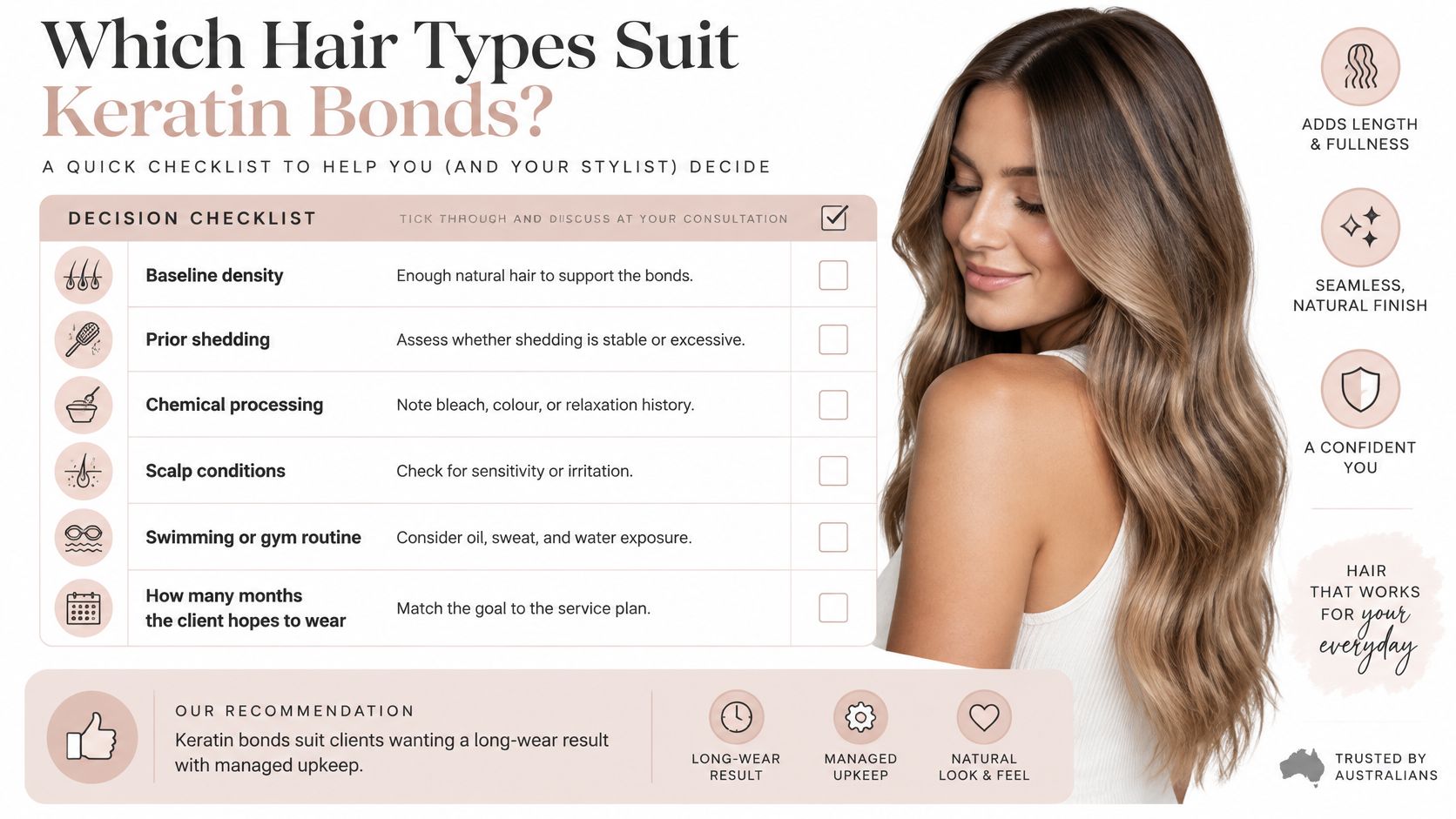
Before recommending an attachment, work through this checklist:
- Baseline density: Assess the supporting hair in each placement area, not just the overall thickness of a ponytail.
- Prior shedding: Establish whether shedding is stable or has recently increased.
- Chemical processing: Record bleach, colour, straightening and any recent breakage.
- Scalp conditions: Disclose dermatitis, tenderness, itching or active irritation.
- Swimming and gym routine: Consider washing, drying, water exposure and how tightly you tie your hair.
- Desired wear period: Match the commitment to your maintenance habits, not just an event date.
Match the method to the supporting hair
Dense, healthy hair wanting length through the ends can be a reasonable keratin candidate. Even then, conservative strand size and sensible placement matter more than fitting the greatest possible amount of hair.
Fine or delicate hair needs a different discussion. Nano beads or a light weft may be more appropriate, but no attachment should be used to disguise an overloaded design. Our fine-hair extension guide for Gold Coast clients helps frame that consultation.
For someone swimming regularly or training most days, the issue is practical upkeep. Frequent rinsing, drying and tying back may make an adjustable bead or flexible weft easier to manage than keratin seals. Heavy root oils and frequent tight upstyles can also work against a bond installation.
Temple thinning, recent breakage, or a tight-ponytail habit warrants caution. Don't add load to the hairline just because that's where you want more coverage.
Which method to ask about first
| Hair situation | Method to ask about first | Think twice about |
|---|---|---|
| Dense, healthy natural hair wanting length | Keratin bonds with conservative strand size | Heavy oils applied at the roots |
| Fine or delicate hair | Nano beads or a light weft | Full keratin sets that overload fragile strands |
| Frequent swimming or gym sessions | Micro beads or butterfly weft | Keratin seals that conflict with upkeep habits |
| Temple thinning, recent breakage or tight ponytails | Lighter method after stylist review, or no installation | Adding any load at the hairline |
| Known sensitivity to glues, resins or dyes | Glue-free bead or weft after medical advice | A walk-in keratin booking |
| Volume without a visible join | Invisible weft | Bonds placed close to the scalp |
Comfort is part of suitability
The American Academy of Dermatology's extension guidance warns that repeated pulling can cause breakage and traction alopecia; pain, headache or excessive tightness means the style should be loosened, not tolerated.
Persistent soreness, itching, redness, bumps, hairline thinning or increased shedding needs prompt review rather than another full maintenance set.
Correctly applied does not mean suitable for every head.
Keratin merits assessment for healthy supporting density and strand styling. Nano beads merit consideration where discretion and fine hair are priorities. Micro beads suit a discussion about adjustable, reusable strands. Invisible wefts suit a volume-led goal. Butterfly wefts suit a preference for lightweight flexibility, provided the attachment base is suitable.
How a Keratin Bond Application Is Done
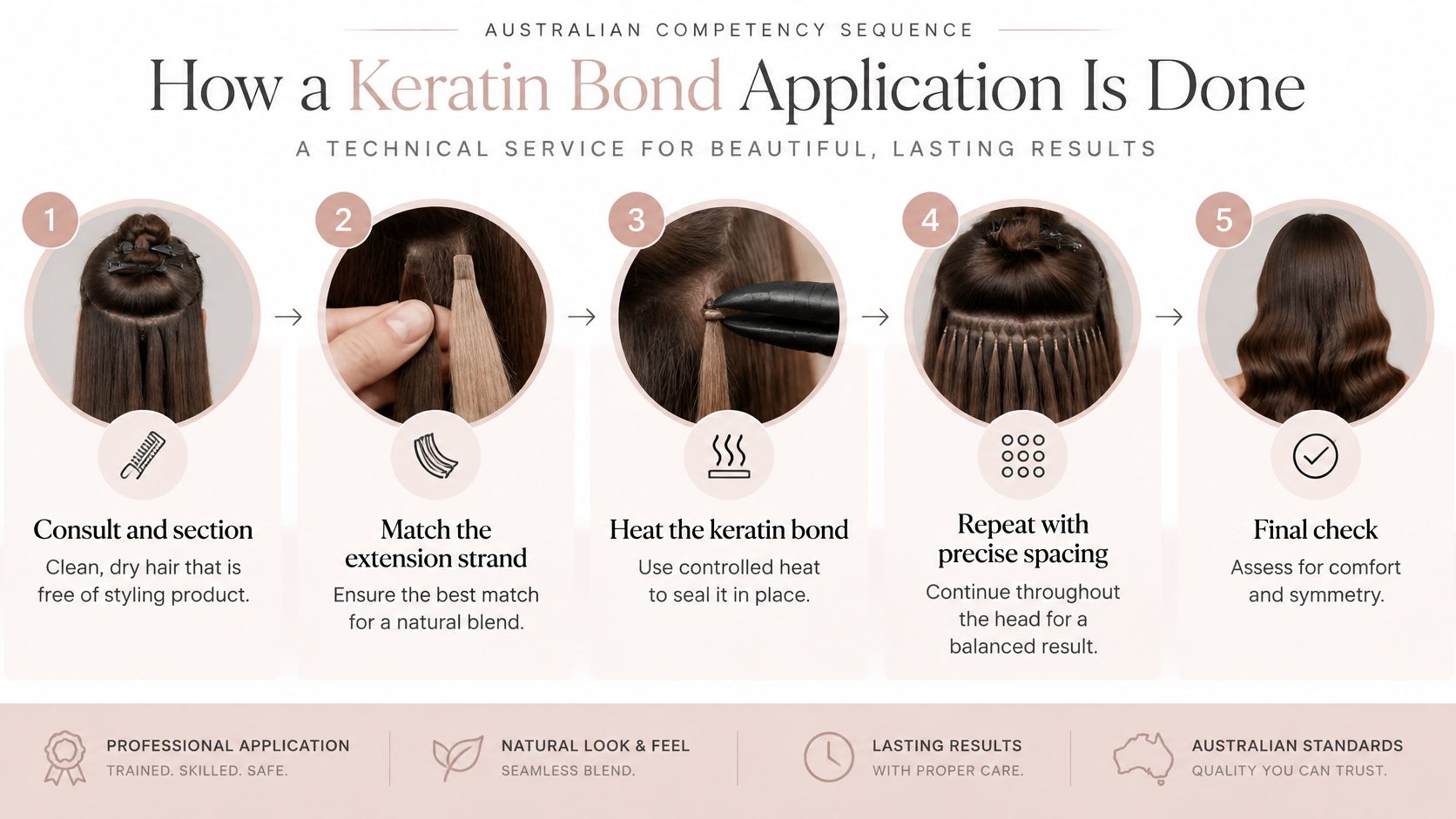
A keratin installation is a technical service, not a walk-in add-on. The Australian hairdressing competency standard requires clean, dry, product-free preparation, manufacturer-directed sealing, client comfort, safe tension selection and maintenance education.
That sequence matters because a neat-looking bond can still be poorly balanced. The application should control both attachment quality and the load carried by your natural hair.
Preparation and placement
-
Consult and prepare the hair.
Confirm suitability, then section clean, dry hair without styling residue. Product left around the attachment area can interfere with a reliable seal; rushing preparation isn't a useful shortcut. -
Match colour and select strand size.
Compare the extension hair with the natural lengths and ends, then choose the supporting section from its density. Oversized extension strands can overload a fine natural section, even when the colour match is excellent. -
Set placement and tension.
Isolate the section cleanly so neighbouring hairs aren't caught across the join. Choose a comfortable degree of tension rather than pulling the section taut to make the work look tidier. -
Seal with the specified bonding tool.
Use the product's prescribed equipment and sealing technique. Guessing at temperature or repeatedly reheating an uncertain join isn't a substitute for knowing the bond system.
Finish the service, not just the attachment
-
Check movement and comfort.
Bonds shouldn't sit against the scalp, crowd the hairline or tug at the temples. Ask the client to move their head and reposition their hair so restricted movement isn't missed while they're sitting still. -
Blend and shape.
Integrate the extensions with the natural cut rather than leaving a dense shelf of added hair beneath shorter layers. Check the result in movement and in the styles the client wears. -
Explain care and arrange follow-up.
Give clear instructions for cleansing, detangling, heat tools, sleeping and review. Without that handover, a client may treat the attachment area like loose natural hair and unknowingly pull or heat the joins.
Colour services also need planning when skin is sensitive. Stacking colour and bonding into an appointment without discussing previous reactions makes it harder to assess whether the combined service is appropriate.
Before leaving, you should be able to identify your attachment areas, describe how you'll brush them and know whom to contact if something feels wrong. Secure shouldn't mean throbbing, and a polished finish isn't a reason to dismiss discomfort in the chair.
Maintenance Windows and Safe Removal
About 3–5 months is a planning benchmark for keratin bonds, not a promise. The appropriate endpoint is set by growth, attachment condition, natural density, strand weight and home care.
Tape methods generally involve earlier move-ups, while wefts follow their own row-refit schedule. Keratin's longer continuous-wear potential changes the planning task: you still need a removal appointment, rather than hoping the bonds will eventually release harmlessly.
Daily protection without overcomplicating it
Use a loop brush suitable for extensions and work from the ends upwards. Support the hair with your hand while detangling so a knot in the lengths doesn't transfer the whole pull to the roots.
- Keep rich products below the joins: Apply conditioner and masks to the mid-lengths and ends, not directly over the bonds.
- Protect the lengths from heat: Use heat protectant, but don't treat it as permission to clamp a straightener onto an attachment.
- Separate gently: Feel for neighbouring strands tangling together and address them before a compact knot develops.
- Sleep without extra pull: If your hair tangles overnight, secure it loosely rather than wearing a tight bun.
- Plan swimming care: Rinse after swimming and dry the attachment area carefully instead of leaving tangled, wet roots unattended.
Fast growth, heavy attachments, oil near the roots and skipped brushing can bring the endpoint forward. Swimming doesn't automatically rule out bonds, but frequent water exposure needs a realistic washing and drying routine.
Inspect early and remove deliberately
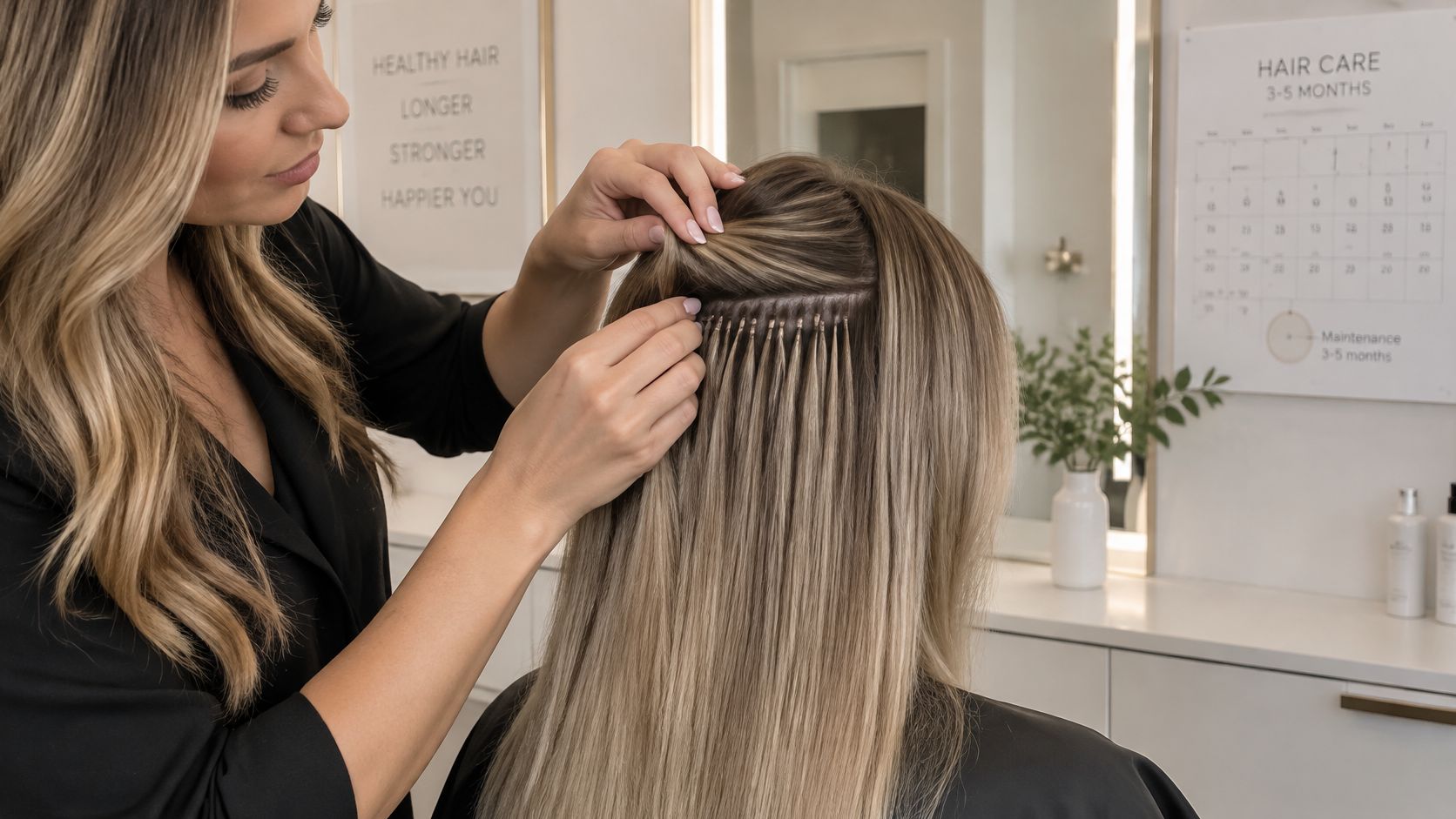
Check for lifting, loosening, root tangling, tenderness or uneven tension. A bond that feels pressed against the scalp deserves inspection; don't assume discomfort is part of getting used to extensions.
Practical rule: Bring the appointment forward when comfort or attachment condition changes. Don't aim to reach a calendar date at your hair's expense.
Removal is a salon procedure using the release method specified for the bond system. That commonly involves removal solution and controlled bond-breaking tools, followed by gentle release, not pulling the extension through resistant natural hair.
Don't use household pliers, snap bonds off in the shower or improvise with heat. The keratin bond removal guide explains why controlled release matters.
After removal, pause before reinstalling if the scalp is sore or shedding has noticeably changed. A fresh set shouldn't cover a problem that still needs assessment.
For a written routine, our free care guide covers washing, product selection, heat protection, sleeping, swimming and maintenance scheduling. A consistent plan is more useful than combining conflicting tips from social videos.
Irritation Tightness and When to Stop
Discomfort isn't a single problem, and a new serum won't fix every cause. Mechanical tension can feel like soreness, pulling or headache, sometimes with bumps around stressed areas. Contact irritation can involve itching, redness, burning or a rash.
Those symptoms can overlap, so don't diagnose the cause from sensation alone. A stylist can assess the attachments; a GP or dermatologist can assess a suspected skin condition.
Tightness needs less load
Use a clear escalation plan rather than trying to tolerate an uncomfortable installation:
- Act at the first ache or pulling. Contact the salon to have the load loosened or professionally removed rather than waiting for it to settle.
- Arrange prompt review for persistent symptoms. Soreness, itching, redness, bumps, temple thinning or rising shedding calls for assessment, not another routine set.
- Pause reinstallation. Resume only after the stylist and, where needed, a doctor has checked the scalp.
Don't scratch aggressively or attempt self-removal. Facial swelling or breathing difficulty requires immediate medical attention.
Skin reactions need a different assessment
Hairdressing involves more than the bond material. WorkSafe Queensland's skin-exposure guidance identifies dyes, bleaching agents, perming solutions, shampoos, wet work, persulfates, perfumes, latex gloves and amine-based chemicals as relevant hazards.
Tell the stylist about previous reactions before combining colour and extensions. A glue-free attachment may avoid a particular adhesive, but it doesn't remove every possible exposure in the appointment.
Healthdirect's allergy-testing guidance explains that medical patch testing can investigate reactions to dyes, preservatives, metals, glues and resins, using up to 30 substances with patches generally left for 48 hours. A casual salon strand trial doesn't replace that assessment.
Ask to see the bond product information and discuss any known sensitivity before proceeding. Under Queensland hazardous-chemical guidance, relevant workplace controls include accessible safety data sheets and staff information and training.
Those records help a salon manage products responsibly; they don't guarantee individual tolerance. Where appropriate, colour and bonding should be separated or modified following professional advice.
Disclose dermatitis before the appointment, and stop wear if symptoms escalate.
Book a Method Check on the Gold Coast
If your supporting density is good, your scalp is calm and you want strand-by-strand styling, keratin bonds are a fair option to assess in person. If your hair is delicate, your hairline is thinning or adhesives concern you, discuss nano beads, micro beads or a light weft instead, without assuming any method is universally safe.
At Hair Extensions Full Stop, 2/24 Commercial Drive, Ashmore QLD 4214, we assess your hair, discuss your goals and recommend the most suitable extension option during consultation. Every installation is customised to your natural hair, lifestyle and desired result.
Bring information that changes the recommendation
A useful consultation isn't just a comparison between your current hair and an inspiration photo. It should establish what can be supported comfortably and what you're willing to maintain.
- Bring reference photos: Include the length, fullness and everyday styles you want, not only a carefully arranged back view.
- List recent chemical services: Note colour, bleach and any processing associated with breakage.
- Disclose scalp history: Mention dermatitis, adhesive reactions, unexplained shedding and tender areas.
- Describe your week: Swimming, gym sessions, work hairstyles and washing habits all affect the practical choice.
Our consultation process includes personalised colour matching, blending advice and honest recommendations. You don't need to arrive already knowing which attachment to book.
Plan the appointment and the exit
When comparing hair extensions Gold Coast services, ask what the quote includes rather than comparing a hair-only figure with a complete application. Hair length, bond count, strand size, existing extension removal and appointment time all affect the work involved.
For a human hair extensions Gold Coast enquiry, explain whether you already have extensions fitted and whether they need removal. That helps make the discussion about both the result and the time you'll need at the studio.
Maintenance timing and removal should be discussed before the first installation. A phone enquiry for a method-check consultation is a more useful next step than committing to bonds before someone has assessed your scalp and supporting hair.
Hair Extensions Full Stop offers in-studio human-hair extension application in Ashmore, with consultation, personalised colour matching and blending suited to your hair. Visit Hair Extensions Full Stop and call to enquire about a method check, bringing your length goals, colour history and any scalp concerns so we can discuss whether keratin bonds are the right fit.
Recent Articles


