

You can tell a lot about a salon by the way your scalp feels when you leave. On the Gold Coast, I still see clients come in after a cheaper appointment with sore temples, a heavy crown and broken hairs around the part line, then tell me they were promised “no glue, no heat, no damage”. That promise sounds reassuring, but it misses the issue, which is how much tension, weight and placement the natural hair is being asked to carry.
Hair extensions without damage is the wrong question if it's framed as a method hunt. The better question is whether the installation has been judged against the client's own hair density, scalp condition and lifestyle, then monitored properly after fitting. Australian dermatology guidance treats repeated pulling as the key risk, and lists extensions, tight buns, braids, ponytails and weaves among the triggers for traction alopecia, which can become permanent if it keeps going DermNet NZ traction alopecia guidance.
Table of Contents
- Why Damage-Free Is a Promise Worth Questioning
- What a Proper Consultation Should Actually Cover
- Matching Low-Tension Methods to Gold Coast Hair
- How to Tell If an Installation Is Too Heavy or Too Tight
- A Weekly Routine That Protects Both Hair and Attachments
- Refits, Scalp Health and Living With Extensions Long Term
- Your Next Step on the Gold Coast
Why Damage-Free Is a Promise Worth Questioning
A lot of people walk in asking for the “safest” method, then leave with the wrong kind of confidence. I understand why. If you've got fine hair, you want length or volume without paying for it later in broken strands, tender scalp or a widening part line.
The problem is that no extension method is automatically damage-free. Australian dermatology guidance on traction alopecia notes repeated pulling as the key risk, and the warning signs often show up early as soreness, itching, visible thinning at the temples, or hairs breaking where the extensions sit. Extensions, weaves, braids, tight buns and ponytails can all contribute when the load is wrong or the wear is careless.
What traction actually means in practice
Traction alopecia is hair loss from prolonged or repetitive pulling on the scalp hair. If tension is removed early and the styling habit changes, hair may recover. If the pulling continues, scarring and permanent loss can follow. That is why I never sell “damage-free” as a guarantee.
Practical rule: if an extension install makes your scalp feel constantly under pressure, the problem is already there, even if the hair looks neat in the mirror.
For a Gold Coast client, the fitting itself matters more than the label on the packet. A discreet weft, a bead system or a keratin bond can all work on the right head of hair, but each one can also be the wrong choice if the natural strands are delicate, the placement sits too close to the hairline, or the total weight is too ambitious. The safest decision starts with a pre-fit check, map density at the temples and part line, then set a conservative weight limit before choosing between weft, bead or bond. Fine hair has less capacity to tolerate concentrated pulling, and humid conditions can make poor placement feel heavier by the end of the day.
That is the core risk-management question. Can this method sit comfortably on this hair, in this climate, with this wear pattern, without pushing the scalp into constant strain?
What a Proper Consultation Should Actually Cover
A proper consultation starts with the scalp, not the catalogue. Before any method is chosen, a good specialist should assess strand calibre, density, breakage, active shedding, scalp symptoms and any existing thinning, then decide whether the hair can carry added length or volume safely. That matters in Australia, where female pattern hair loss affects more than 32% of adult women of European descent RACGP AJGP female pattern hair loss.
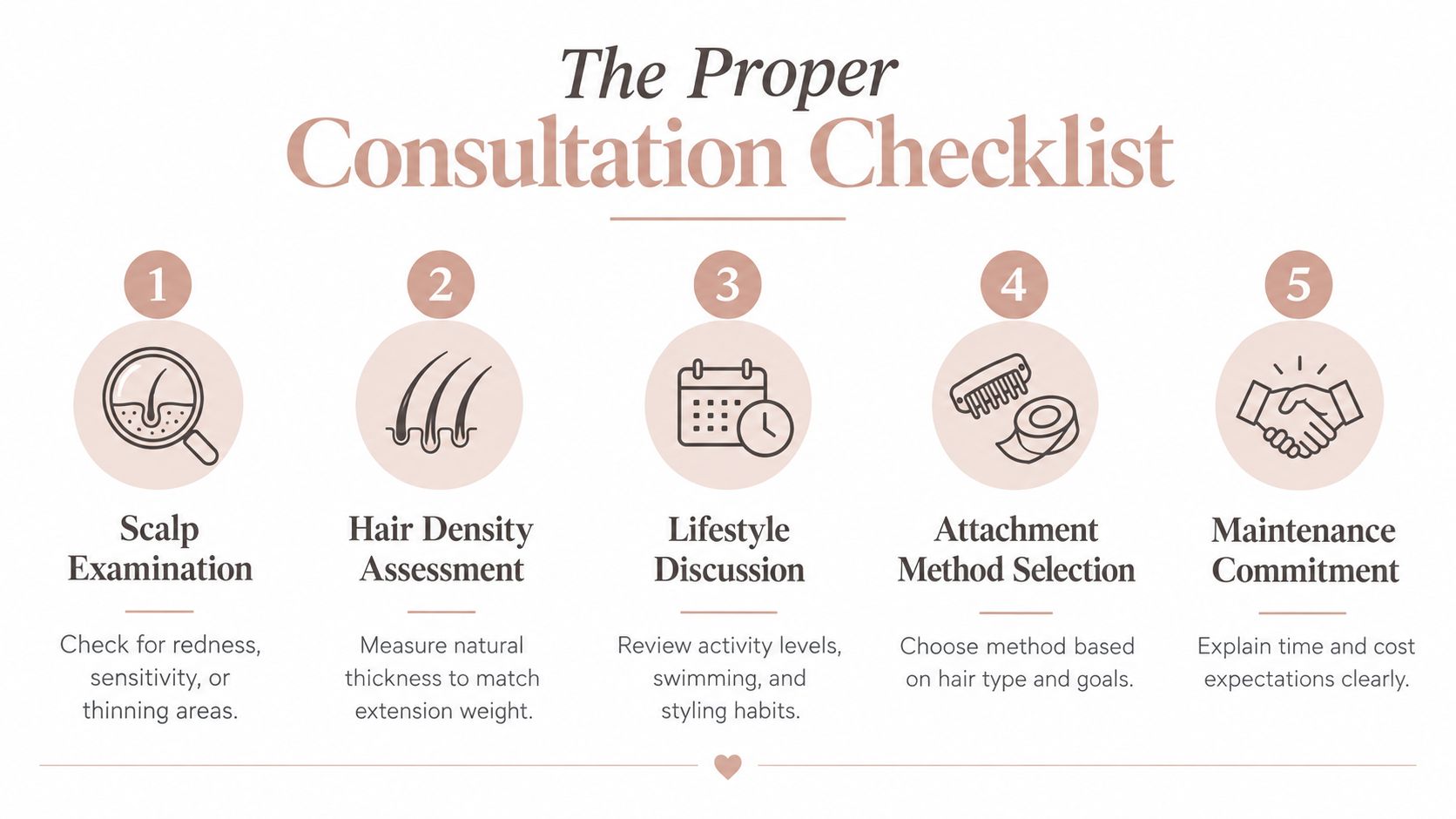
What should be checked before fitting
A serious extension consultation goes well beyond colour matching and length goals. It should ask about past shedding, scalp tenderness, headaches, exercise habits, swimming, styling time and how often the client can return for refits. The same method can behave very differently on a desk worker, a swimmer, a gym-goer or someone with fragile hair after colour work.
For clients with fine or delicate hair, the discussion should include fragile zones such as the temples and front hairline, because those are often the first places to show overload. If the scalp is already inflamed, the hair is shedding suddenly, or there is an unexplained loss pattern, the safer move is to pause and seek GP or dermatologist input before fitting.
What the client should disclose
Be open about recent bleaching, breakage, postpartum shedding, tight hairstyles, itchiness and any cosmetic sensitivities. If you have sensitive skin, discuss new scalp products with your clinician first. That matters when products are used near the scalp, even if the attachment system itself is not adhesive.
A consultation that starts with the hair you have, not the look you want on day one, is the one most likely to protect it over time.
Matching Low-Tension Methods to Gold Coast Hair
There's no perfect method for every head of hair, and that's where a lot of salon marketing gets sloppy. A method can sit flat, look invisible and still be wrong if it loads the hair poorly or makes hygiene hard in a humid, active lifestyle. On the Gold Coast, I have to think about salt water, chlorine, sweat and the way people live.
The most useful conversation is usually about invisible weft, butterfly weft, micro bead, nano bead and keratin bond options, then which one matches the client's density and maintenance tolerance. The method name matters less than how the weight is spread, how close the attachment sits to fragile zones, and how easy it is to keep the scalp clean.
| Method | Attachment style | Best suited to | Watchpoints |
|---|---|---|---|
| Invisible weft | Flat row attachment | Clients wanting discreet volume with a soft finish | Needs careful row placement and regular refits if the root area grows out |
| Butterfly weft | Lightweight weft system | Clients who want movement and less bulk | Still needs enough natural density to support the row |
| Micro bead | Bead-based attachment without glue or heat | Clients who want reusable wear and a non-adhesive option | Tension still matters, especially at temples and hairline |
| Nano bead | Smaller bead attachment for finer hair | Fine or delicate hair that needs a more discreet attachment | Can still be too much if the hair is sparse or fragile |
| Keratin bond | Strand-by-strand bonded attachment | Clients wanting flexible placement and styling versatility | Heat and sectioning need to be controlled carefully |
What “no glue, no heat” does and doesn't mean
Glue-free and heat-free sounds gentle, and sometimes it is. But mechanical tension and total weight still matter, especially around the temples and the front of the scalp. A bead method can be a better fit than a heavier row for some fine-haired clients, but if the total load is wrong, the follicle doesn't care that the method sounds gentle.
Useful test: if a method only sounds safe because it avoids glue or heat, but no one has talked about density, placement or comfort, you're not getting a real risk assessment.
For many Gold Coast clients, the practical shortlist is smaller than the menu suggests. The choice is usually between a light weft, a discreet bead system, or a bond method, with the decision driven by density, lifestyle and how much ongoing upkeep the scalp can tolerate.
Hair Extensions Full Stop in Ashmore offers consultations, application and maintenance across methods such as invisible weft, butterfly weft, micro bead, nano bead and keratin bond systems, so the method can be matched to the client instead of forced onto them. Hair Extensions Gold Coast method guide
How to Tell If an Installation Is Too Heavy or Too Tight
The most important moment isn't after the appointment, it's during it. If your scalp is trying to tell you the install is wrong, you need language for that in the chair, not after you've spent the week hoping it settles down. The American Academy of Dermatology says pain or a headache during extension or weave installation means the style is too tight, and the stylist should loosen the affected area AAD preventing hair damage from weaves and extensions.
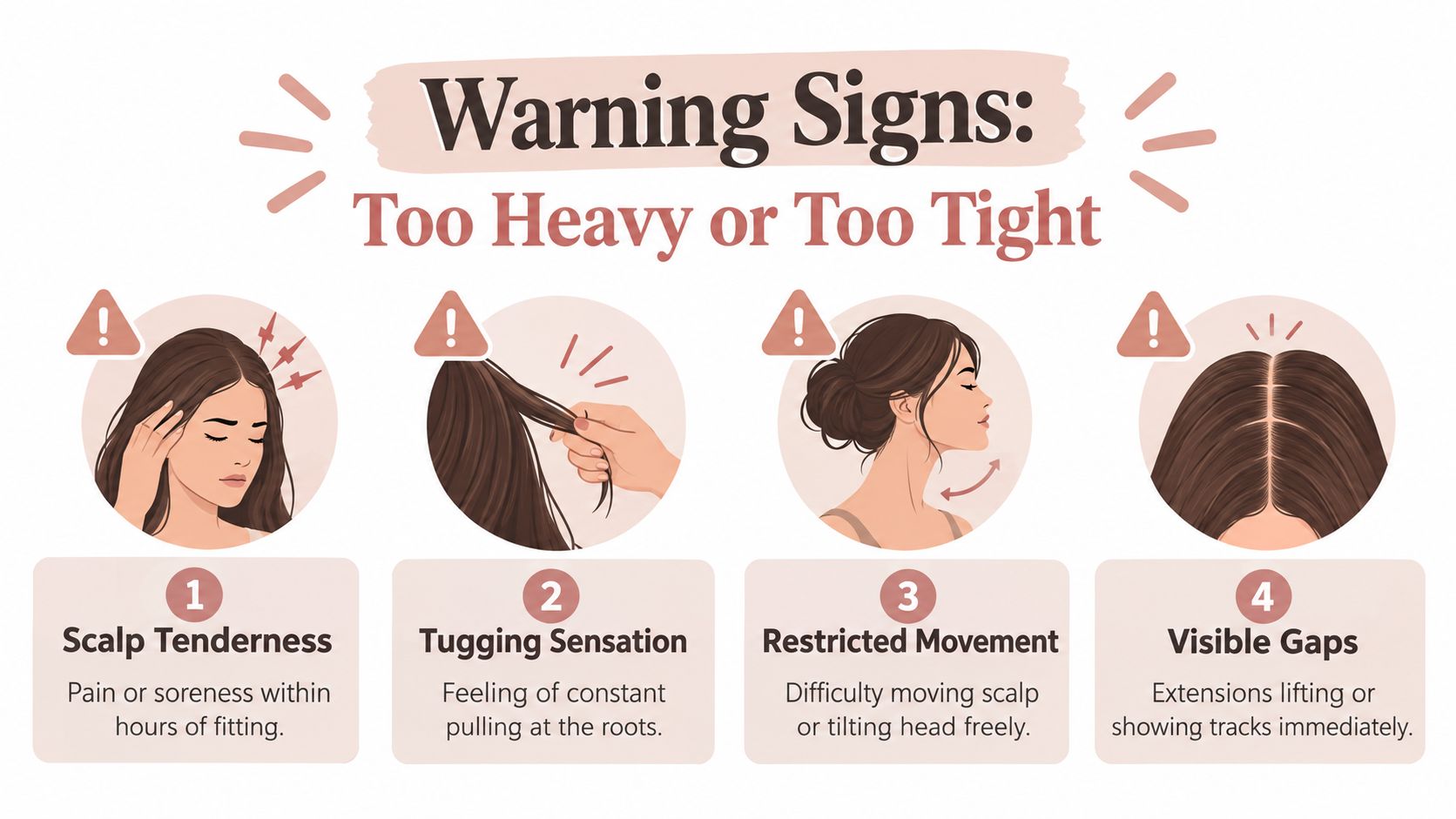
Warning signs you shouldn't normalise
Some tightness can feel unfamiliar on day one. Persistent tenderness, headache, scalp pimples, redness, broken hairs around the attachment and a widening part line are different, and they're not things to shrug off as an adjustment phase. If the discomfort is there when you move your head, tilt back in the chair or run your fingers across the roots, the placement or weight needs attention.
A good install should be tested during movement. Turn your head from side to side, look down, lift your chin, and check whether the attachments tug more in certain positions. If they do, the system is too concentrated or too tight in those areas.
What to say in the chair
You don't need to be polite about discomfort at the expense of your hair. Say the area feels sore, say the pull is constant, or ask the stylist to reduce the tension before the service continues. Starting with a conservative weight is usually smarter than loading the hair heavily and then trying to rescue it later.
Speak up early. If the style hurts, don't wait for “settling in” to fix it. Hair should adapt to the style, not the other way around.
If you're comparing options for finer hair, the margin for error is smaller, so the consultation and the installation technique matter just as much as the product itself Hair extensions for fine hair Gold Coast. A low-damage result starts with permission to stop or adjust the fit before the scalp gets irritated.
A Weekly Routine That Protects Both Hair and Attachments
Extensions last longer when you treat them as a load-management system. The routine is simple on paper, wash, dry, detangle and protect the hair at night. The trade-off is clear, if you skip the basics, humidity, sweat and friction will start working against the attachment points.
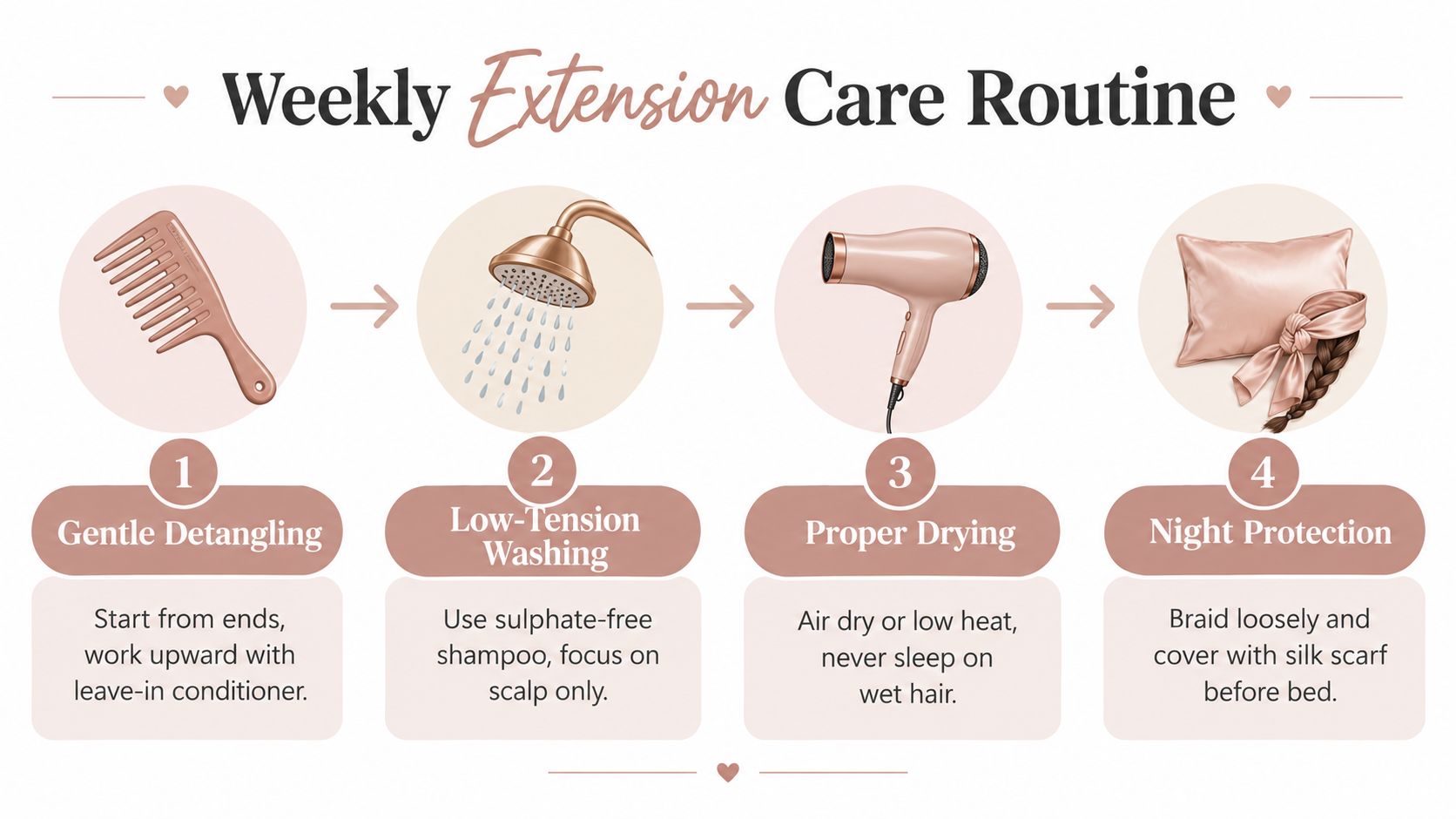
The routine that actually holds up
Detangle from the ends upward. Starting near the roots puts unnecessary force on beads, bonds and wefts, and that is where avoidable stress builds fastest. Wash the scalp and attachment zones thoroughly, but keep your hands gentle. Rough circular scrubbing creates knots and pushes hair into the attachment.
Dry the roots and attachment areas fully before you leave them alone. Damp hair around the fittings keeps friction and moisture trapped together, which is a poor combination for attachment stability. At night, tie the hair loosely and cut down pillow friction with silk or satin. That small change reduces the morning tug that clients feel after a restless sleep.
Heat needs restraint as well. Australian Product Safety guidance says hair straightener plates can exceed 200°C in under 10 minutes, and Queensland guidance notes they can reach up to 200°C within minutes Product Safety Australia straightener safety. Dry roots fully, then style with the lowest effective temperature, keeping tools moving and away from beads, weft rows and keratin bonds to protect attachments.
Product choices and beachside habits
If you have a sensitive scalp or a history of reactions, check with a doctor or dermatologist before using new products around the hairline.
Cleanse after sweaty sessions or a swim, and do not leave salt or chlorine sitting near the attachment points any longer than needed. On the Gold Coast, that matters because humidity can keep the hair from resetting properly if you let buildup linger.
For clients who want method-specific support, a structured care system like the one used by Hair Extensions Full Stop can help keep the routine consistent without guessing at every wash. The true test is practical, whether the method fits your hair's weight, your scalp's tolerance and the way you live between appointments.
Refits, Scalp Health and Living With Extensions Long Term
Long-term wear works best when you treat every appointment as a maintenance checkpoint, not a fresh start. I always want to know the installation date, attachment count, scalp response and any shedding notes from the last visit, because patterns matter more than one-off comments. If a unit has become tight, matted or painful, tightening it further is the wrong move, it should be removed or refitted.
Hygiene is part of the fit, not an afterthought
Australian public-health guidance says hairdressing can transmit scalp infections, including impetigo and fungal infections, if hygiene is poor, and recommends clean equipment, hand hygiene and proper handling of reusable tools NSW Health hairdressing hygiene. That matters in extension work because the scalp needs access, the tools need to be clean, and the studio needs to behave like a clinical service when the scalp is irritated or vulnerable.
A hygienic studio should be able to tell you how it processes tools, how it handles reusable items and what it does if the scalp looks inflamed on arrival. It should also be willing to postpone a service if there's suspected infection, dermatitis, open skin or unexplained loss rather than pushing ahead for the booking.
When a break from extensions makes sense
Some clients need a pause, especially when there's new patchy loss, sudden shedding or persistent irritation. Australian primary-care data reported alopecia areata incidence of 0.278 per 1,000 person-years and point prevalence of 0.13% in 2020, which is a reminder that not every loss pattern is just “stress” or “seasonal shedding” Abby Health summary of Australian hair loss data. New, patchy or medically unexplained loss should be assessed rather than covered up.
A serious Gold Coast studio should also be willing to talk about timing and refits in plain English, not vague reassurance. For me, that's a sign the practice is focused on the client's hair health, not just getting them back in the chair.
If you want to compare how one strand-by-strand system is maintained over time, keratin bond extension maintenance is worth reading before you book.
Your Next Step on the Gold Coast
If you want hair extensions without damage, keep the checklist simple. Make sure the consultation covers your scalp and density, ask how weight and placement will be managed, speak up if anything hurts, follow a proper weekly routine, and book the refit before regrowth starts levering the attachments down.
That's the version of hair extensions without damage on the Gold Coast. It isn't about chasing the softest-sounding method, it's about choosing a specialist who fits, monitors and maintains with the same care they use to colour-match and blend.
Hair Extensions Full Stop in Ashmore offers one-to-one consultations, premium human hair extension application and ongoing maintenance for Gold Coast clients who want a more considered approach. If you're ready to talk through weight, placement and the right method for your hair, visit Hair Extensions Full Stop or call to book a consultation with the team.
Recent Articles


