

22-inch extensions are about 56 centimetres long from the weft or bond and usually finish between the bra band and just below the waist, depending on your height, before any method is chosen. But if that length looks right in a photo, does your natural hair have enough strength and coverage to carry it comfortably?
That's the more useful question for a Gold Coast lifestyle that includes humid days, swimming and hair tied up for exercise. Searching for “22 hair extensions” can help you find a look, but choosing the installation means balancing length, coverage and scalp comfort, not just selecting the fullest set.
Table of Contents
- Where 22 Inch Extensions Finish
- How Much Hair That Length Needs
- Methods That Can Carry 22 Inches
- Weight, Scalp Safety and Daily Care
- Gold Coast Looks at This Length
- Book a Length Check in Ashmore
Where 22 Inch Extensions Finish
The measurement describes the extension hair itself. It isn't measured from your crown, and it doesn't mean your finished hairstyle will extend that distance beyond your natural ends.
The attachment position matters, as do your torso length and the shape of your haircut. Two women wearing the same extension length can have noticeably different results, even when they're similar heights.
Where 22-inch extensions usually finish
Use these height examples as a visual starting point, not a fitting chart or a promise of where your ends will land.
| Height | Usual endpoint | How it reads | What changes it |
|---|---|---|---|
| Petite frame, for example under about 157 cm | Potentially past the waist towards the upper hip | Very long relative to the body | Torso length and attachment height |
| Shorter-to-average frame, for example 160–165 cm | Around or just below the waist | A pronounced long-hair finish | Blending cut and natural proportions |
| Medium-to-tall frame, for example 168–173 cm | Between the bra band and waist | Long through the back without necessarily reaching the hips | Row placement and styling |
| Taller frame, for example 175 cm and above | Often reads as mid-to-lower-back length | Less dramatic relative to height | Back length, posture and texture |
Measure from the proposed attachment
A flexible dressmaker's tape is more useful than a reference photo alone. Have someone hold it at the proposed attachment position and let it follow your back naturally, rather than pulling it diagonally towards your waist.
Check the result in a rear-view mirror while standing normally. Then bring the hair forward over your shoulders, because a length you like from behind may feel different around your chest or clothing.
Lower rows place the ends farther down your back, but they leave less visible extension hair below your natural haircut. They also need enough natural hair above them to conceal the attachment when you move.
Allow for the finished shape
Cutting and styling change the outline. A substantial blending cut can remove visible length, while layers soften the transition without necessarily shortening every strand equally.
Straight hair displays the fullest drop. Waves use some of that length in their curves, so the ends appear higher, especially with a tighter bend.
Length-check rule: Choose the endpoint on your own body before choosing the installation method.
Bring a straight-hair reference and a waved reference if you wear both looks. Match the height example that resembles you, then treat that picture as a target to assess for weight, not a reason to install the fullest possible set.
How Much Hair That Length Needs
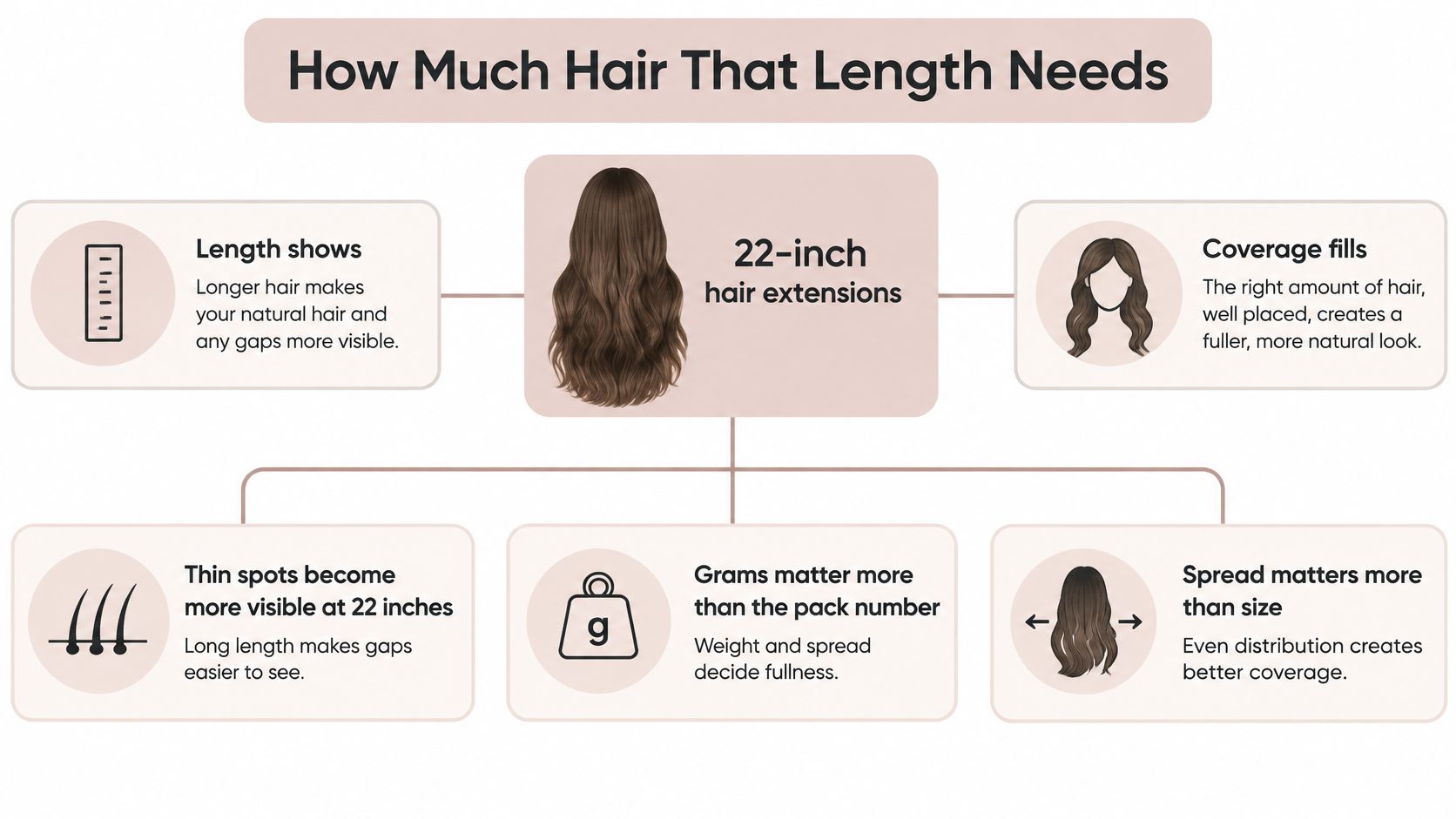
Length and coverage are different jobs. Length determines how far the hair reaches; coverage determines whether the transition from your natural haircut looks convincing.
Long extensions can make gaps easier to notice because the eye follows the outline from your shoulders to the ends. Adding more length won't necessarily fix a transparent perimeter or a visible ledge where your own hair stops.
Think in finished looks, not pack sizes
Consider these as hypothetical consultation examples, not standard prescriptions or safe-weight limits:
- Light lengthening: An example set of 80–120 grams might create a softer outline for fine hair without aiming for a dense curtain. Whether that weight is suitable still requires an assessment of the supporting hair.
- Balanced fullness: An example of 120–160 grams might help blend shoulder-length hair into a longer shape, provided the natural density and attachment areas can support it.
- A fuller perimeter: An example of 160–200 grams represents a substantially heavier result. A desire for thick ends doesn't establish that someone's hair can carry that load.
The useful number is the weight assigned to each supporting section, not the total on a consultation sheet. The same total can feel very different when concentrated in a small area rather than distributed across suitable sections.
Rows work like shelves
Think of rows as shelves positioned at different heights. A lower shelf supports the outline through the ends, while higher shelves help fill the transition through the mid-lengths.
Stacking long, dense rows everywhere adds weight without guaranteeing a better blend. A short, blunt bob may need more careful coverage around its strong cutting line, whereas natural hair below the shoulders can make a lighter installation easier to disguise.
Colour affects the impression too. A solid shade that doesn't match can make the extension section look like a separate, heavy block, even when the actual weight is modest.
More hair isn't the automatic answer to every visible gap.
If the length is right but the result still looks sparse, assess placement, distribution and the haircut. If the concern is a see-through part, adding weight through the ends won't address the area you're looking at.
Methods That Can Carry 22 Inches
Several methods can create this length. The meaningful comparison is how each attachment shares the load, how well it stays concealed and whether it suits the way you wear your hair.
22-inch sets by method and weight
The gram ranges below are illustrative planning examples, not clinical safety thresholds or a recommendation for your hair.
| Method | Best suited to | Watch-out at this length |
|---|---|---|
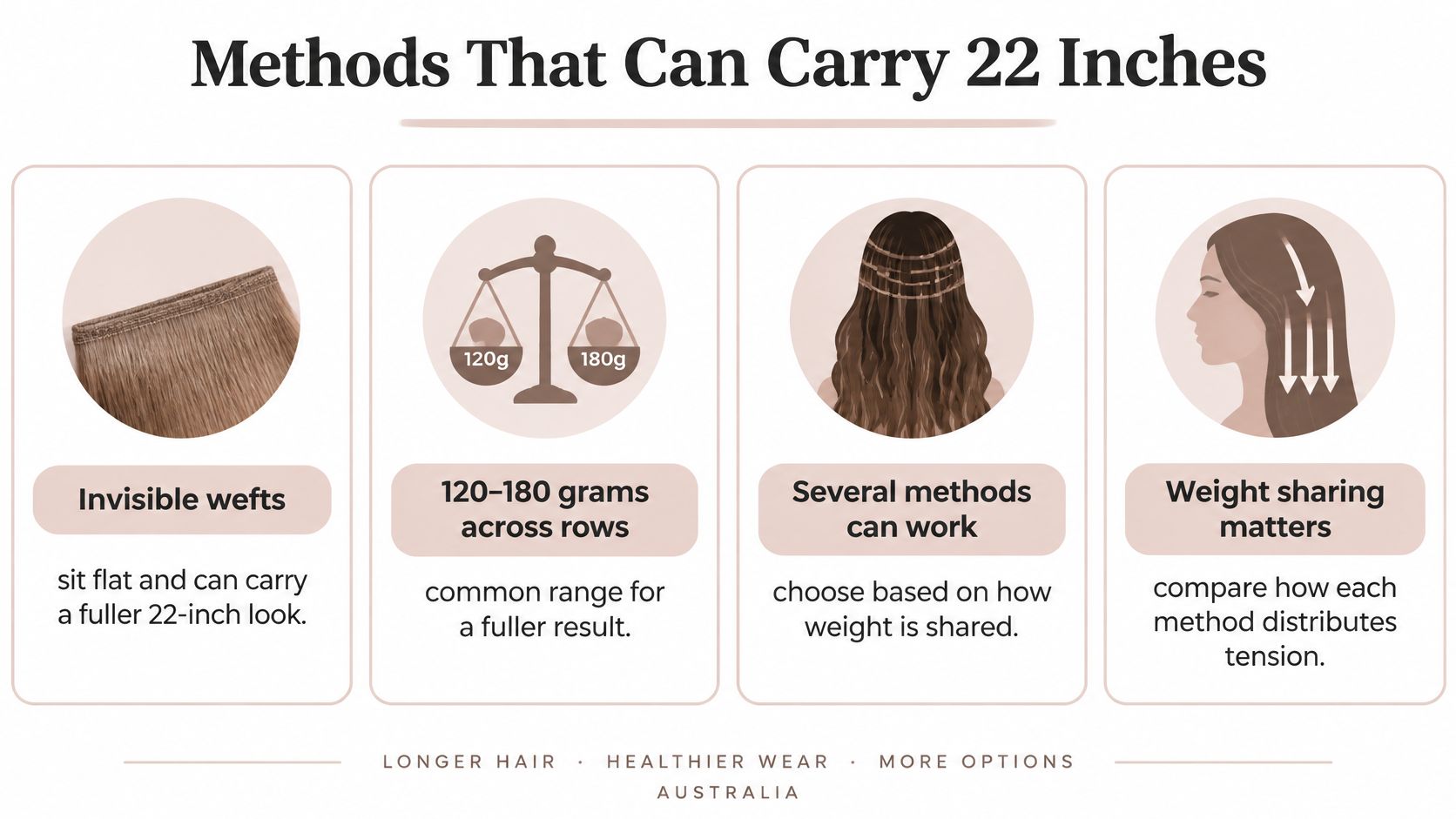
| Invisible weft | Medium-density hair wanting volume, with an illustrative 120–180 grams distributed across suitable rows | Cumulative row weight, especially where rows overlap |
| Butterfly weft | Clients wanting movement, with an illustrative lighter 100–160 gram design | Too many rows still add drag |
| Micro bead | Glue-free, reusable wear, with an illustrative 80–140 grams placed in suitable sections | Tight beads and unevenly loaded supporting sections |
| Nano bead | Fine or delicate hair, with an illustrative 60–120 gram design only where appropriate | A discreet attachment can't make a very thick set suitable for sparse hair |
| Keratin bond | Strand-by-strand blending, with an illustrative 80–150 grams distributed individually | Heat at installation and tension at individual attachment points |
Wefts spread hair across a row
An invisible weft sits flat and can create a fuller shape without a bulky-looking attachment. Its flat appearance doesn't make the installed weight disappear, though, so each row needs an appropriate supporting section.
Butterfly wefts offer flexibility and movement. They can suit someone who wants hair that swings rather than a solid-looking curtain, but adding extra rows still increases the load.
For either approach, the fitting should account for head shape and the natural hair available to cover the row edges. A method that looks hidden with your hair down may be exposed in your usual ponytail.
Individual attachments divide the placement
Micro beads attach small sections without glue or heat and allow reusable wear. Each bead remains a separate anchor, so careful sectioning matters more than fitting as many pieces as possible.
Nano beads offer a discreet individual attachment, which can help with fine hair. However, small attachments aren't permission for a heavy installation.
Keratin bonds allow detailed strand-by-strand blending. They involve heat during fitting and require attention to the amount of natural hair supporting each bond.
Choose around density and styling habits
Daily high ponytails, fine temple hair and a preference for centre-parted styles should all influence the design. They may point away from heavy rows or placements that become exposed when lifted.
Our guide to choosing a hair extension method on the Gold Coast explains the application options in more detail. During consultation, we assess your hair and discuss your goals before recommending a suitable option.
Ask whether a sample placement can help assess concealment and comfort before committing to a complete installation. It's a useful check, although an initially comfortable attachment isn't a guarantee that the full set will remain suitable.
Weight, Scalp Safety and Daily Care
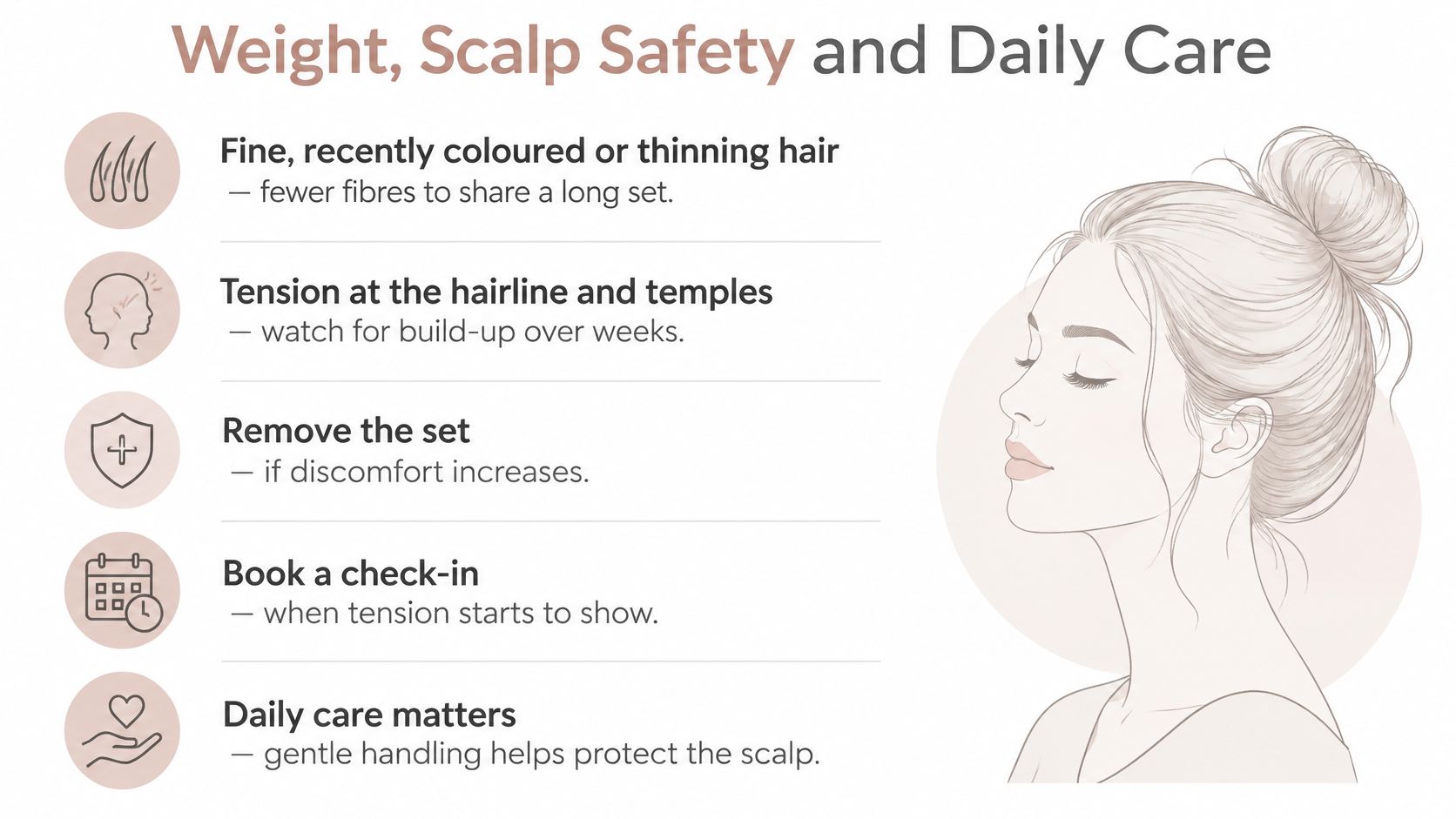
Persistent tenderness, headaches, sore attachment points, snapped hairs, a widening part or recession around the temples are reasons to act. Don't wait for a scheduled refit if the installation feels increasingly uncomfortable.
Sustained pulling from extensions can contribute to traction alopecia, and continued tension can cause permanent follicle damage, as described in Abby Health's Australian guide to female hair loss. Arrange a professional check and appropriate adjustment or removal rather than trying to get used to pain.
When lighter is the better result
Fine or thinning hair offers less supporting coverage, while recently coloured hair needs assessment for breakage and condition. The hairline and temples shouldn't be recruited to carry extra weight to hide a gap.
Possible alternatives include fewer rows, a lower overall weight, carefully spaced individual attachments or a shorter finish. For example, an 18-to-20-inch design may deliver a convincing long-hair result without pursuing the longest outline.
Crown coverage is a separate consideration. A topper may address a visible part more directly than adding long attachments beneath it, but suitability still needs assessment.
Extensions don't treat hair loss. Approximately 49% of women experience hair loss during their lifetime, according to the Royal Australian College of General Practitioners' clinical review, so unexplained shedding deserves a GP assessment rather than a cosmetic workaround.
A practical wash and dry routine
Scalp care and extension-hair care aren't interchangeable. You can have smooth-looking ends while sweat and product remain around the attachments.
- Detangle before wetting. Start at the dry ends with a wide-tooth comb, working upwards while supporting the hair above the section you're combing.
- Cleanse the scalp carefully. Use a gentle shampoo compatible with the attachment method. Discuss sulfate content and product formulation with your stylist rather than assuming every sulfate-free product is suitable.
- Rinse the attachment zones. Use your fingertips rather than scratching with your nails, and rinse thoroughly without piling the lengths onto your head.
- Condition below the attachments. Apply through the mid-lengths and ends, keeping slippery products away from beads, bonds and tracks.
- Blot and dry thoroughly. Avoid rough towel rubbing. Dry the roots and attachment areas fully before bed.
- Protect before heat styling. Apply heat protectant before tonging or straightening, and keep hot tools away from attachment points.
After swimming, rinse out salt or chlorine and dry the anchors the same day. For sleep, loosely secure dry hair in a braid or use a silk wrap without tightening the hairline.
Let scalp condition guide maintenance
There isn't a universal wash interval that suits every swimmer, gym routine and scalp. Cleanse when sweat, oil or buildup requires it, rather than stretching washes purely to preserve the extension hair.
The WA Health guideline for the hairdressing industry identifies poorly cleaned equipment as an infection-control concern. Clean salon practice and sensible home care both matter, particularly if the scalp is already irritated.
- Comfortable scalp and separated attachments: Continue your care routine and planned maintenance.
- Matting, persistent odour or itching: Book an assessment rather than covering the problem with dry shampoo.
- Redness, soreness, broken skin or discharge: Seek medical advice where appropriate, and arrange professional removal if the attachments are contributing.
Comfort comes first: Keeping a set installed longer isn't a success if your scalp becomes sore or difficult to clean.
Our guide to reducing the risk of damage from hair extensions offers further practical guidance. Don't cut bonds, pry open beads or pull out a weft yourself.
Gold Coast Looks at This Length
A useful hairstyle decision starts with an ordinary week, not an event photo. These hypothetical examples show how the same desired length can lead to different application choices.
Straight for work and waved at weekends
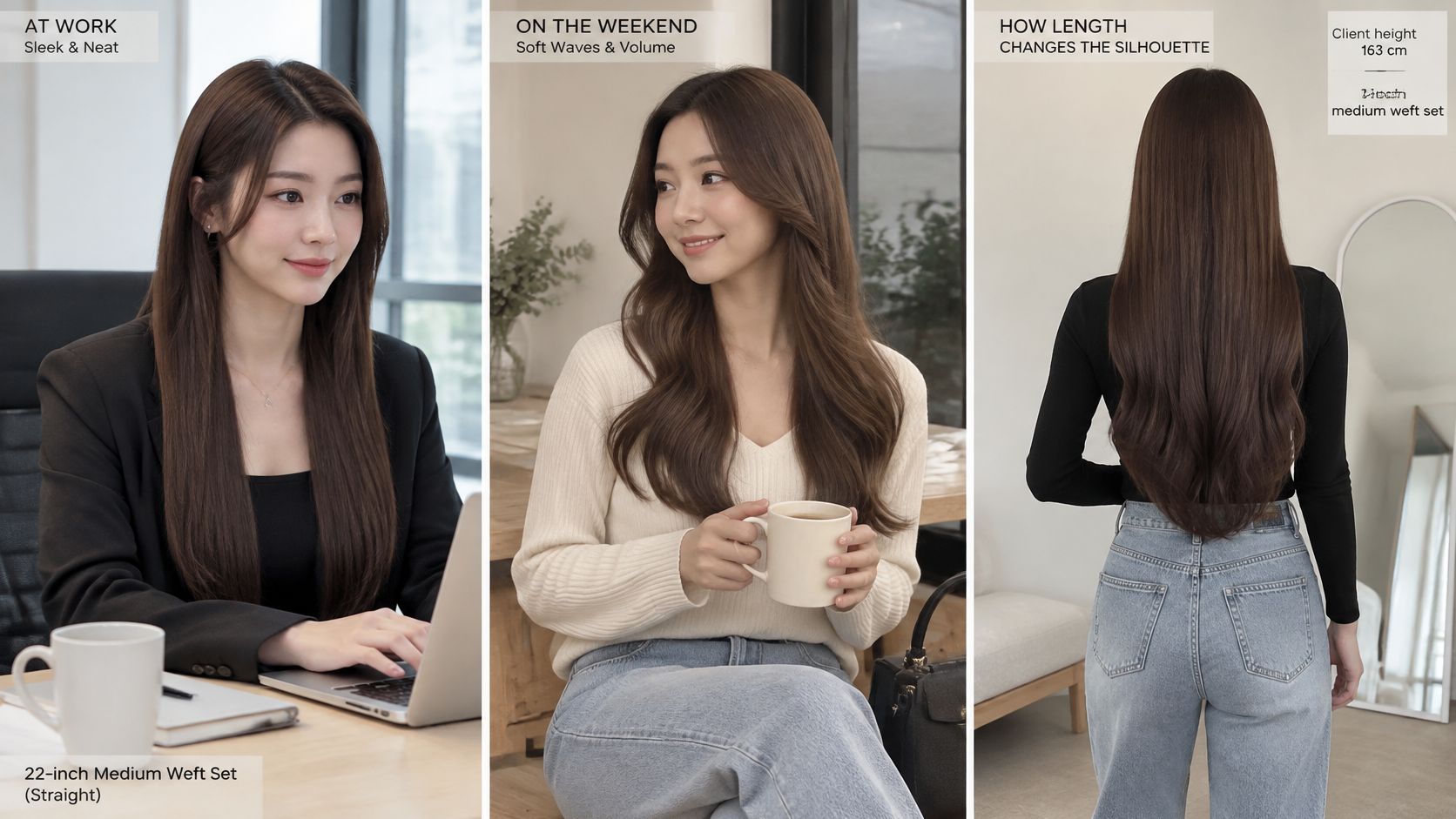
Say a client is 163 cm tall, has shoulder-length hair and wants a waist-leaning finish. Her consultation might explore a medium-weight weft design, with the final endpoint checked on her body before fitting.
She wears it straight for work and adds loose waves on weekends. Rather than increasing the weight to keep every waved strand at her waist, she accepts a slightly higher styled outline and asks for a soft transition around her natural ends.
The choice: A balanced weft installation with enough coverage to blend, not maximum density for its own sake.
Swimming and hair-up days
Consider a 170 cm client who swims regularly and usually ties her hair back. A lower-back target could be more practical for her than an upper-hip outline, particularly when she wants to rinse and dry her hair after exercise.
Her consultation should include the actual ponytail position she uses, not just how the installation looks worn down. A lighter individual-bead or flexible-weft design may be worth considering if it suits her supporting hair and allows the attachments to remain concealed.
The choice: Prioritise a manageable outline and an application compatible with her daily styling.
Fine ends with a visible crown
Another client wants long hair but is most bothered by a see-through crown. Adding dense lower rows would change her silhouette without necessarily improving the part she checks in the mirror.
A lighter design through the ends, combined with an assessment for targeted crown coverage, may produce a more believable balance. The aim is to address the visible concern without asking delicate edges to conceal an unnecessarily heavy installation.
The choice: Separate the crown-coverage decision from the length decision.
For all these looks, colour should help the join disappear. A rooted brunette or balayage blend may integrate better than a solid shade that's slightly wrong, but the natural hair and extensions must still be matched in daylight; our extension colour-matching guide explains what to check.
For anyone comparing human hair extensions Gold Coast options, these are consultation decisions, not catalogue looks to order unchanged.
Book a Length Check in Ashmore
Don't choose your installation from a photo alone. Bring an endpoint reference, explain how you normally wear your hair and mention any shedding, scalp sensitivity or areas you're trying to conceal.
At Hair Extensions Full Stop, we assess your natural hair, discuss your goals and recommend the most suitable extension option. With over 20 years of experience, our consultation process focuses on matching the application to your hair and lifestyle rather than treating a trending length as the starting requirement.
Bring the details that change the recommendation
- Your preferred outline: Show where you want the ends to finish, including whether that reference is straight or waved.
- Your actual routine: Mention swimming, gym sessions, frequent ponytails and the time you can realistically spend drying.
- Your hair history: Explain recent colour work, breakage, previous extension discomfort and any current medical assessment for shedding.
A useful outcome is a named method, a sensible proposed weight and a maintenance plan. It can also be a shorter recommendation if that will create a better blend or a more manageable result.
Include hygiene in the conversation
Queensland's personal appearance service hygiene guidance identifies handwashing, clean equipment and safe procedures as core infection-control measures. Ask how reusable tools are cleaned between clients, which items are single-use and how shared products are handled.
For example, NSW Health's hairdressing guidance recommends decanting creams and liquids into single-use containers with fresh applicators. Those are practical questions, not cosmetic extras.
If you're seeking a hair extension specialist Gold Coast appointment, our address is 2/24 Commercial Drive, Ashmore QLD 4214. Plan your length check before your next colour or major cut so those decisions can work together.
Hair Extensions Full Stop offers personalised consultation, colour matching, professional application and ongoing maintenance for natural-looking human hair extensions. Visit Hair Extensions Full Stop to enquire or call to book a length check in Ashmore, and find out whether a 22-inch installation, a lighter set or a shorter finish best suits your hair.
Recent Articles


