

An Australian keratin-bond installation commonly ranges from roughly $300 for a small partial-volume application up to about $1,000 for a 100 g full head in standard Russian hair, with luxury hair and longer lengths pushing higher. Ongoing refits and removal must be added to get the true cost.
You may be comparing two Gold Coast quotes that both say “keratin bonds”, yet one is several hundred dollars higher. That doesn't automatically mean the dearer salon is overcharging. The quotes may include different hair weights, lengths, quality grades, colour work, application time, or aftercare.
The right question isn't just, “What's the keratin bond hair extensions price?” It's, “What result will this quote buy, how will it suit my natural hair, and what will I spend to keep it looking good?” The numbers below give you a practical Australian benchmark, while the method, your hair condition, and your lifestyle determine whether keratin bonds are sensible for you.
Table of Contents
- What a Keratin Bond Quote Really Covers on the Gold Coast
- How Keratin Bond Extensions Work
- The Four Levers That Move Your Quote
- Typical Australian Price Ranges at a Glance
- Why Salon Labour and Timing Sit Inside the Price
- Installation Is Only Half the Cost
- When a Lighter Method Is the Better Value Choice
- Getting a Quote That Reflects Your Hair and Your Goals
What a Keratin Bond Quote Really Covers on the Gold Coast
A credible quote bundles more than a packet of extension hair. It covers the hair itself, strand-by-strand application, consultation, colour matching, blending, finishing, and the professional judgement needed to distribute the weight safely. If one salon quotes for a complete service and another quotes only for application, the figures aren't comparable.
Start by asking for the installed weight. An Australian salon price schedule lists 22-inch Russian-hair keratin bonds at $300 for 25 g, $520 for 50 g, $650 for 75 g, and $780 for a 100 g full head. Its luxury range lists the same quantities at $350, $595, $765, and $930, while the 26-inch prices rise further, reaching $850 for 100 g of Russian hair and $1,000 for 100 g of luxury hair. These figures are published on the Australian salon keratin-bond price schedule.
That spread explains why “full head” isn't a reliable unit of comparison. One client may need a subtle volume application, while another needs enough density to blend a significant length change. The salon should connect the amount of hair to your natural density, head shape, existing colour, and desired finish.
Read every line item
Ask these questions before accepting a quote:
- How much hair is installed? Request the weight in grams or the strand count, not just “one head”.
- What finished length is included? Longer hair generally costs more because the raw material costs more.
- Which hair grade is being used? Confirm whether the quote covers standard Russian hair, luxury hair, European hair, or another specified grade.
- Is colour matching included? A multi-tonal blonde, balayage, or lived-in brunette may require more than a flat shade.
- What happens after installation? Confirm the price of removal, refitting, replacement bonds, and any blending appointment.
Gold Coast conditions also matter. Sun, humidity, swimming, salt water, and pool chlorine can affect how your extensions wear and how much care they need. A client who swims regularly or uses heated styling tools often needs a different maintenance conversation from someone who washes less frequently and air-dries.
Practical rule: A cheap quote is only cheap if it includes the same hair weight, length, finish, and future appointments as the quote beside it.
The Gold Coast guide to hair extension costs is useful background, but your written consultation quote should remain the deciding document. It should state what you're buying, what isn't included, and what future services may cost.
How Keratin Bond Extensions Work
The installation quote is the most visible number, but it covers only the first appointment. Removal, refits, and replacement bonds are separate costs, so the wearing cycle matters as much as the initial application.
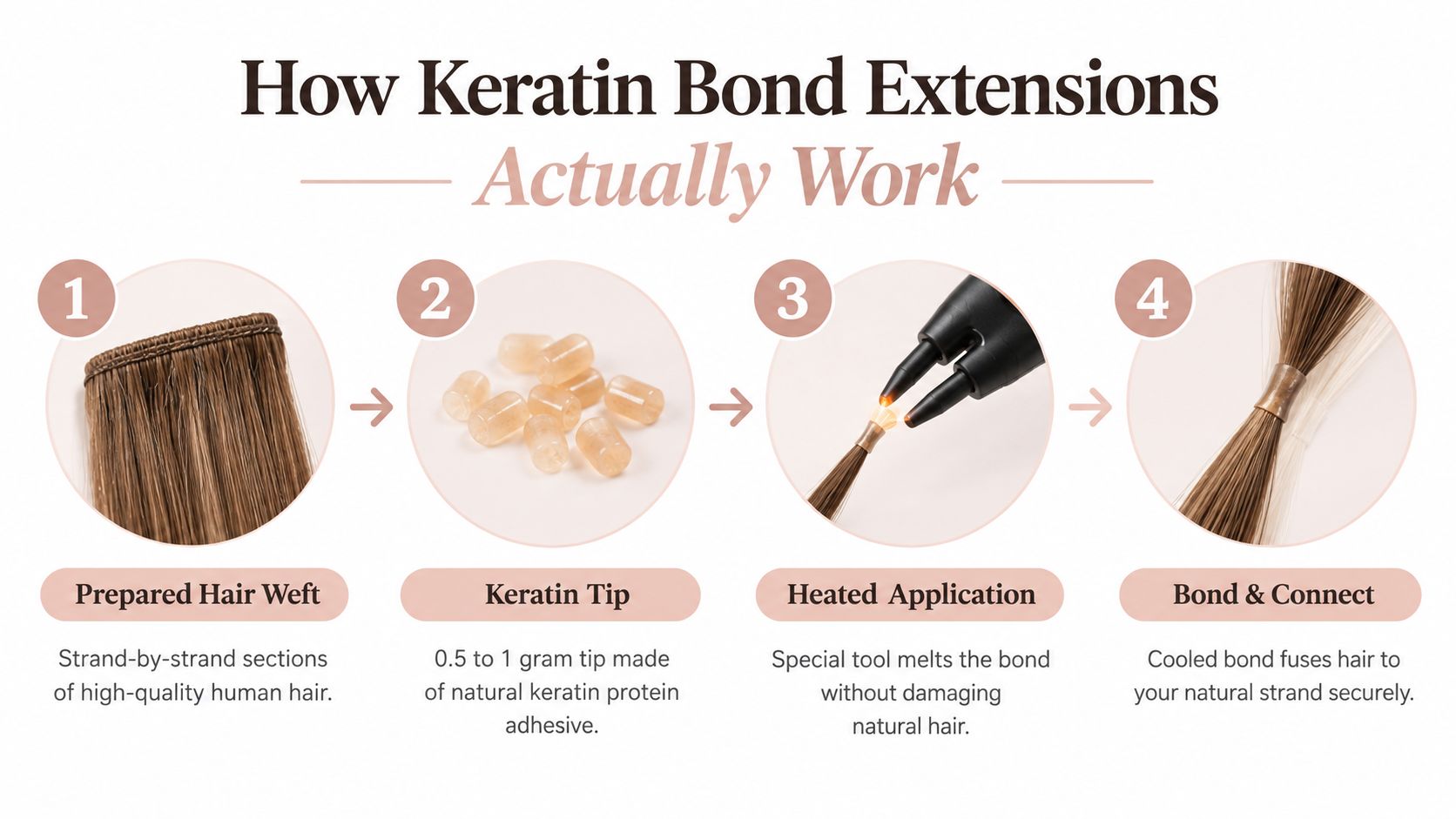
Keratin bonds attach small sections of human hair to carefully selected sections of your natural hair. Each extension tip contains a keratin protein adhesive. A heated application tool softens the tip, allowing the stylist to mould it around the natural section. Once it cools, the bond hardens into a compact attachment.
The process is individual rather than row-based. The stylist sections the hair, checks the placement, applies and shapes each bond, then repeats the work across the head. This gives the method precise control around the crown, sides, and hairline. It also explains why the labour component can be higher than a faster application, even before the hair is priced.
How the method differs from other systems
A weft extension is manufactured as a connected curtain or row. The stylist attaches that row by sewing, bonding, or another approved technique. Wefts can add broad volume efficiently, but their placement is less precise than individual bonds.
A micro-bead or nano-bead extension uses a small ring or bead instead of heated keratin adhesive. The stylist threads the natural hair and extension through the bead, then secures it with a specialised tool. These methods suit clients who prefer a heat-free or glue-free application.
Keratin bonds offer detailed placement between those systems. They can create a discreet, customised result, but every attachment requires hands-on work. Your quote therefore reflects both the hair and the time needed to distribute it properly.
What the stylist is controlling
The bond must sit away from the scalp, and each natural section must carry only the weight it can support comfortably. Placement also needs to suit ponytails, parting, sleeping, brushing, and the way the attachment shows when the hair moves.
Hair condition and lifestyle belong in this decision. Fragile strands, active shedding, or existing tension can make bonds unsuitable. Daily styling habits can also increase maintenance and shorten the practical value of the installation. Choose the method your hair and routine can support, not the one promising the biggest change on day one.
The best bond is the one your natural hair can carry comfortably, not the one that creates the biggest transformation on day one.
The Four Levers That Move Your Quote
A Gold Coast quote moves with four variables: installed weight, finished length, hair grade, and professional time. The application method sets the framework, but it does not determine the final cost by itself. Hair condition and lifestyle also affect value, because an installation that needs extra care or proves unsuitable can cost more over its wearing cycle.
Installed weight
More grams mean more extension hair and usually more individual bonds. The published Australian schedule shows the predictable relationship between weight and material cost, with larger applications carrying a higher total than partial-volume work. The figures come from the published Australian keratin-bond price list.
Ask for the planned gram weight, bond count, and reason behind both. “Full head” is a package label, not an explanation. Fine hair may need fewer grams for a balanced result, while dense hair may need more to achieve a convincing blend. Installing excess weight can also create avoidable strain.
Finished length
Longer extensions cost more because they require more material. They can also demand extra shaping and blending, particularly where your natural ends are shorter or uneven. The longer the finished look, the more important the transition becomes.
Decide whether your priority is length, fullness, or both. If your goal is thicker-looking hair, allocating the budget to additional length may produce less visible benefit than adding density in the right areas. A skilled stylist should explain that trade-off before ordering the hair.
Hair grade
Hair grade affects movement, blending, durability, and styling tolerance. Higher-grade options carry a higher material cost in the published Australian examples, but the practical question is whether the hair suits your routine and expected wearing period.
Ask what “premium” or “luxury” means on the written quote. The description should identify the hair category, colour work, and any customisation included. A higher grade is useful when you regularly heat-style, wear the hair loose, or want the extensions to remain polished through repeated washing. It has less value if your routine is gentle and the installation is temporary.
Labour and consultation
A stylist who spends hours consulting, sectioning, placing, shaping, blending, and finishing is selling technical work, not just hair. Bond count, density, parting, colour matching, and the condition of your natural hair all change the time required.
The appointment must include enough time to distribute weight safely and create a finish that works with your part, ponytail, sleeping habits, brushing routine, and daily styling. A rushed installation may look acceptable at first, then reveal poor spacing or difficult maintenance once the hair moves.
Professional time also includes decisions made before the first bond is attached. A useful consultation can prevent an unsuitable order, reduce unnecessary grams, and identify whether keratin bonds fit your hair condition and lifestyle. That advice has value because the actual cost includes maintenance, removal, and the quality of the result throughout wear, not only the installation day.
| Lever | What changes | Effect on the quote |
|---|---|---|
| Installed weight | Gram weight and bond count | More hair and more placement work |
| Finished length | The selected extension length | Higher material and blending demands |
| Hair grade | Hair quality and customisation | Higher-grade options cost more |
| Professional time | Consultation, placement, blending, and finishing | Longer or more complex appointments cost more |
Use the published schedule as a comparison point, not a universal Gold Coast menu. The right quote explains each lever, shows what is included, and matches the amount of hair to your condition, lifestyle, and intended result.
Typical Australian Price Ranges at a Glance
Australian keratin-bond quotes work best as weight-and-length benchmarks, not as a single national tariff. The figures below provide a practical Australian reference point. Your method choice, hair condition, and lifestyle determine whether keratin bonds make sense for you.
Published examples show a partial-volume application starting at about $300 to $440, depending on hair grade and length. A 100 g full-head service in the same schedule sits around $780 to $1,000 for the listed 22-inch and 26-inch options.
A separate Australian pricing guide shows why quotes vary between salons and regions. It lists 25 cm bonds from approximately $155 for 10 strands to $1,399 for 100 strands, while 60 cm bonds range from about $287 to $2,690. It also lists approximately $750 for 50 g, $1,125 for 75 g, and $1,300 for 100 g in its Australian Gold Coast hair extension pricing guide.
These figures measure different combinations of strand count, length, package structure, and hair quality. A Gold Coast client seeking extra fullness should not compare a 10-strand quote with a 100-strand transformation and label one salon expensive. Hair condition and daily habits matter too. Fragile hair may need a lighter application, while frequent swimming, heat styling, or tight ponytails can make a lower-maintenance method the better financial choice.
| Installation | Weight or strand basis | Standard hair | Luxury or higher-grade hair |
|---|---|---|---|
| Small partial-volume application | 25 g | About $300 in the published 22-inch Russian example | About $350 in the published 22-inch luxury example |
| Mid-volume application | 50 g to 75 g | About $520 to $650 at 22 inches | About $595 to $765 at 22 inches |
| Full-head application | 100 g | About $780 at 22 inches | About $930 at 22 inches |
| Longer full-head application | 100 g | About $850 at 26 inches | About $1,000 at 26 inches |
The table reflects one published Australian salon schedule, not every Gold Coast studio. A quote may sit above or below these figures because it covers a different strand count, length, colour service, application fee, or hair grade.
Use the installation figure as the starting cost, not the full wearing-cycle budget. Maintenance, removal, and replacement timing affect what the service costs over time. Compare quotes only after confirming the weight, finished length, hair grade, colour matching, cutting, styling, and aftercare guidance included. If those details differ, the headline prices are not comparable.
Why Salon Labour and Timing Sit Inside the Price
Keratin bond installation is a hands-on appointment, and the time required forms part of the Gold Coast quote. A stylist works through small sections, places each bond, checks its position, and shapes the result as the application progresses. Consultation and colour matching add more time when your hair has dimensional colour or needs a customised blend.
Australian service costs have also risen. The Australian Bureau of Statistics recorded a 6.4% increase over the year to the December quarter of 2024 for the Hairdressing and Personal Grooming Services component of the Consumer Price Index. Its release also reports quarterly movements of 7.1%, 5.6%, and 6.3%.
Those figures do not mean every salon applies one identical increase. They show that businesses are carrying changing costs for staffing, premises, supplies, administration, and appointment time. Extensions combine a physical product with a lengthy specialist service, so labour can represent a substantial part of the quote.
Appointment timing affects operating cost
The Fair Work Commission's Hair and Beauty Industry Award 2020 sets employment conditions across Australia's hair and beauty industry. Fair Work lists ordinary minimum rates at 100% from Monday to Friday between 7.00 am and 9.00 pm, 133% on Saturday between 7.00 am and 6.00 pm, 200% on Sunday between 10.00 am and 5.00 pm, and 250% on public holidays in its minimum wage and penalty-rate information.
The listed Level 1 example is $27.81 per hour at the ordinary rate, $36.99 on Saturday, $55.62 on Sunday, and $69.53 on a public holiday. These are employment rates rather than a fixed customer surcharge. They explain why a Gold Coast salon may set different prices for weekend or public-holiday appointments.
From 1 July 2026, award minimum rates increased by 4.75%, while the National Minimum Wage became $26.44 per hour or $1,004.90 per week for a 38-hour week, according to Fair Work's minimum wage information. The updated rates apply from the first full pay period beginning on or after 1 July 2026. Fair Work gives the example of a Monday-to-Sunday pay cycle moving to the new rates from Monday 6 July 2026, because 1 July falls on a Wednesday, as explained in its 2026 Annual Wage Review guidance.
A sound price reflects the defined result, suitable hair quantity, and method that fits your hair and routine.
Ask whether the quoted price is fixed for the appointment time and whether the consultation, colour match, blow-dry, cut-in, and styling are included. Confirm whether the same work applies to your intended grams and finished length. A rushed appointment can leave fewer bonds or less finishing work, which changes the result rather than improving the value.
Installation Is Only Half the Cost
The first appointment is the easiest figure to notice because it's the figure shown in the initial quote. It isn't the full cost of wearing extensions. Removal, residue removal, replacement hair, maintenance, blending, and aftercare products all belong in the budget.
Australian service listings show removal charges of approximately $150 for 25 to 75 g and $250 for 100 to 150 g, with removal appointments taking about two to two-and-a-half hours. The reason is straightforward. Each bond must be softened and detached individually, then the stylist removes residue and prepares the natural hair. These figures are listed in the Australian keratin-bond removal and installation service listing.
Build the wearing-cycle budget
Before booking, ask for four separate figures:
- Initial installation: Include the hair, application, colour work, cut-in, and styling.
- Scheduled maintenance: Confirm what happens as the natural hair grows and the bonds move away from the scalp.
- Removal: Ask whether the quoted amount covers detachment and residue removal.
- Replacement or reinstallation: Find out whether the same hair can be reused or whether fresh bonds or fresh hair are required.
A salon listing also shows installation prices of approximately $590 for 25 strands, $855 for 50, $1,432 for 75, and $2,510 for 100 strands. That demonstrates why you need to ask whether a listed price is a package, a strand-count service, a hair-inclusive installation, or a separate stage of the process.
The table below uses only the verified removal benchmarks. It deliberately leaves installation and refit costs as quote-dependent, because those amounts change with the hair weight, method, salon, and result.
| Cost item | Frequency | Per visit AUD | Annual total AUD |
|---|---|---|---|
| Initial installation | Once at the beginning of the wearing cycle | Quote required | Quote required |
| Professional maintenance or refit | As recommended after consultation | Quote required | Quote required |
| Removal for 25 to 75 g | When the installation is removed | About $150 | About $150 per removal |
| Removal for 100 to 150 g | When the installation is removed | About $250 | About $250 per removal |
| Colour, blending, or styling | If required | Quote required | Quote required |
You can find practical upkeep guidance in this guide to keratin bond extension maintenance, but your own maintenance schedule should reflect your hair growth, bond position, daily styling, swimming, and scalp comfort.
Gold Coast clients should be particularly honest about lifestyle. Pool chlorine, ocean swimming, strong sun, frequent blow-drying, and sleeping with wet hair can all make aftercare more demanding. The cheapest installation can become poor value if the hair needs premature correction or removal.
When a Lighter Method Is the Better Value Choice
Keratin bonds are discreet and versatile, but “premium” doesn't mean “best for everyone”. A client with fine, fragile, or thinning hair may be better served by a lighter system, even if the original dream was long, strand-by-strand extensions.
Australian health guidance identifies traction alopecia as hair loss associated with chronic tension from practices including hair extensions. Early intervention matters because ongoing traction can progress from potentially reversible loss to permanent follicle damage, as outlined in this Australian guide to female hair loss causes and treatment.
Match the method to the condition
A consultation should look closely at:
- Natural density: Fine hair may need fewer, lighter attachments rather than a heavy full-head result.
- Scalp sensitivity: Existing tenderness or tension is a reason to reconsider bond placement and weight.
- Current shedding: Active shedding needs attention before adding extension weight.
- Hairline strength: Fragile areas may not tolerate the same attachment as denser sections.
- Lifestyle: Frequent swimming, heat styling, or tight ponytails may favour a different system.
- Desired result: Volume often needs less hair than a dramatic length change.
Micro-bead and nano-bead methods offer heat-free and glue-free attachment options. Weft systems can distribute hair across a broader section rather than concentrating weight on individual strands. None is universally gentle, and none should be selected without assessing the natural hair.
If your priority is preserving your existing hair, don't pay for maximum length before confirming that your hair can safely carry it.
A cheaper method isn't automatically better either. Poor placement, excessive weight, delayed maintenance, or unsuitable aftercare can create problems in any system. The value calculation includes comfort, wearability, maintenance discipline, and the likelihood that the method will achieve your actual goal.
Read this guide on choosing the right hair extension method on the Gold Coast before you treat a keratin-bond quote as the default answer. If you have significant shedding, scalp pain, or suspected hair loss, extensions should wait while you seek appropriate health advice.
Getting a Quote That Reflects Your Hair and Your Goals
A Gold Coast consultation should connect your desired result with the practical cost of wearing extensions. Tell the stylist whether you want volume, length, coverage, colour blending, or a combination, then explain your usual heat styling, swimming, washing, and updo routine. Bring clear photos of your current hair, including the back and sides.
The figures below provide a practical Australian benchmark. Your method choice, hair condition, and lifestyle will determine whether keratin bonds make sense for you. Ask the salon to record the agreed hair quantity, finished length, hair grade, and colour formula in writing, so the quote can be checked against the result delivered.
Confirm what the price includes:
- Colour matching, blending, cutting, and styling
- The installation time and any appointment conditions
- Removal, refitting, and replacement pricing during the wearing cycle
- The maintenance schedule and products the salon expects you to use
- The process if a bond slips, sheds, or needs replacing earlier than planned
Request both a package total and a breakdown. The total shows your likely spend, while the breakdown reveals whether two quotes cover the same hair, labour, and follow-up care. Ask what could change the price before booking, particularly if your hair history or colour requires extra preparation.
A quote should help you compare the complete service, not just the installation figure. Hair Extensions Full Stop provides consultation-led keratin bond applications, colour matching, blending, refits, and alternative methods for Gold Coast clients. Visit Hair Extensions Full Stop in Ashmore to discuss your target result and maintenance budget.
Recent Articles


