

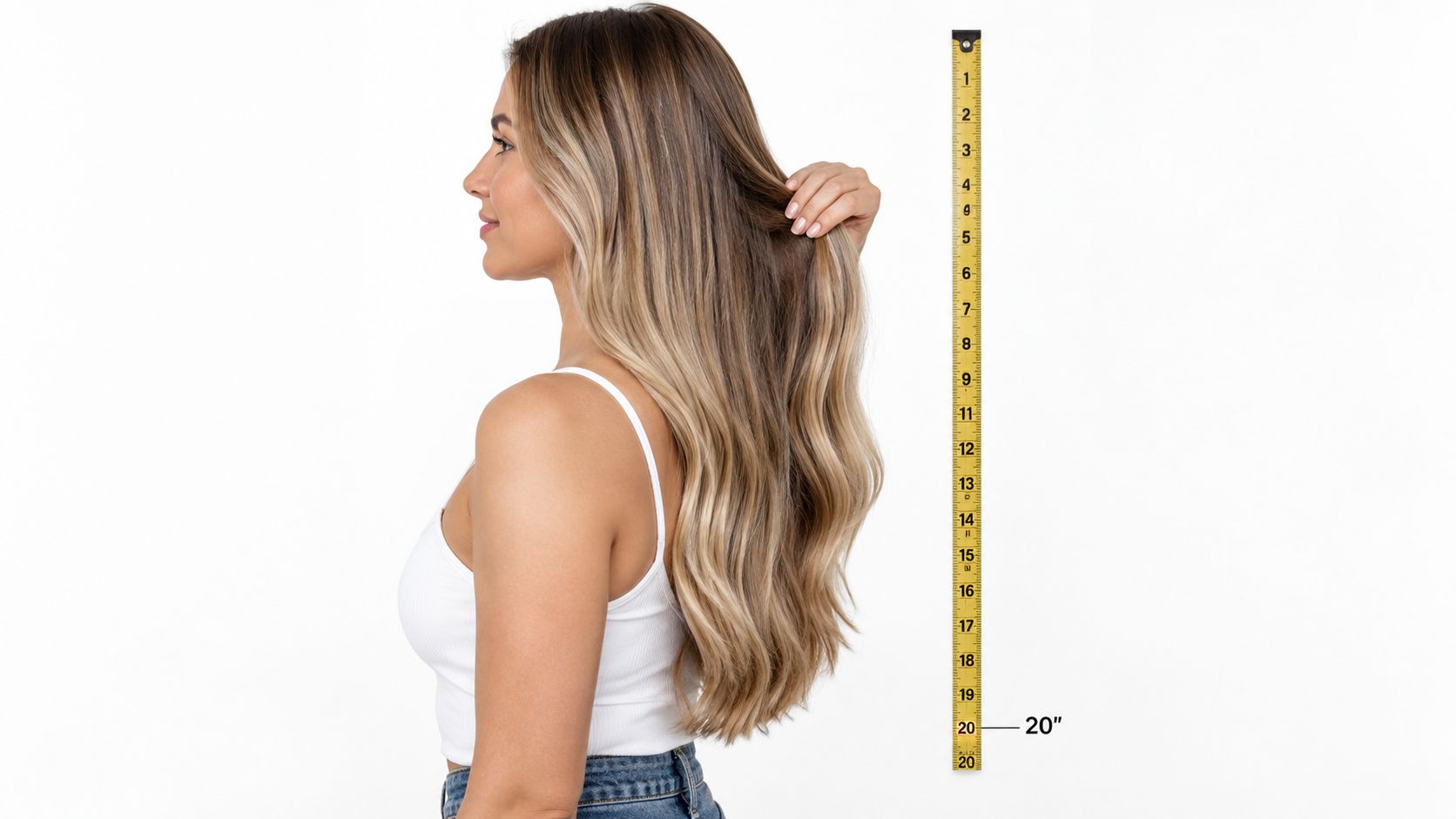
20-inch human hair extensions typically sit around mid-back when worn, with 50 cm as the common finished length in Australia, but comfort and suitability depend far more on attachment method, weft weight, and your natural hair density than on length alone. If you're standing in front of the mirror after a Gold Coast blow-dry wishing your hair would finally move past your shoulders, 20 inches can deliver that change, but only when the added hair is matched properly.
The question I hear most often isn't just, “How long will 20 inches look?” It's, “Will it look natural on my hair, and can I wear it comfortably every day?” That's the right question, especially if your hair is fine around the perimeter, sparse through the sides, or easily weighed down. Length creates the visual impact, while placement, density, and maintenance determine whether the result feels like your hair.
Table of Contents
- What 20 Inch Hair Extensions Actually Look Like
- Height, Length Fall, and Visual Impact
- Matching 20 Inch Extensions to Your Hair Type
- Real Styling and Daily Wear Considerations
- How to Choose the Right 20 Inch Extension Approach
- Next Steps for Gold Coast Clients Considering 20 Inch Extensions
What 20 Inch Hair Extensions Actually Look Like
You may have seen 20-inch hair extensions on a model with a polished blow-dry and assumed the same length will look identical on you. It won't. A shorter client may see the ends fall closer to the lower back, while a taller client may see the same extension finish around the mid-back. Your starting length, height, layers, body proportions, and natural wave pattern all change the final silhouette.
In Australia, 20-inch human hair extensions are commonly sold as 50 cm finished length. Suppliers may offer that length in different loading options, including 50 g double-layer or 130 g triple-layer weft sets, as shown in this Australian weft extension example. Those figures aren't interchangeable. The length tells you where the hair can fall, while the weight tells you how much hair is being added to your head.
Length is only half the result
A heavy set can create a full, dramatic finish on strong, dense hair. On fine or sparse hair, the same loading may make the attachment points easier to see and place unnecessary tension on the natural strands. The goal isn't to use the most hair available. It's to use enough hair to create a balanced shape without asking delicate sections to carry more than they can comfortably support.
The Australian market is heavily supplied through imports, with imports estimated to satisfy 95–98% of domestic consumption and China supplying roughly 60–70% of import volume. Human hair extensions account for about 60–65% of market value, according to Australia hair extensions market data. That premium position makes sense for a 20-inch service, because human hair offers the movement, blending, and styling flexibility clients expect from a salon result.
Before booking, look through the Hair Extensions Full Stop look book, but use the images as a guide rather than a promise. Ask where the model's natural hair ends, how much density is visible through the top and sides, and whether the finished shape is straight, waved, or layered. Those details often matter more than the number on the length chart.
Height, Length Fall, and Visual Impact
Twenty inches is a substantial length, but it isn't automatically waist length on every person. Measure from the intended attachment area downwards, rather than measuring from the crown, because extensions are fitted beneath a layer of natural hair. This gives you a more honest idea of where the ends will finish when you move, sit, or wear your hair in a low ponytail.
A 50 cm extension can sit differently on a petite frame and a taller frame. Someone with a shorter torso may see the ends approach the lower back, while someone taller may have a more obvious mid-back finish. Existing natural length changes the effect too. If your hair already reaches the upper back, 20 inches may add polish and fullness. If your natural hair is much shorter, the extensions create a stronger contrast and require more blending.
Read the image, then check your starting point
Online photographs can mislead because cameras flatten proportions and styling changes the fall point. Waves shorten the visible length, while a sleek straight finish shows every centimetre. Layers can make the ends appear lighter, and a dense set can look shorter at the bottom because the hair carries more body rather than hanging in one narrow line.
For most Gold Coast clients, 20 inches suits the person who wants noticeable length, movement, and a more elongated shape without going beyond the lower back. It's a strong choice for soft waves, long layers, ponytails, and polished straight styling. It's less suitable if you want a very light, barely-there enhancement or if your daily routine makes long hair constantly inconvenient.
Use these questions before choosing the length:
- Starting point: Where does your natural hair finish when it's dry and in its usual texture?
- Fall point: Do you want the ends at mid-back, lower back, or closer to the waist?
- Daily shape: Will you wear it straight, waved, curly, tied back, or under a helmet?
- Density balance: Does your natural perimeter have enough fullness to blend into the added length?
A consultation should show you the expected fall point on your own body, not just a generic swatch. The right 20-inch result looks intentional from the front, sides, and back.
Matching 20 Inch Extensions to Your Hair Type
Fine hair can wear 20-inch extensions, but it needs a measured plan. Length alone is rarely the issue. The main risks are excessive weight, concentrated attachment points, and too little natural hair to cover the system. A set can look polished in the chair yet feel uncomfortable later if the load is poorly distributed.
For fine or delicate hair, I recommend discreet attachments and controlled density. Invisible weft extensions and butterfly weft extensions can sit flatter when the stylist selects the right weft and places it carefully. Micro bead extensions and nano bead extensions allow individual placement without heat or glue, helping the stylist spread the load across suitable areas instead of relying on one heavy row. Keratin bond extensions offer strand-by-strand placement and flexible styling, but each bond must match the strength of the natural section.
| Method | Best for | Heat or glue | Weight note |
|---|---|---|---|
| Invisible weft extensions | Fine to medium hair needing discreet, flat volume | Depends on the fitting system | Keep the weft light enough for the supporting section |
| Butterfly weft extensions | Flexible movement and a soft blend | Depends on the fitting system | Helpful when a bulky row would show, but density still needs control |
| Micro bead extensions | Individual placement and avoiding heat or glue | No heat or glue | Distribute strands carefully around fine areas |
| Nano bead extensions | Fine or delicate hair needing discreet individual attachment | No heat or glue | Smaller points can be less visible, but they still need suitable hair weight |
| Keratin bond extensions | Strand-by-strand versatility and flexible styling | Heat is used during bonding | Keep bonds light and avoid overloading the perimeter |
Fine hair needs a different definition of fullness
A thick 20-inch set is not automatically the most natural choice for fine hair. If the top is delicate while the ends need more shape, a partial application may work better than full coverage. The stylist can add length through stronger zones, leave fragile areas lighter, and shape the ends so the natural hair does not vanish into a dense extension wall.
Sparse perimeter hair needs particular care. Attachments placed too close to the hairline or temples can show through and increase local tension. Leave enough natural hair over each attachment for concealment, with space around the perimeter so the hair can move comfortably.
Practical rule: If the extensions feel heavy before you wash or style them, review the loading or placement. Discomfort is a fitting problem, not something you should have to accept.
Hair density, condition, texture, and your desired length should determine the method, as explained in this Australian guide to extension methods. For Gold Coast clients, the consultation should also cover shedding, previous colour work, breakage, scalp sensitivity, and how you normally wear your hair. Our guide to hair extensions for fine hair on the Gold Coast gives further context for assessing finer or sparse hair before a fitting.
“I want 20 inches” is a starting preference, not a complete specification. A suitable application should feel balanced, leave the scalp comfortable, and look natural at the perimeter as your hair moves.
Real Styling and Daily Wear Considerations
A 20-inch set has to work beyond the salon chair. On fine hair, the right application should move softly, blend into the natural lengths, and avoid making the ends look overloaded. Medium-density hair can carry a fuller curtain through the mid-lengths, while thick hair may need additional extension hair or a stronger shape to stop the natural ends sitting above the extension line. For finer Gold Coast clients, comfort and believable movement matter more than creating the biggest possible transformation.
Gold Coast weather adds another test. Humidity can make natural hair and extension hair behave differently, especially when one is straight and the other has a wave. Beach days, outdoor work, gym sessions, and long periods wearing the hair up can reveal poor blending or excess weight quickly. I recommend a slightly lighter set that stays comfortable through ordinary routines rather than a dramatic application that needs constant adjustment.
Maintenance keeps the length wearable
Refit timing depends on the method and the speed of natural hair growth. Tape and weft systems are commonly maintained at 6–8 weeks, while micro-ring systems are often maintained at 8–12 weeks. Finer hair may need appointments closer to 5–7 weeks, since attachment points that have moved down the hair can increase tangling and local tension, as outlined in this Australian salon maintenance guidance.
Tape, micro-bead, and weft systems are also commonly serviced at 6–8 weeks, while keratin bonds are often maintained around 8–12 weeks. The Gold Coast extension maintenance guidance explains why the schedule varies. As the natural hair grows, attachments move away from the scalp, increasing the chance of slippage, tangling, and discomfort if the extensions are not repositioned.
Your home routine determines how well the length remains wearable:
- Wash thoughtfully: Australian aftercare guidance commonly recommends washing human hair extensions 1–2 times per week. Clean the scalp gently with your fingertips, and follow this guide to washing your hair when you have hair extensions and these extension aftercare tips.
- Brush from the ends: Detangle the lower lengths first, then work upwards with an extension-safe brush. Avoid pulling from the roots or attachment points.
- Keep styles relaxed: Avoid tight ponytails and buns during the first two weeks after fitting, then limit any style that creates ongoing tension.
- Control heat: Use low to medium heat where possible, keep hot tools away from bonds and attachments, and protect the mid-lengths and ends.
- Manage sleep: A loose braid can reduce rubbing and tangling without pulling on the roots.
Budget for the full care cycle, not only the initial fitting. Australian cost guides place maintenance appointments for semi-permanent extensions, including tape-ins, micro-beads, and wefts, in a broad range of $160 to $850, depending on method and service frequency, according to this Australian hair extension cost guide. Include refits, blending, aftercare products, and the time required to maintain 20-inch hair.
How to Choose the Right 20 Inch Extension Approach
Start with the outcome, not the method name. Tell your stylist whether you want length without obvious extra volume, fullness through the ends, a fuller crown, or enough hair for waves and upstyles. A method that suits one goal may be excessive for another.
Build the application around your hair
A professional consultation should cover four decisions:
- Assess the natural hair: Check density, strength, breakage, scalp comfort, perimeter coverage, and previous chemical services. Fine hair may need lighter loading and more conservative placement.
- Match the colour and texture: Compare the extension hair against the lengths and ends in natural light. A precise match includes undertone, not just whether the hair looks blonde, brunette, or copper.
- Choose the attachment: Invisible wefts and butterfly wefts can suit clients wanting flat, flexible volume. Micro beads and nano beads provide heat-free, glue-free individual placement. Keratin bonds can offer strand-by-strand versatility where the hair can support them.
- Set the maintenance plan: Decide how often you'll return before installation. A 20-inch application needs a realistic brushing, washing, styling, and refit routine.
If your main concern is fullness at the crown rather than length through the back, full-length extensions may not be the right first answer. Crown coverage and V part toppers can add volume where the scalp shows most while avoiding unnecessary rows through the lower hair. That can be a more proportionate solution for clients who want a fuller silhouette but don't need a long extension through every section.
Bring these questions to your appointment
Ask how much hair will be installed, where the attachments will sit, how the ends will be blended, and what happens if the set feels too heavy. Ask whether your preferred style will be possible with the selected method, particularly if you wear a high ponytail, beach waves, or your hair up for work.
You should also ask what maintenance looks like in practice. Australian salons commonly schedule tape and weft refits around 6–8 weeks and keratin bond maintenance around 8–12 weeks, according to professional extension service guidance. Treat those intervals as part of the design, not an optional extra.
The right plan might be 20 inches with a lighter application. It might be 20 inches only through selected zones, paired with crown coverage. It might be a shorter length that blends more naturally with your current hair. A good hair extension specialist will explain the trade-off clearly instead of agreeing to maximum length without considering the support underneath.
Next Steps for Gold Coast Clients Considering 20 Inch Extensions
Twenty inches is a strong choice if you want meaningful length, movement, and styling flexibility. It's not the right choice because the number sounds impressive. It's right when the finished length, density, attachment method, colour, and maintenance schedule work with your natural hair and your daily routine.
For clients searching for hair extensions Gold Coast, the most useful first step is an in-person assessment. A professional hair extension application Gold Coast consultation can confirm whether human hair extensions are suitable, how much weight your hair can support, and whether a weft, bead, nano, or bond approach will give you the most natural result. It also lets you discuss colour matching and the way you wear your hair.
If you're looking for a hair extension specialist Gold Coast, contact the studio with your preferred length, current hair photos, and styling goals. You'll get clearer advice by discussing comfort and upkeep before installation than by choosing a set based only on a model photograph.
Hair Extensions Full Stop offers consultations, bespoke colour matching, professional application, blending, and ongoing maintenance for clients considering 20-inch human hair extensions on the Gold Coast. Visit Hair Extensions Full Stop to discuss your hair density, preferred method, and the practical length you want to wear every day.
Recent Articles


