

You're standing in front of the mirror before a beachside wedding, a summer holiday, or just another morning when your natural hair won't hold the volume you want. The colour looks close enough indoors, but you're wondering whether a blonde hair extension will blend in daylight, survive Gold Coast humidity and still look discreet when your roots grow.
Blonde extensions aren't a one-off colour purchase. They're a decision about method, tone and maintenance rhythm. Your hair density, swimming habits, styling routine and tolerance for refit appointments all matter. This guide takes the same practical approach I'd use in a one-to-one consultation, so you can narrow your options before you sit in the chair.
Table of Contents
- A Realistic Starting Point for Gold Coast Blonde Wearers
- Extension Methods Explained Without the Sales Talk
- Choosing the Right Blonde Tone for Your Hair
- Matching Method to Fine or Delicate Hair
- What a First Consultation and Installation Should Cover
- Upkeep Between Refits in the Gold Coast Climate
- Misconceptions Worth Clearing Up Before You Book
- Putting It All Together and Booking a Local Consult
A Realistic Starting Point for Gold Coast Blonde Wearers
A client might arrive wanting “longer blonde hair”, then point to three different screenshots. One shows cool platinum lengths, another has warm honey through the mid-lengths, and the third has a soft beige blonde with a darker root. All three can look natural, but they won't behave the same way on the same head of hair.
The first question is what you want the extensions to do. Added length needs a different weight and placement strategy from extra fullness around the sides. A client with fine, shoulder-length hair may need discreet volume and a modest length increase, while someone with dense hair may want a fuller set that supports a longer finish. Trying to force the same result onto both clients is how attachments become uncomfortable or visible.
The second question is tone. Blonde is a family of colours, not one shade. Ash, beige, honey, golden, platinum and bronde-adjacent tones each interact differently with your natural root, existing colour and complexion. A shade that looks polished in a product photo can appear too grey, too yellow or too stark beside your own hair.
The third question is your real maintenance rhythm. Permanent extensions move as your natural hair grows, and lighter shades show dryness, brassiness and uneven blending more readily than deeper colours. Saltwater, strong Queensland sun, pool chlorine and frequent heat styling can all make the lengths look tired sooner, particularly if the extension hair has already been lightened.
Australia's category is heavily import-led, with imports estimated to satisfy 95–98% of domestic hair-extension consumption, while domestic production is described as commercially insignificant. The same industry analysis describes recurring replacement demand, with tape-ins typically refreshed every 4–8 weeks and clip-in sets replaced every 6–12 months. It also projects Australian market value growth of 5–8% annually through 2035, with volume growth of 2–4% annually, as premium human hair takes share even when unit growth is more modest. Australian hair-extension market analysis
Practical rule: Choose a blonde extension that fits the way you live for the entire wear cycle, not just the way it looks on installation day.
Extension Methods Explained Without the Sales Talk
The attachment method determines how the hair feels, how it moves and what you'll notice as the weeks pass. Start with lifestyle and density, then consider the finish you want.
What each method feels like in daily wear
Tape-ins use flat adhesive panels that sit between sections of natural hair. They can feel relatively flat when installed correctly and suit clients who want a smooth result without individual beads. They're less forgiving of oily roots, heavy product use and rough swimming routines, because moisture and residue can affect the adhesive. If the hair is worn up, careful placement matters because a low ponytail can expose the panels.
Micro-beads, also called micro-links, secure small sections without glue or heat. The attachments sit close to the scalp and can offer good movement, but the beads may be detectable to the fingers and can show if the hair is very fine or pulled tightly back. They're reusable when removed and refitted properly, although frequent surf exposure and aggressive brushing can encourage movement at the root.
Sew-in wefts are attached along a track, usually by braiding or securing the natural hair before stitching the weft into position. They can create substantial fullness, but a dense row can feel heavy on fine hair and may be more noticeable when the hair is tied up. The row shifts down with regrowth, so the attachment becomes less discreet if a refit is delayed.
Hand-tied wefts are thinner and more flexible than many traditional wefts. They can lie flatter and distribute the load across a broader area, which is useful for clients wanting volume without a bulky band. They still need correct tension and placement, particularly around the temples and parting, where fine hair offers less coverage.
Keratin bonds attach small strands individually using a keratin-based bond. They allow detailed placement and styling flexibility, but the quantity and position of each bond must match the strength of the natural hair. Too many bonds in a concentrated area can create pulling, and regrowth may make individual attachments easier to feel or see.
Clip-ins are the occasional option rather than a permanent solution. They're useful for a wedding, event or temporary length change, but they need to be removed before sleeping and swimming. They can also feel heavy if several pieces are stacked onto hair that doesn't have enough density to support them.
Humidity doesn't automatically rule out any method. The practical issue is how often your attachments are exposed to sweat, saltwater, chlorine, leave-in products and friction. If you train regularly and swim often, a method that stays discreet under movement may suit you better than one that looks flatter but needs very careful adhesive care.
| Method | Attachment | Refit cycle | Best for |
|---|---|---|---|
| Tape-ins | Flat adhesive panels | Scheduled refit as the panels move | Flat volume and clients who prefer a smooth attachment |
| Micro-beads | Small beads securing individual sections | Regular movement and refit checks | Clients wanting a glue-free individual method |
| Sew-in wefts | Weft secured along a track | Refitting as the row grows away from the scalp | Fuller volume on suitable hair density |
| Hand-tied wefts | Thin flexible weft distributed along a row | Planned refit before the band becomes visible | Natural movement and lighter row-based volume |
| Keratin bonds | Individual strand bonds | Bond maintenance according to growth and condition | Detailed placement and styling flexibility |
| Clip-ins | Removable clips | Remove and reinstall as needed | Occasional events and temporary wear |
A useful starting point is this guide to choosing the right hair-extension method on the Gold Coast. Don't choose based on the method name alone. Ask where the attachments will sit, how they'll feel when your hair is wet, and what the regrowth will look like in your usual hairstyle.
Choosing the Right Blonde Tone for Your Hair
The most reliable colour match considers root depth, mid-length tone and undertone. Holding a blonde extension against the ends alone is a mistake, because the extension must blend through the whole visible section of hair.
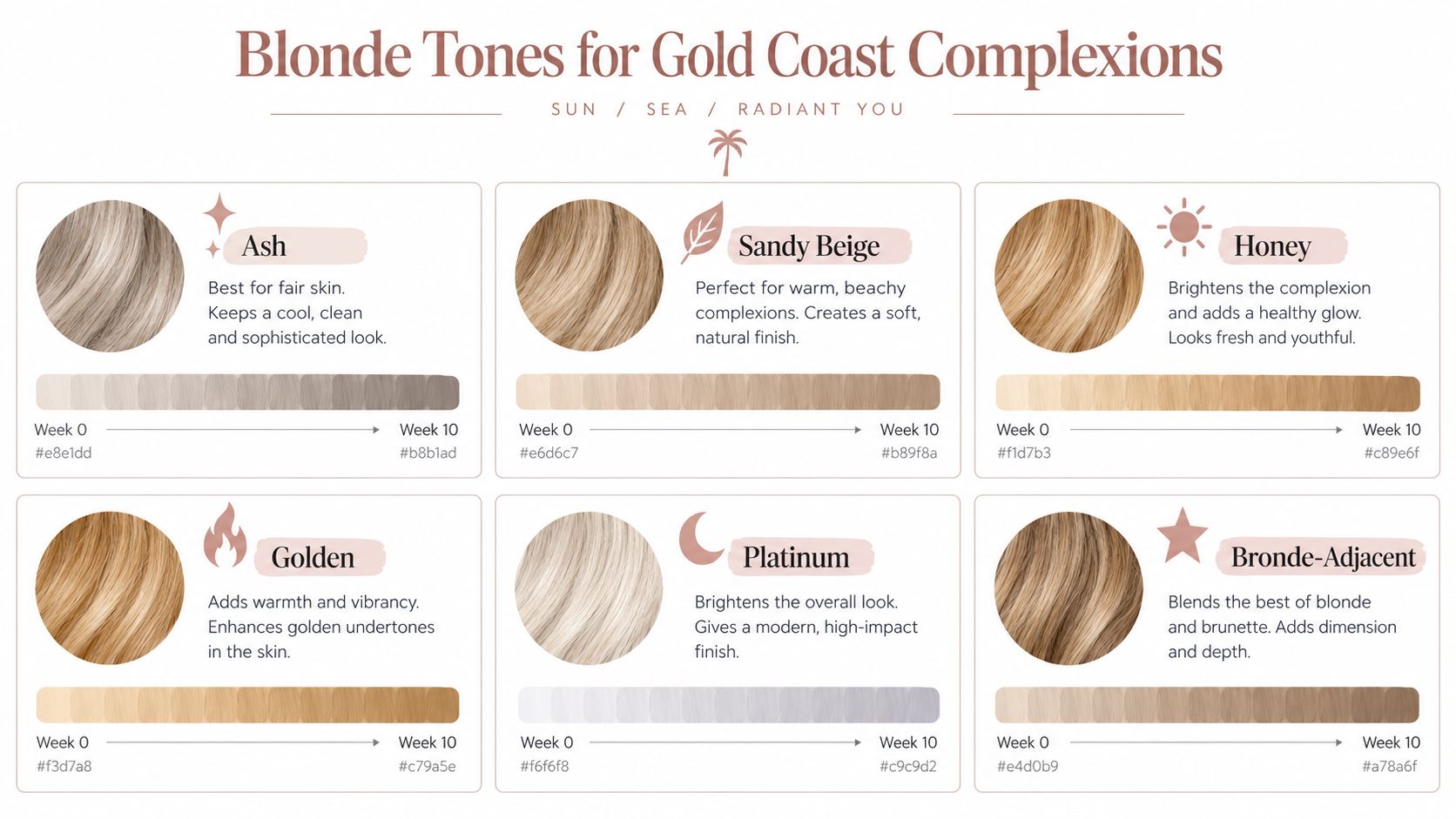
Ash blonde suits clients who prefer a cooler, cleaner finish and often works well beside naturally cool or neutral bases. It can make warmth in the natural hair more obvious, though, so inconsistent toning may create a grey-to-yellow contrast. Ash also shows root depth clearly when the extension is much lighter than the natural base.
Sandy beige is usually easier to blend than an extreme cool blonde because it carries both cool and warm elements. It's a strong option for clients who want a natural coastal blonde without a very yellow finish. Beige can become dull if too much cool pigment is layered over dry hair, so the tone needs to be maintained rather than repeatedly over-toned.
Honey blonde adds softness and warmth without looking aggressively golden. It can flatter warm or neutral complexions and often disguises a small amount of root contrast better than platinum. The trade-off is that unwanted warmth may become more visible in strong sunlight if the natural hair contains yellow or orange undertones.
Golden blonde is deliberately warm and works best when the natural colour and complexion can support that warmth. It's not the right choice for every client who says she wants “brighter” hair. Brightness can come from lightness, shine or contrast, and pushing a golden tone too far can make the overall result look brassy.
Platinum blonde creates the strongest visual impact and the least forgiving grow-out. A very light extension beside darker roots can produce a hard line, particularly when the hair is worn straight or in a high ponytail. Platinum also demands careful handling because lightened fibres are more vulnerable to dryness and colour shift.
Bronde-adjacent shades sit between blonde and light brown. They're a sensible choice when you want length and fullness but don't want to maintain a solid light block through the mid-lengths. A shadowed or blended bronde can make regrowth less obvious and often suits clients who wear their hair in changing styles.
Queensland UV can expose undertone differences quickly. Before your colour-match consultation, narrow your preference to one or two directions, such as sandy beige or honey, rather than arriving with one screenshot that may have been edited, filtered or photographed under different lighting.
A Brazilian fibre study found that bleaching reduced tensile strength from 3.2 to 2.8 gmf.mm², about 12.5%, while bleached-and-dyed hair fell to 2.7 gmf.mm², about 16.6%, compared with virgin hair. The study links the change to oxidation of cystine disulfide bonds, which weakens the fibre's ability to tolerate load. Research on bleaching and hair-fibre strength
That's why a blonde match should account for how the hair was lightened, not only what it looks like today. A low-oxidation approach, conservative heat use and sensible tension help protect both your natural hair and the extension lengths.
Matching Method to Fine or Delicate Hair
Fine hair describes strand thickness, not just the amount of hair on your head. A full head of fine strands needs a different plan from low-density hair with fewer strands overall. Your specialist should also assess scalp sensitivity, previous traction, temple breakage, and how often you swim or train on the Gold Coast.
Lighter methods generally suit natural hair with limited strength. Tape-ins and hand-tied wefts distribute weight across several attachment points, while nano or micro-bead systems use smaller individual sections. For placement detail, see this guide to hair extensions for fine hair on the Gold Coast. The method alone does not determine comfort. A lightweight attachment can still pull if it is placed poorly or concentrated around the hairline.
A heavy keratin-fusion installation or dense sew-in can overload fragile strands. The risk continues after installation. As the hair grows, each attachment moves farther from the scalp, increasing strain, pulling and the chance that the extension line becomes visible.
| Method | Weight per attachment | Best suited to | Watch-outs for fine hair |
|---|---|---|---|
| Tape-ins | Spread across a flat panel | Fine hair needing soft, distributed fullness | Adhesive care, product build-up and visible panels when worn up |
| Hand-tied wefts | Distributed across a thin row | Fine-to-medium density seeking flexible volume | Row tension, temple placement and delayed refits |
| Micro-beads | Small individual sections | Clients wanting glue-free placement | Bead visibility, concentrated tension and snagging |
| Nano beads | Very small individual sections | Delicate hair needing discreet attachment | Requires careful sectioning and consistent maintenance |
| Keratin bonds | Individual strands | Hair with enough strength for detailed placement | Too many bonds can overload a small area |
| Dense sew-in wefts | Larger row-based load | Hair with suitable density and strength | Bulk, traction and excessive weight on one track |
Choose the amount your natural hair can safely support, not the maximum length available. Excess weight can make the temples look thinner, leave the attachment line more visible as the weeks pass, and cause soreness or fragility. Australian salon guidance commonly places permanent-system move-ups around 6–10 weeks, depending on method and growth. Your refit schedule is part of the safety plan. Australian guidance on weft methods and maintenance
The Gold Coast climate and an active routine also affect the practical choice. Swimming, training and frequent styling place more demands on attachment care, so a method that looks discreet on installation day must remain manageable between appointments. Australian salon guidance identifies tape-ins and micro-links as common options for fine hair, while traditional wefts may put too much weight on one row. Maintenance guidance commonly places nano or bead systems around 4–8 weeks and wefts around 6–8 weeks, depending on the installation and wearer. Australian guide to methods, application and care
Fine hair usually needs a better weight distribution strategy, not a bigger set.
What a First Consultation and Installation Should Cover
A proper consultation starts before anyone discusses the final shade. I'd want to know how often you swim, whether you train, how much time you spend in direct sun, how you wear your hair for work and how frequently you use a straightener or curling tool.
The assessment should include a look at density across the crown, sides, nape and hairline. The specialist should identify areas of previous breakage, check scalp comfort and assess whether your strands can support the proposed attachment. A small test section can reveal far more than a quick visual glance.
Colour matching belongs in good natural light. Hold multiple swatches beside the root, mid-lengths and ends, then check the result from different angles. The match may need a blended combination rather than one flat blonde, particularly if your natural hair contains a root shadow or several existing tones.
Questions to ask before the first row is installed
- How much hair will be installed? Ask for the planned amount and why it suits your density, rather than assuming more hair creates a better result.
- Where will the attachments sit? Confirm how the specialist will handle the parting, temples and hairline, especially if you wear your hair up.
- What is the expected refit interval? The answer should reflect the method, your growth and your lifestyle.
- What happens if an attachment slips early? Ask how the salon assesses and corrects a problem, and whether the agreed aftercare is documented.
- How will the hair be blended? A precise cut and shape should connect the extension lengths to your natural ends.
A rushed installation often leaves clues. Overlapping bonds, no test strand, a colour decision made under salon lighting only, or a specialist who can't explain the maintenance schedule should make you pause. Queensland consumer guarantees apply to services delivered with due care and skill and fit for a specific purpose, with possible remedies including a repeat service, repair, refund, replacement or compensation for reduced value when the guarantee isn't met. Queensland consumer guarantees for services
Upkeep Between Refits in the Gold Coast Climate
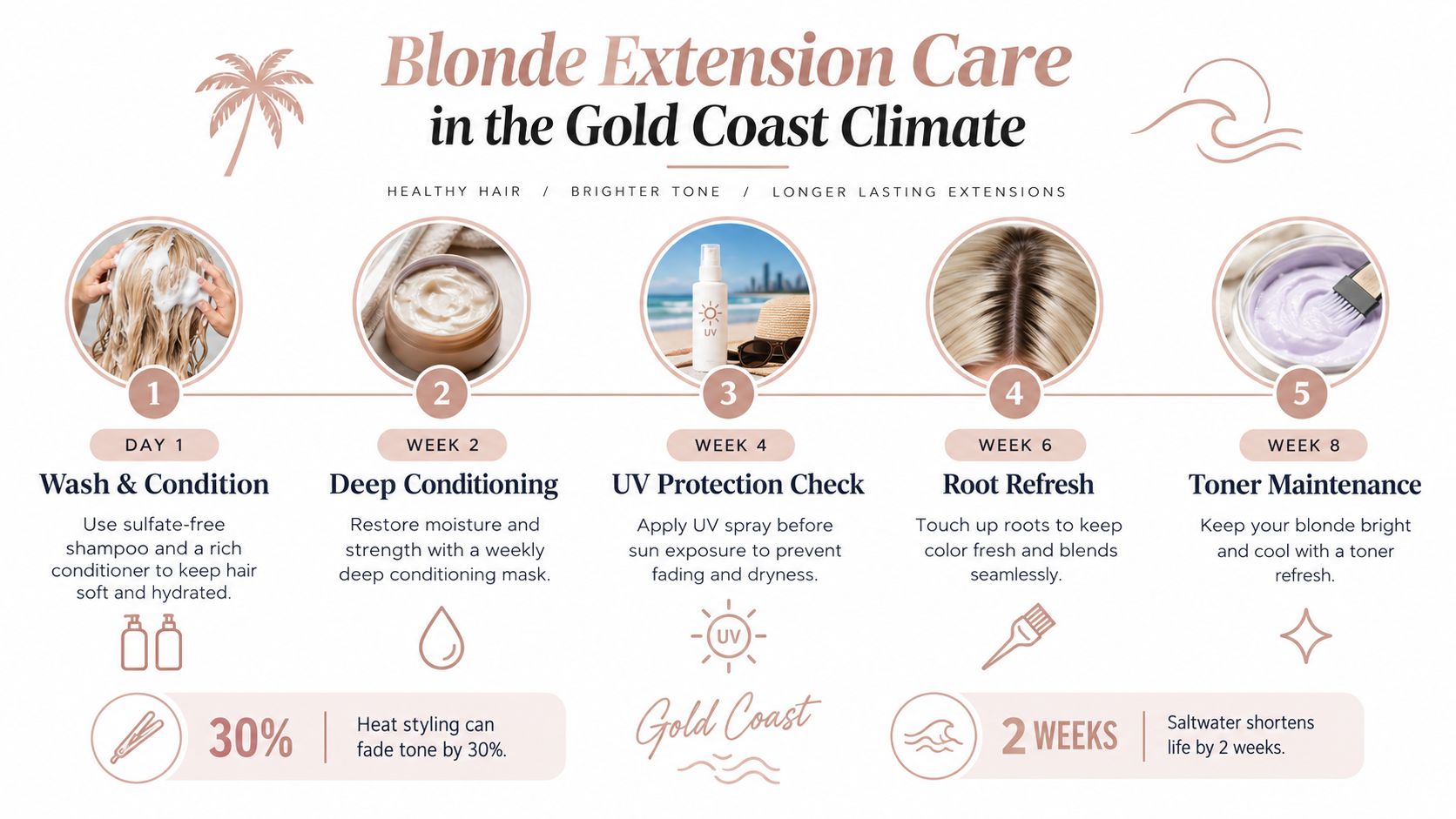
Blonde extensions need a routine that protects both the attachment and the colour. Start with a sulphate-free cleanser, work it through the scalp without scrubbing the bonds, and apply conditioner from the mid-lengths down. Excessive washing can dry the extension hair and encourage faster tone change, while under-washing can leave sweat, salt and product residue around the attachments.
Brush from the ends upwards with an extension-friendly brush. Support the attachment area with one hand, then work through small sections rather than dragging a brush from the roots to the ends. Pay particular attention to the nape, where friction from collars, pillows and damp hair can create matting.
Swimming needs a separate routine
Before entering a pool or the ocean, wet the hair with fresh water and apply a suitable leave-in product through the lengths. Tie it loosely or braid it to reduce tangling, then rinse thoroughly with fresh water afterwards. Chlorine and saltwater can leave lighter hair feeling rough and can make tone variation more obvious.
Don't go to bed with wet extensions. Air-dry the attachment areas where possible, then use controlled heat only on the lengths if needed. Always apply heat protection, keep the tool moving and avoid repeatedly pressing hot plates over the same section.
Purple shampoo can help neutralise unwanted yellow tones, but it isn't a daily cleanser and it can leave porous blonde hair feeling dry or unevenly toned. Use a professional recommendation for frequency, and consider a salon toner when the colour needs balancing across several shades rather than just cooling down the ends.
For a practical washing routine, follow this guide to washing hair with extensions. The refit window for many permanent systems sits around 6–10 weeks, but your actual appointment may need to come earlier if attachments are moving, the roots are tangling, the hairline feels sore or you can see the row when your hair is down.
Gold Coast humidity and UV exposure can compress your comfortable wear period compared with a cooler, less exposed routine. Treat the six-to-ten-week window as a planning guide, not permission to ignore visible movement or discomfort.
Misconceptions Worth Clearing Up Before You Book
“Blonde” on the label tells you almost nothing about whether an extension will blend. The level, undertone, root shadow and distribution of lightness all have to work with your natural hair. A warm blonde weft beside cool, pale lengths can look like a stripe, while a platinum piece against a deeper root can create a hard horizontal line in sunlight.
The problem often appears when the hair is moving. Indoors, the mismatch may seem minor. Outside, Queensland light can separate the tones quickly, especially when one section reflects light more strongly than the surrounding hair.
The second mistake is treating a longer wear cycle as a saving. As attachments move away from the scalp, they can pull at a different angle, loosen, catch during brushing and become harder to hide. Wefts can lift, bonds can become easier to feel and the nape can tangle if the hair is repeatedly worn damp.
Colour can also shift during the same period. Lighter hair exposed to washing, UV, chlorine, saltwater and heat may become warmer, drier or less reflective. Extending the appointment gap doesn't stop those changes. It can leave you needing a corrective colour service or an urgent removal instead of a planned refit.
Spot the warning signs early
- A visible band: The row or attachment shows when your hair is down, not only when it's tied up.
- Root pulling: The scalp feels sore after brushing, sleeping or wearing a ponytail.
- Persistent tangling: Knots keep returning at the nape despite gentle drying and brushing.
- A harsh colour block: The extension looks separate from your own hair in outdoor light.
- Slippage: A bond or panel has moved enough to catch on clothing or your brush.
A good maintenance plan prevents most of these problems. The appointment schedule should fit your calendar, not your wish to postpone the next cost.
Putting It All Together and Booking a Local Consult
Make the decision in this order. First, shortlist two methods based on density, scalp comfort and lifestyle. Someone with delicate hair who swims regularly may need a different shortlist from someone with stronger hair who rarely gets it wet.
Next, narrow the colour to one or two directions using your natural root and mid-lengths. Don't choose from the ends alone, and don't rely on a filtered screenshot. Sandy beige, honey, soft golden, cool ash or a bronde-adjacent blend may all be described as blonde, but they create very different grow-out patterns.
Finally, put the refit into your actual calendar. If you have a wedding, holiday, regular beach days or a busy work period ahead, plan the installation and maintenance around those dates. The most flattering method is still the wrong choice if you can't maintain it comfortably.
A local consultation should convert those preferences into a fitted plan. Ask for a strand assessment, a daylight colour match and a tension check on a small test row before committing to a full installation. The value of the appointment is the judgement behind the recommendation, not being talked into the largest amount of hair.
Gold Coast is a substantial service market, with 321,659 females in the Gold Coast LGA, representing 51.5% of the local population, according to the Australian Bureau of Statistics. That scale supports a local, appointment-led approach for women seeking added length, volume or discreet coverage close to home. Gold Coast LGA population profile
Bring reference photos, but also bring useful information about your own hair. Note any breakage or thinning, explain how often you swim or train, and be honest about heat styling. If you're comparing a hair extension specialist on the Gold Coast, choose the consultation that leaves you with a clear method, tone and maintenance plan.
If a service concern does escalate, keeping your consultation notes, quote, colour discussion and refit schedule can help clarify what was agreed. Queensland consumer law covers services bought in person, online or by phone, and the Queensland Civil and Administrative Tribunal handles consumer and trader disputes up to and including $25,000. Queensland consumer rights and dispute information
Hair Extensions Full Stop provides one-to-one consultations, bespoke colour matching, human hair extension application and ongoing refits at its Ashmore studio, with methods selected around your hair type and lifestyle. Visit Hair Extensions Full Stop to discuss your blonde tone, compare suitable methods and book a local consultation before committing to an installation.
Authored using the Outrank app
Recent Articles


