

You're tying your hair up before a swim, a gym session or lunch out, and you catch the same problem in the mirror. The lengths look fine, but there's no fullness through the sides, and your ponytail feels thinner than you'd like. You want more volume, but you don't want a bulky row, visible beads or hair that only looks good worn one way.
That's usually where invisible weft hair extensions enter the conversation. They're popular for a good reason, but invisible is a trade-off, not a promise. How discreet a row looks depends on your hairstyle, parting, density and regrowth, and on fine hair, tension matters more than how thin the weft is.
Table of Contents
- What Invisible Weft Extensions Are
- Where Invisible Wefts Sit Among Extension Methods
- Benefits and How Visible a Flat Weft Really Is
- Who Suits Invisible Wefts With Flat Scalps and Fine Hair
- What Happens at the Consultation Before Installation
- How Invisible Weft Installation Works Step by Step
- Maintenance and Refit Timing for Invisible Wefts
- Confirm Your Fit and Book a Consultation
What Invisible Weft Extensions Are
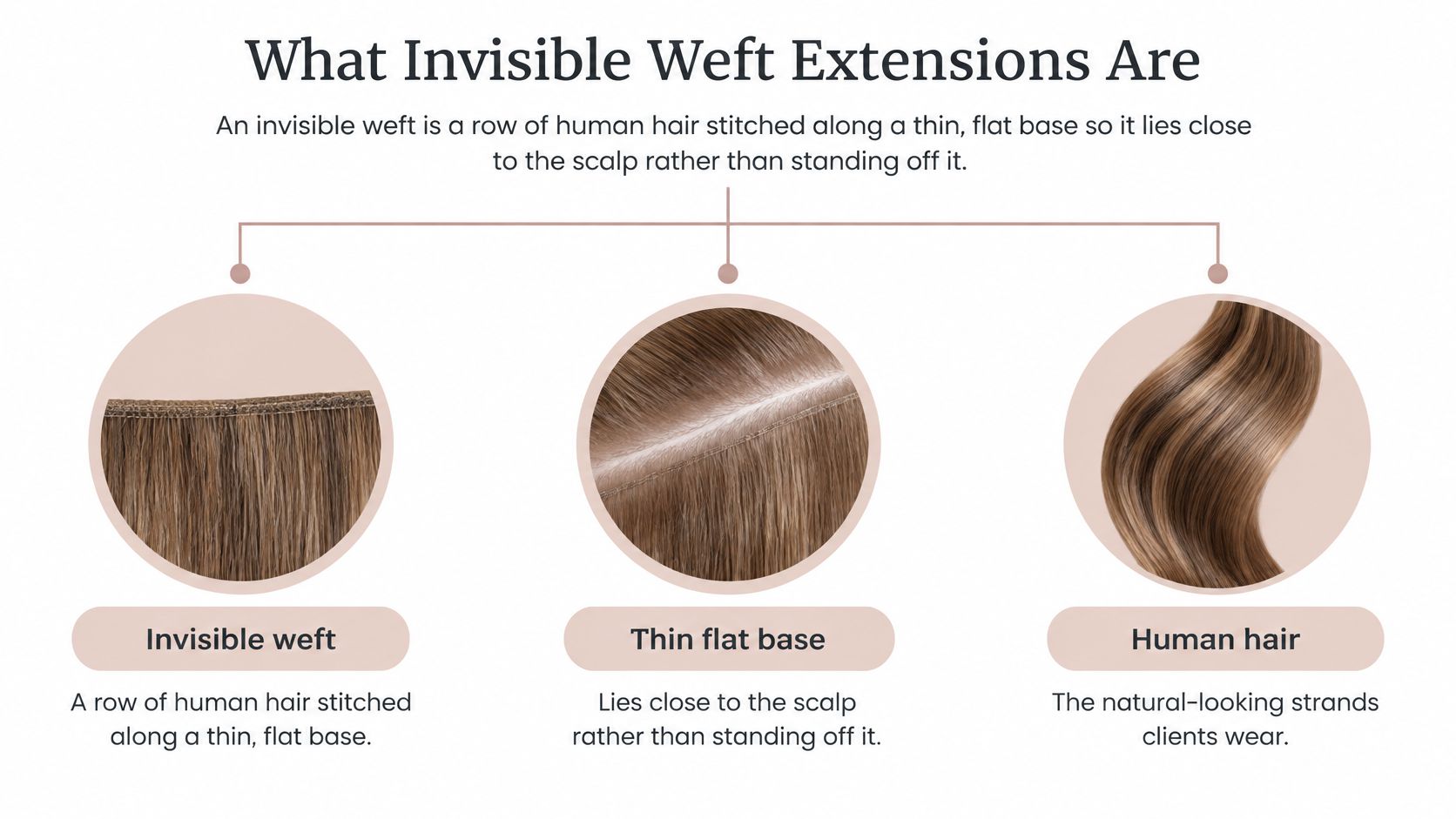
An invisible weft is a row of human hair stitched along a thin, flat base so it lies close to the scalp rather than standing off it. That one sentence explains most of the appeal. Instead of dozens of separate attachments, you get hair distributed across a row, with your natural hair falling over the join.
Many people searching for human hair extensions Gold Coast meet the term invisible weft first, so it's worth clearing up what it means before comparing studios and methods. The word describes how the row sits. It doesn't guarantee nobody could ever see it.
The Three Parts You'll See in the Salon
- The weft: The strip of human hair itself, stitched along the top edge so the lengths hang together as one row.
- The base or track: The fine foundation the weft attaches to, often a braided row or thin base sitting close to the scalp.
- Your natural hair: The hair left above and around the row, which covers the join when the style is worn down or loosely tied.
Think of a sewn hem that disappears into a garment. You don't judge it only by the thickness of the fabric. You judge it by the stitching, placement and whether the cloth around it is strong enough to hold it without puckering.
Why Flat Matters for Volume
A flat profile lets a stylist add density across one row without building a bulky ridge under the parting. Hair falls over the top, so the extra fullness reads as thickness through the lengths rather than as a lump near the scalp. That's why this method suits clients who want their hair to look fuller every day, not only styled for photos.
Invisible means low profile, not undetectable. A good row should be hard to spot in normal wear, but parting, wind and regrowth can still change what shows.
Before you book, ask three simple questions. How is the weft attached, what base does it sit on, and how close does the row sit to the scalp? Clear answers tell you far more than the word invisible on a price list.
Where Invisible Wefts Sit Among Extension Methods
Use this table as a lookup, not a ranking. Read across each row to compare how it attaches, its profile and weight, whether it uses heat or glue, and who it usually suits.
Invisible weft compared with other extension methods
| Method | How It Attaches | Profile and Weight | Heat or Glue | Usually Suits |
|---|---|---|---|---|
| Invisible weft | Sewn to a braided track or thin base close to the scalp | Flat, low profile, adds volume across one row | No heat or glue in a standard sewn application | Clients wanting discreet volume with a flat profile |
| Butterfly weft | Sewn or clipped to a small track | Lightweight and flexible, moves with natural hair | No heat or glue | Clients wanting lightness and natural movement |
| Micro bead | Small beads clamp sections of natural hair | Light and reusable | No heat and no glue | Clients sensitive to heat or adhesives |
| Nano bead | Smaller beads placed in fine sections | Most discreet individual method | No heat and no glue | Fine or delicate hair |
| Keratin bond | Individual keratin bonds placed strand by strand | Seamless, individual strand finish | Heat is used to set each bond | Clients wanting strand-by-strand placement and styling versatility |
How to Read the Table for Your Hair
Start with your main priority. If you want a flat, discreet row that builds volume across the back and sides, start with the invisible weft line. If your scalp reacts to heat or adhesives, check the micro bead and nano bead lines first, because both avoid heat and glue.
The attachment method sets more than the look. It affects comfort, how the hair moves when you brush it, how freely you can change your parting, and what upkeep feels like between appointments. A flat weft and a nano bead can add similar length on the same head and still behave very differently day to day.
Say you wear your hair down most days and want fullness through the mid-lengths. A single row may do that neatly. Say you change your parting often, wear sleek up-styles and have very fine hair around the front. Individual placement may give you more freedom, even if the appointment structure differs.
Butterfly wefts sit lighter and move more with natural hair. Keratin bonds give a strand-by-strand finish for clients who want versatile styling. Neither fact makes one method best for everyone.
Your density, texture, scalp sensitivity and lifestyle decide the fit, and a consultation confirms it. If you're weighing up options, our guide to choosing the right hair extension method on the Gold Coast walks through that decision in more detail.
Benefits and How Visible a Flat Weft Really Is
The benefits are straightforward. You get a flat profile against the scalp, volume added along a single row, and a sewn application that avoids heat in a standard installation. Worn down, the hair can look fuller without the bulk some people expect from extensions.
That's the part most marketing stops at. It doesn't answer the question you care about, which is whether anyone will see the row when you live in it.
Where Invisibility Has Limits
- Cover matters: The row needs enough natural hair above it to hide the join. Fine hair at the crown gives you less cover to work with.
- Regrowth changes the fit: Medusa Australia's frequently asked questions note wefts may need repositioning every 6-8 weeks as natural hair grows.
- Movement exposes edges: A technically flat weft can still show when hair is tied up, wet, windblown or separated at the crown.
As the row moves further from the scalp, it can affect your parting, ponytails, sleeping comfort and brushing. It may catch slightly under a brush, sit differently when you lie down, or peek through when fine hair separates. None of that means the installation was poor. It usually means the row is due to be moved back up.
The thinnest attachment isn't automatically the least noticeable. Colour matching, row placement, density, hair texture and your styling habits decide how discreet it looks.
Run a Visibility Test Before You Book
Ask your stylist to work through these checks with your hair type and usual styles in mind.
- Centre part: Does natural hair cover the row when the parting sits where you normally wear it?
- High ponytail: Can you lift your hair without the edge of the row lifting into view?
- Wet or windblown hair: What shows after swimming, or on a windy beach walk, when hair clings and separates?
- Crown separation: Separate the crown and look at how much cover remains.
- Regrowth interval: Confirm when repositioning is due, and what changes as that date approaches.
If you live in high ponytails, have very fine cover at the crown, or want maximum freedom to move your parting, nano beads or a lightweight butterfly weft may suit you better. No single invisible weft design works equally well for every client, and a stylist who says so is giving you useful information, not talking you out of a service.
Who Suits Invisible Wefts With Flat Scalps and Fine Hair
Two questions come up constantly. Will a row sit properly on a flat scalp, and can fine hair carry it safely? They're related, but they're not the same question.
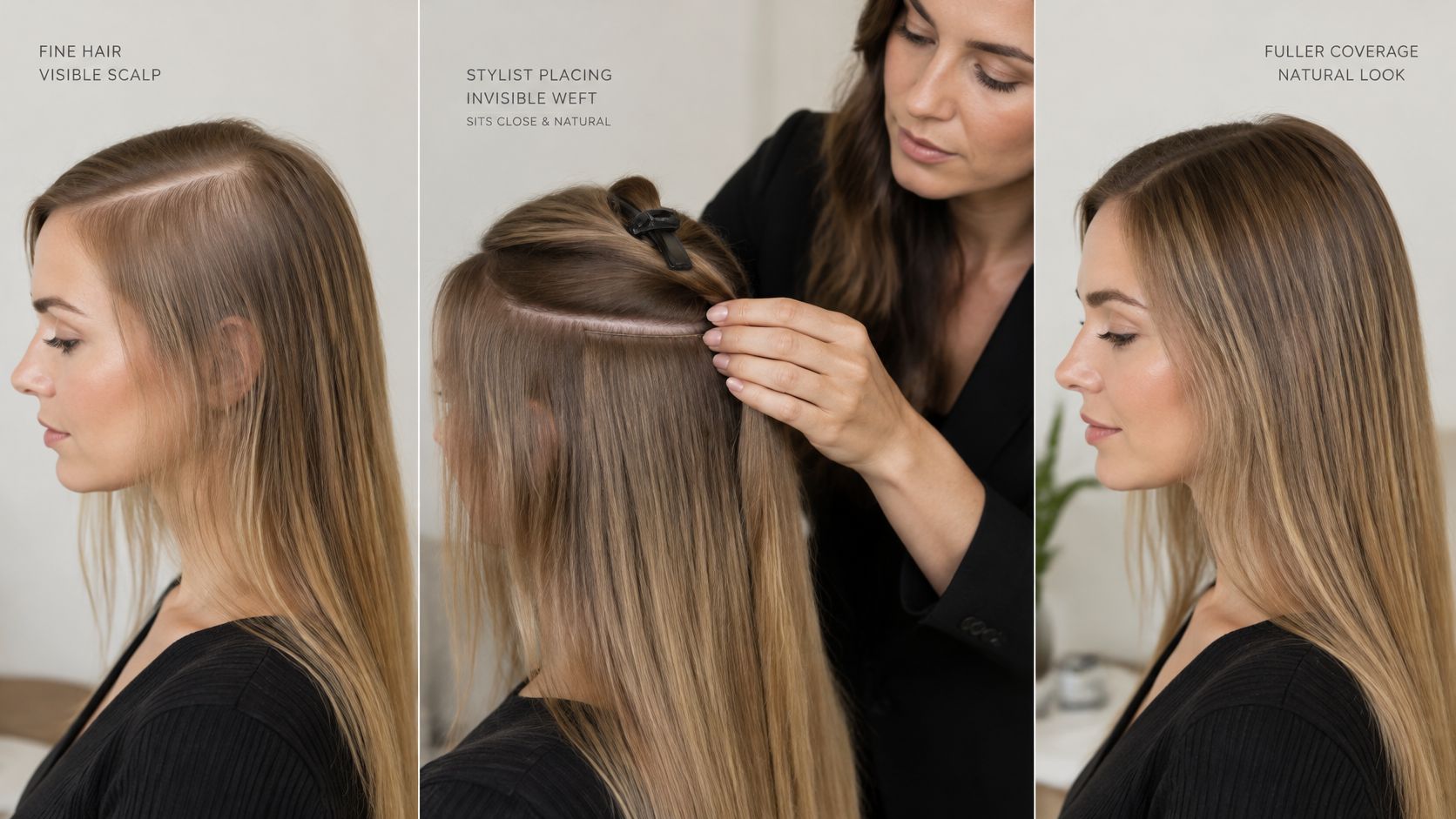
A flat scalp with dense natural hair usually gives a row a smooth surface and plenty of cover, so the weft sits neatly. Fine hair is a weight question. Fewer, thinner strands are anchoring the row, so the plan needs lighter density, careful sectioning and honest limits on how much volume goes into one row.
Tension Matters More Than Thickness
Invisible weft extensions should be designed with a focus on tension management, not just concealment. Australia's national hair extension training standard SHBHDES005 requires practitioners to select an appropriate degree of tension to prevent traction damage and traction alopecia, and to match the extension system to the client's natural hair type.
In plain terms, if too much hair or an overly tight attachment loads a narrow strip of natural hair, that strip carries sustained pulling. The risk is higher around the temples, hairline and finer crown sections. Traction alopecia is hair loss caused by prolonged, repetitive pulling in the same direction, and it's preventable when tension is reduced early.
A sound consultation assesses strand diameter, density, scalp sensitivity, existing shedding and your normal styling tension before anyone chooses weft width or placement. The weft should spread across adequate natural hair support and stay comfortable when you move your head. Afterwards, report tenderness, headache, itching or increased shedding rather than waiting for your next appointment.
Suitability by hair and scalp situation
| Hair and Scalp Situation | Suitability | Why It Matters |
|---|---|---|
| Flat scalp with dense natural hair | Usually a good fit | Enough natural hair covers the row and the weft sits flat |
| Fine hair with a flat scalp | Suitable with conservative weight | Less natural hair anchors the row, so use lighter density and check tension |
| Fine hair with a sensitive scalp | Discuss nano or micro bead methods first | Lower-tension options without heat or glue may be more comfortable |
| Thin crown or receding hairline | Assess carefully before any row is placed | Load near the hairline increases traction risk |
| Daily tight ponytails or plaits | Plan a different routine or method | Constant pull on the same row can cause tenderness |
| Tender or previously damaged hair | Needs assessment before application | Existing shedding and breakage change the weight and placement plan |
If fine hair is your main concern, our page on hair extensions for fine hair on the Gold Coast covers the lighter options in more depth. Whatever method you choose, hold on to one rule.
Pain is a warning sign, not proof of a secure fit. A row that hurts needs its load or tension adjusted.
What Happens at the Consultation Before Installation
A good consultation answers one question before anything else: can your hair safely carry the result you want? The method, the weight and the placement all come out of that answer.
The Three Checks, in Order
First comes the hair assessment. Your stylist looks at strand thickness, density, length, existing shedding and scalp sensitivity. This sets how much weight your hair can carry and where a row could sit. On fine hair this check matters more than the weft itself, because even a very thin weft pulls if the row is overloaded.
Second is your goal. Flat volume, added length, discreet everyday wear, frequent styling and a set event date all lead to different plans. Colour matching happens at this stage too, aligned with your natural hair. If you wear your hair up often or switch your parting, say so now, since a row that stays hidden in loose waves can show along a high ponytail or a new parting line.
Third is your lifestyle. This sounds similar to the goal check, but it measures something different: your goal is the result you want, your lifestyle is what your hair has to survive to keep it. Daily styling, sport, swimming, sleeping habits and how often you tie your hair up all change how a row behaves. A method that suits someone who wears loose waves may frustrate someone who trains daily with a tight ponytail.
The method recommendation comes after those checks. Every service includes personalised colour matching, expert blending and honest advice aligned with your hair goals, which sometimes means suggesting a lighter method than the one you arrived asking about.
There's a practical consumer point here. The ACCC's personal services guide to the Australian Consumer Law says service providers must supply services with due care and skill and make them fit for any purpose the client specifies, and it gives hair extensions as an example of a product resulting from a service that must be fit for the stated purpose. So state your purpose clearly, and expect an agreed result that's realistic for your hair rather than a generic promise of natural-looking results.
Five Questions to Take With You
- Tension: How will you check tension during and after installation?
- Colour: How is the colour matched to my natural hair?
- Hygiene: How are tools cleaned between clients?
- Refits: How often will this row need repositioning?
- Aftercare: What care guidance is included once I leave?
Bring recent photos of your hair, a short note of your daily styling habits and any event date you're working towards. Arrive with your hair as you normally wear it. Straightening it specially for the appointment hides the starting point your stylist needs to see.
How Invisible Weft Installation Works Step by Step
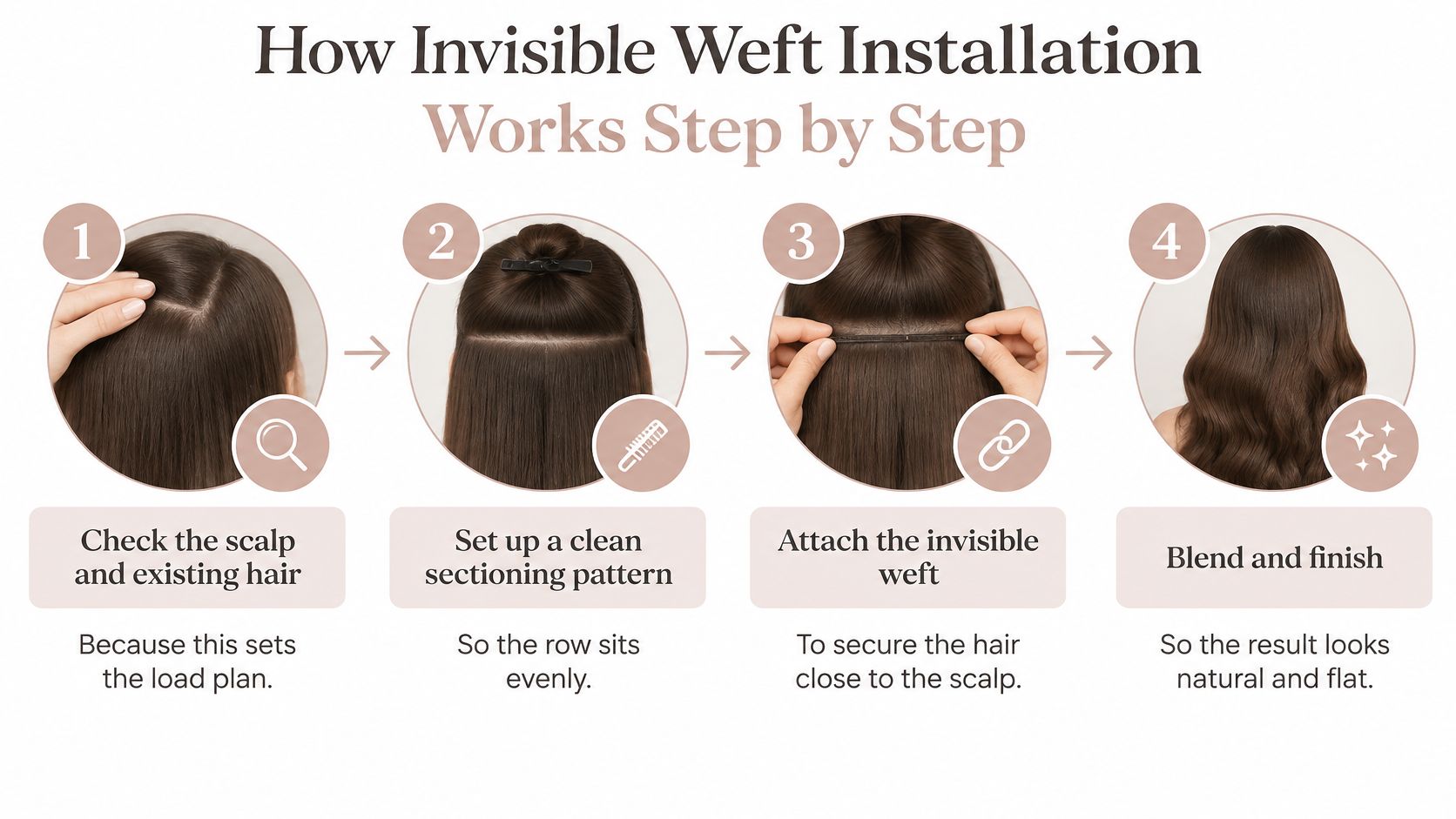
Every installation is customised to your natural hair, lifestyle and desired result, but the sequence below shows what a careful hair extension application Gold Coast appointment involves and why each step is there.
From Scalp Check to Final Blend
- Check the scalp and existing hair. Your stylist looks for tenderness, shedding or irritation before anything is attached. This sets the load plan, because hair that's already stressed shouldn't carry the same weight as strong, dense hair.
- Set up a clean station. Hands are washed, jewellery that could touch your skin comes off, and cleaned, inspected tools are laid out. Queensland's infection control guidelines for personal appearance services require hand hygiene, removal of jewellery that could contact a client's skin, cleaning contaminated instruments as soon as practicable, and visually inspecting instruments for wear or damage before cleaning, with faulty items removed from use immediately.
- Section the natural hair. Clean sections create an even base for the row. Sections stay away from the hairline where possible, because that's where tension is felt most.
- Prepare the track or base. This is the foundation the weft attaches to, built close to the scalp so the finished row sits flat rather than perched on top of your hair.
- Choose weft width and density. The stylist matches the amount of hair to what your natural hair can support. Spreading weight across adequate support matters more than squeezing maximum volume into one row.
- Attach the weft close to the scalp. Tension is checked as the work progresses, not only at the end. Secure should never mean pulled tighter than your hair can comfortably carry.
- Blend the weft into your natural hair. The stylist trims and shapes the edges so the join softens and the lengths move together. This step is where a row stops looking added and starts looking like your hair, only fuller.
- Test movement and comfort. Turn your head, tilt it, and say so if anything pinches or pulls. Tenderness flagged now is simple to adjust. Tenderness ignored for a week is a different conversation.
- Hand over aftercare. You leave knowing how to brush, wash and sleep with the row, plus the date your refit is due. If an appointment ends without that information, ask for it before you go.
Use step two as a quiet checklist wherever you book. A clean workstation, tools in sound condition and equipment that's cleaned between clients are reasonable expectations for close-contact work near your scalp. They matter even more with fine or delicate hair, where careful sectioning and controlled placement shape both comfort and the finished look.
Maintenance and Refit Timing for Invisible Wefts
Good maintenance is mostly small habits done consistently. The schedule below covers what to do, when, and why it matters for both the attachment and your natural hair.
Invisible weft maintenance timing and checks
| Timing | What to Check or Do | Why It Matters |
|---|---|---|
| Every day | Brush from the ends upward and avoid pulling along the weft line | Limits repeated tension on the attachment |
| Before bed | Loosen tight plaits, ponytails and buns | Stops the same row carrying constant pull overnight |
| Every wash | Wash and dry gently around the attachment area | Keeps the join clean without stressing the row |
| Every 6-8 weeks | Refit, reposition the row, recheck tension, colour and condition | The row moves away from the scalp as hair grows |
| Ongoing | Check for soreness, redness or unusual shedding | Early signs are easier to correct and may need prompt review |
What a Refit Actually Does
At about 6-8 weeks, your natural hair has grown enough that the row sits noticeably further from your scalp. A refit repositions that row, resets its tension and rechecks colour and condition. Your stylist also checks how your natural hair and scalp have responded, which is information you can't get from a mirror.
A refit isn't a full reinstallation. A refit resets placement and tension on your existing system. A new installation starts again with a fresh assessment of your hair, goals and method. If your hair, health or styling habits have changed significantly, treat the appointment as a reassessment rather than an automatic rebooking of the same thing.
Daily habits protect the work between visits. Brush from the ends upward so you aren't dragging knots through the attachment line. Ease off tight styles before bed so one row isn't under constant pull for eight hours. Wash and dry gently around the join, taking care that the attachment area dries properly rather than staying damp under the row.
Warning Signs and Removal
Persistent soreness, redness or unusual shedding means book a review promptly. Don't wait for your scheduled refit and hope it settles.
If those signs appear, ask the studio to remove the weft rather than pulling it out at home. Forcing an attachment can damage your natural hair and the join, and it skips the scalp and hair check that should follow removal. Early removal with a proper check protects the hair you'd want extensions on next time.
Your stylist sets the exact schedule for your hair, because growth rate and hair strength differ between clients. For a broader look at timing, read our guide on how long hair extensions last. Book the refit before you leave each appointment, while the right interval is fresh in everyone's mind.
Confirm Your Fit and Book a Consultation
A consultation settles the question this guide can only narrow down: whether an invisible weft stays hidden on your hair, at your parting, with your density. Three checks tell you whether it is worth asking that question in the chair.
- Is your main goal flat, discreet volume rather than maximum length? Invisible Weft Extensions lie flat against the scalp and are built for adding volume without the bulk of a traditional weft.
- Do you have enough natural cover, and does your scalp tolerate the tension a row needs without ongoing soreness? A thin weft helps, but density and healthy roots decide whether it stays invisible.
- Will you keep regular refit appointments, booked ahead rather than squeezed in once the row feels loose?
If you answered yes to all three, your next step is a consultation at our Gold Coast studio, where we can check your hair in person and confirm placement, weight and colour. If fine or delicate hair is your main concern, Nano Bead Extensions are our most discreet individual method and are especially suitable for fine or delicate hair, so the consultation can compare nano and micro bead options beside a weft instead of pushing one answer.
Hair Extensions Full Stop is a professional hair extension specialist Gold Coast service offering consultations, custom colour matching, installation and refit appointments. The invisible weft is one method we discuss in that consultation, alongside the alternatives if your hair points that way. You'll also receive care guidance after installation, and our free care guide covers how to wash extensions correctly, the best products to use, why heat protectant matters, sleeping and swimming tips, and a recommended maintenance schedule.
Call the studio or book a consultation through the website when you're ready. There's no pressure to commit on the first visit. A first appointment that ends with a clear plan, or an honest not yet, has done its job.
If you're considering hair extensions Gold Coast clients can wear comfortably every day, Hair Extensions Full Stop offers one-to-one consultations, personalised colour matching, professional installation and scheduled refits across invisible weft, butterfly weft, bead and keratin bond methods. Bring your questions about tension, visibility and upkeep, and we'll assess your hair and recommend the method that suits it best. Visit Hair Extensions Full Stop to book your consultation or call the studio to talk through your options.
Recent Articles


