

Queensland authorities document that hair straighteners can exceed 200°C within 10 minutes and remain hot for more than 30 minutes after shutdown. Heat protectant reduces styling stress, but it doesn't make heat safe, especially when you're wearing hair extensions.
You're rushing out on a humid Gold Coast morning, your natural hair has puffed slightly overnight, and your human hair extensions need smoothing before work. Perhaps you reach for a flat iron, curl the ends, or use a hot brush to bring the whole style together. The product beside your tools says “heat protection”, so it's easy to assume your hair is covered.
It isn't. A heat protectant for hair is useful, but it's only one part of a safer styling routine. The right product can reduce friction, moderate heat transfer and help limit moisture loss. It can't reverse existing damage, make maximum temperature harmless, or protect an attachment point from direct contact with a hot plate.
Table of Contents
- Why Heat Protection Matters for Gold Coast Extension Wearers
- How Heat Protectant Actually Works on Hair and Extensions
- Ingredients to Look For and Avoid With Hair Extensions
- How to Apply Heat Protectant for Different Extension Methods
- Common Misconceptions About Heat Protectant and Extensions
- Building a Safe Heat-Styling Routine for Extension Clients
Why Heat Protection Matters for Gold Coast Extension Wearers
Queensland's product-safety authorities have documented a clear risk from heated styling appliances. In a 2012 safety campaign, authorities reported that a child suffered serious burns from hair straighteners approximately every week, while the Royal Children's Hospital Burns Unit in Brisbane reported that 80% of hair-straightener burns treated there affected children under five. The same safety context included cases ranging from superficial burns to full-thickness injury, with most hospital-treated cases involving toddlers aged six months to two years and approximately 40% of admitted children requiring long-term scar management. These figures concern accidental contact rather than normal hair styling, but they show how quickly heated tools can damage skin, as explained in the Queensland product-safety campaign.
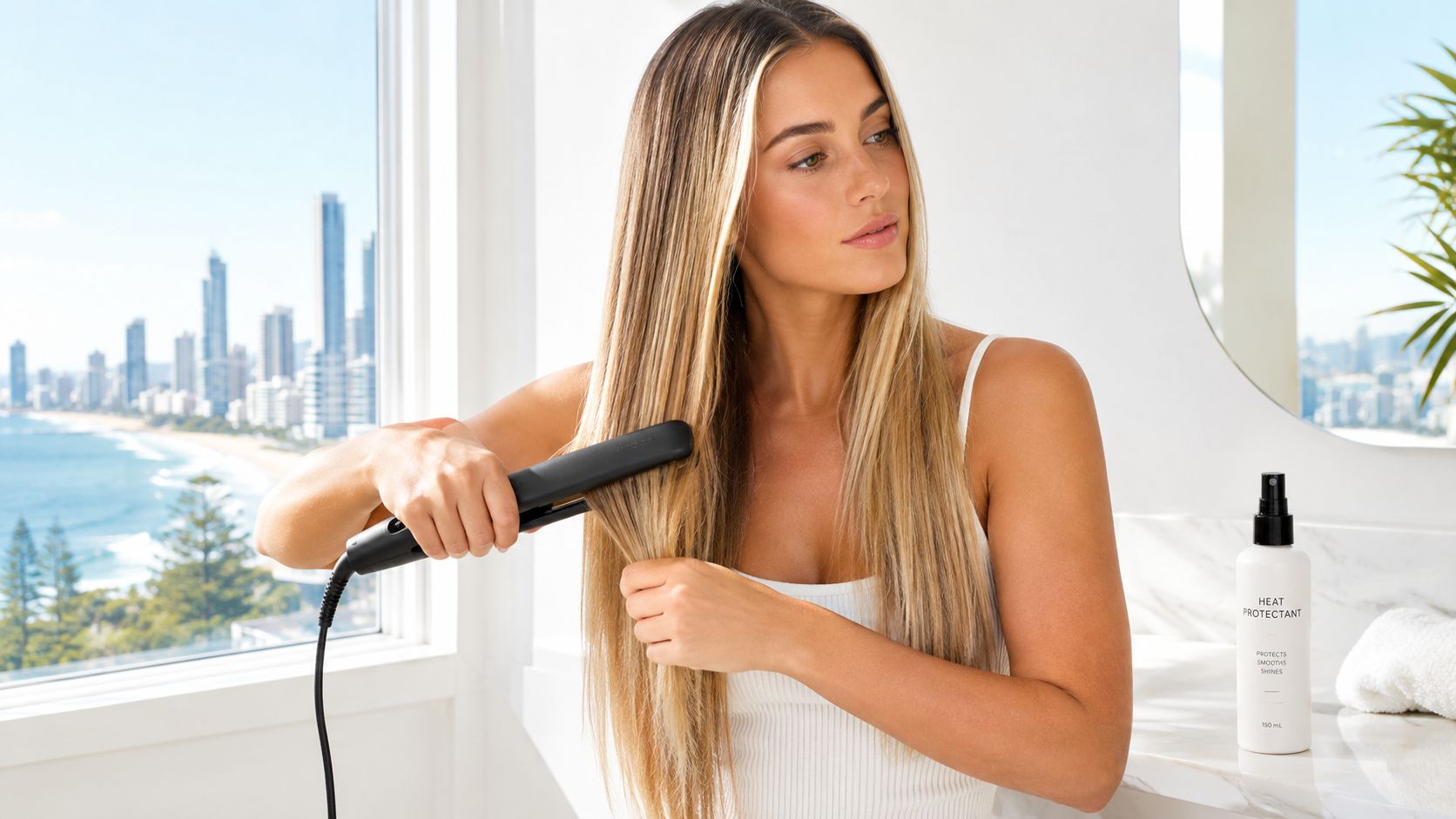
What the product can and cannot do
For someone searching for hair extensions Gold Coast advice, the practical answer is yes, you should generally use heat protectant before heated styling. Apply it properly, select the lowest effective temperature, keep contact brief and avoid repeated passes over the same section.
The product helps most with:
- Friction: A smoother surface allows a straightener or curling tool to move through the hair with less drag.
- Moisture loss: A light film can slow the rapid evaporation that leaves hair dry and brittle.
- Heat distribution: The coating helps spread the effect of the tool more evenly instead of creating as much concentrated stress in one spot.
It doesn't make hair heat-proof. It also doesn't turn a bond, bead, tape, weft seam or scalp into a heat-safe surface. Extension hair has no natural scalp sebum travelling through it, so mid-lengths and ends can become dry and rough more readily than hair close to the scalp.
Practical rule: Treat heat protectant as a risk-reduction layer, never as permission to use the hottest setting.
A Gold Coast lifestyle adds other variables. Humidity can encourage repeated smoothing, while outdoor exposure can leave lengths feeling dry before a styling tool is used. If you're constantly correcting frizz with heat, the better solution may be a different drying technique, a lighter styling product, or a conversation with your hair extension specialist Gold Coast about whether your current method suits your routine.
How Heat Protectant Actually Works on Hair and Extensions
A heat protectant usually deposits a thin, lubricating film over the hair shaft. Think of it as a lightweight coating that helps the hot tool glide, rather than a shield that blocks heat completely. The film can reduce friction and moderate how quickly heat reaches the inner structure of the fibre.
That distinction matters with human hair extensions. The extension length is older hair, and it doesn't receive natural scalp oils. When the surface becomes rough, a straightener catches more easily, which can lead to extra passes and more mechanical stress. A suitable product improves slip without leaving the hair so coated that it becomes stiff or difficult to style.
The four useful effects
- Film formation: Film-forming ingredients create a light surface layer that reduces direct friction between the hair and tool.
- Lubrication: Improved slip helps the tool move through the section without snagging.
- Moderated transfer: The coating can slow and distribute heat, but it can't stop thermal energy reaching the fibre.
- Surface smoothing: A smoother cuticle feels softer and reflects light more evenly, which is especially noticeable on extension lengths.
Australian hair-care guidance commonly recommends keeping fine or damaged hair below 150°C, while thicker hair may need a higher setting. The safer benchmark is still the lowest temperature that achieves the result, not the highest temperature printed on a product label. The Australian straightener styling guidance also supports using a suitable protectant, dry hair and controlled styling rather than relying on heat claims alone.
Hair must be completely dry before a flat iron or curling tool is used. Water trapped under a hot plate can rapidly turn to steam and increase fibre stress. For a blow-dry, choose a formula intended for damp hair, then allow the hair to dry fully before using a direct-plate tool.
The best result comes from combining the film with sensible exposure control. Use a fine, even layer, comb it through, wait until the hair is dry, and style each section with one controlled pass wherever possible.
Ingredients to Look For and Avoid With Hair Extensions
Product labels are more useful than the front of the bottle. “Maximum heat protection” is a marketing statement, not a reason to ignore your hair's condition or the restrictions of your extension method.
Look for a lightweight film-forming formula that gives the hair slip without leaving a greasy coating. Film-forming silicones, light conditioning agents and polymer coatings may help reduce friction and limit moisture loss. The ideal finish is smooth and flexible. If your hair feels sticky, crunchy or coated after drying, the formula may be too heavy for your application or you may be using too much.
A practical label comparison
| More suitable for many extension clients | Use carefully or keep away from attachment areas |
|---|---|
| Lightweight sprays or lotions | Heavy oils that leave a dense coating |
| Film-forming conditioners | Waxes that can accumulate around seams |
| Evenly distributed polymer-based products | High-alcohol formulas that may feel drying |
| Formulas suited to damp or dry styling, as stated on the label | Rich products that make the hair stiff or tacky |
The concern with buildup isn't only cosmetic. A stiff coating can make the tool drag, which encourages repeated passes. Product accumulation near beads, bonds, tapes or weft seams can also make cleansing more difficult and affect how cleanly the extensions sit during maintenance.
Australia's labelling framework requires cosmetic products to display an ingredient list using English or International Nomenclature Cosmetic Ingredient names. It also distinguishes cosmetics from therapeutic goods according to primary use, ingredients and claims, as outlined in the Australian cosmetics labelling consultation paper. That's a useful reminder to inspect the formula rather than assume every heat-protection product has been assessed in the same way.
For keratin bonds, beads and weft seams, don't spray directly onto the attachment system. Place the product on the lengths, distribute it with a comb and keep the root area clean unless your extension professional has recommended a specific product for it. If you're unsure whether your current formula is suitable, bring it to your consultation or refit appointment. A product that works beautifully on loose natural hair may be too rich for extensions.
For detailed care around bonded systems, see this guide to keratin bond extensions maintenance.
How to Apply Heat Protectant for Different Extension Methods
Application should change according to the attachment system. The lengths still need protection, but the areas closest to the scalp and attachment points need a more controlled approach.
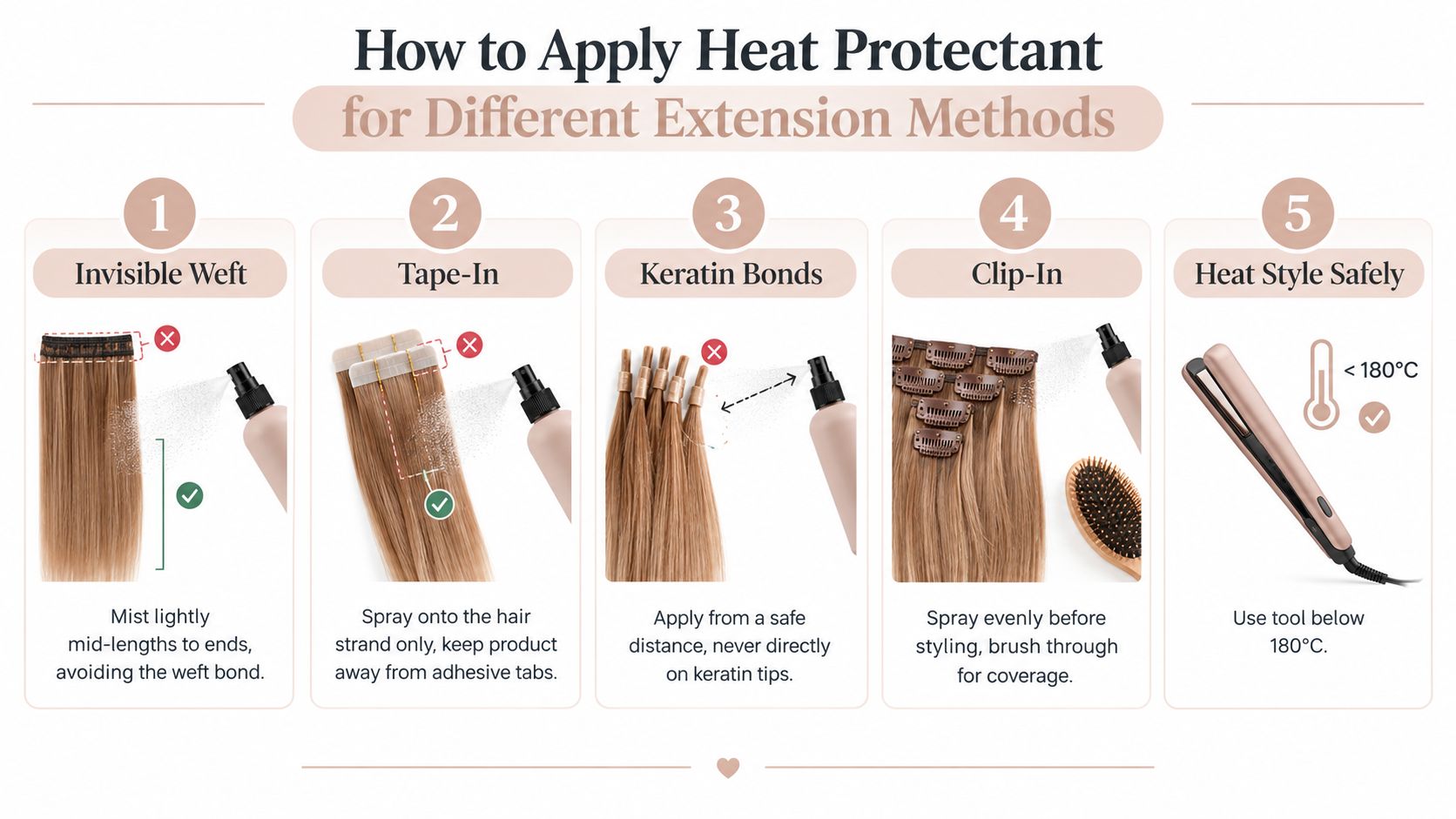
Start with clean, detangled hair and divide it into manageable sections. Use a product designed for the condition of your hair and the stage of styling, then mist or smooth it through the mid-lengths and ends. Comb through gently so the coating reaches the underside of each section rather than sitting only on the visible surface.
Invisible Weft and Butterfly Weft
With Invisible Weft Extensions, apply a light mist from the mid-lengths through the ends and work it through with a wide-tooth comb or suitable extension brush. Keep the weft seam and attachment area as dry and product-light as possible. Concentrate on the exposed lengths, where heat and brushing create the most wear.
Butterfly Weft Extensions benefit from the same principle. Their lightweight movement can be lost if you saturate the hair with oils or heavy creams. A fine spray is usually easier to distribute evenly, particularly when you're preparing the hair for a smooth blow-dry or soft curl.
Micro Bead and Nano Bead
For Micro Bead and Nano Bead extensions, section carefully and avoid spraying directly over the beads. Product trapped around the attachment area can contribute to buildup and make the system harder to keep clean.
Dry the root area with controlled airflow, keeping the dryer moving. Direct high heat close to the scalp or beads isn't necessary for a polished result. Apply the protectant lower down, then style the lengths while maintaining a clear gap around the attachment points.
Keratin Bond
Keratin Bond Extensions need extra care around the bond. Keep heat protectant off the keratin tip itself and avoid placing a flat iron or curling barrel over the bond. Excess heat close to an attachment can affect the bond over time, even when the lengths have been protected.
A safe sequence looks like this:
- Section the hair: Work in sections you can see and control.
- Distribute lightly: Apply a fine, even film through mid-lengths and ends.
- Comb through: Remove concentrated patches and check that no section is wet.
- Allow complete drying: Never place a direct-plate tool over damp hair.
- Style once: Use one controlled pass instead of reheating the same area repeatedly.
- Protect the attachments: Keep tools, rich products and unnecessary heat away from beads, bonds, tapes and weft seams.
The correct method and aftercare plan should match your hair density, styling habits and tolerance for maintenance. This guide to choosing the right hair extension method can help you prepare questions for a professional consultation.
Common Misconceptions About Heat Protectant and Extensions
Heat protectant is often described with confident language, but extension wearers need a more precise interpretation. The product can reduce stress. It can't remove every risk created by temperature, contact time, dryness or poor placement.
“It prevents all damage”
It doesn't. Existing dryness, split ends and weakened areas won't be repaired by spraying a coating over them. Australian dermatology guidance recommends reducing temperature, contact time and styling frequency while using heat protectant, rather than treating the product as a licence for maximum heat. The Australian advice on dry and damaged hair also supports the distinction between mitigating future stress and reversing damage that's already present.
“Heat-free installation means heat-free maintenance”
Micro Bead and Nano Bead methods can be installed without glue or heat, but the finished hair may still be straightened, curled or brushed with heated tools at home. “Heat-free application” describes the installation process. It doesn't describe every styling choice during wear.
The same applies to a client who chooses a method because she's sensitive to adhesives. The attachment may avoid adhesive and heat during application, yet the lengths still require a heat-aware routine after washing.
“More product gives more protection”
Heavy application can create the opposite result. If the hair becomes stiff or tacky, you may use more passes to achieve smoothness. Buildup near a bead, bond or weft seam can also complicate cleansing and maintenance. A light, even film is more useful than a saturated section.
“One application lasts through every styling session”
Not necessarily. A product applied before blow-drying may not automatically provide adequate coverage when the hair is completely dry and you decide to restyle with a straightener or curling tool later. Check the label's directions and your professional's aftercare advice. Reapply where appropriate, but avoid layering multiple heavy products just because the hair feels dry.
Heat protectant supports a careful routine. It doesn't replace one.
Building a Safe Heat-Styling Routine for Extension Clients
A practical Gold Coast routine starts with exposure control. Use a lightweight product suited to your styling stage, keep fine or damaged hair at a conservative temperature, dry the hair completely before direct-plate tools and limit contact time. Keep the tool away from bonds, beads, tapes and weft seams, then switch it off and store it safely on a heat-resistant surface.
Sun exposure deserves its own layer of protection. ARPANSA recommends sun protection whenever the UV Index reaches 3 or higher, including protective clothing, broad-spectrum water-resistant SPF50 or SPF50+ sunscreen, a broad-brimmed or legionnaire-style hat, shade and sunglasses. Sunscreen should be applied 20 minutes before going outdoors and reapplied every two hours, according to ARPANSA's ultraviolet radiation guidance. A hat can help cover the scalp and crown, but it rarely provides enough protection by itself when broader sun protection is advised.
Your hair routine should also include gentle washing, careful drying and scheduled extension maintenance. Advice on how to wash your hair when you have hair extensions is particularly useful if humidity, outdoor activity or frequent styling affects how often you cleanse.
Tell your extension professional how you typically style your hair, including whether you use a flat iron, curling wand, hot brush or blow-dryer. That information helps match the method, product placement and maintenance plan to your lifestyle rather than to an ideal routine you won't follow.
Hair Extensions Full Stop provides personalised consultations, colour matching, application and ongoing care for clients seeking human hair extensions on the Gold Coast. Visit Hair Extensions Full Stop to discuss Invisible Weft, Butterfly Weft, Micro Bead, Nano Bead or Keratin Bond options and receive practical guidance on heat protectant use for your chosen method.
Recent Articles


