

You've styled your hair for work, checked the back in the mirror and noticed that your crown still looks flat. You want enough fullness for everyday wear and weekend events, not a heavy head of extra length. Hair volume extensions can help, but the starting point is how much support your natural hair can provide, not how much added hair you can fit in.
For fine or thinning hair, a small, well-placed installation can make more sense than full-head coverage. At Hair Extensions Full Stop in Ashmore, our consultation starts with your hair and your goals, so the application plan suits the person wearing it.
Table of Contents
- Volume Options at a Glance
- How Volume Extensions Create Fullness
- Choosing a Method for Fine or Thinning Hair
- Placement and Weight Rules That Protect Your Hair
- Warning Signs That Mean Stop and Get Checked
- Maintenance That Keeps Volume Looking Full
- Book a Volume Consultation on the Gold Coast
Volume Options at a Glance
Say your ends look reasonably full, but your crown separates under overhead lighting. Adding long extensions underneath won't necessarily cover that area. You need to distinguish coverage at the scalp from extra body through the lengths before choosing an attachment method.
Volume methods compared
| Method | Volume it adds | Best suited to | Attachment |
|---|---|---|---|
| Invisible weft | High, full coverage across crown and sides | Medium to dense hair, with careful weight allocation | Sewn tracks, no glue |
| Butterfly weft | Medium, lightweight and flexible | Medium hair wanting natural movement | Sewn tracks, no glue |
| Micro bead | Medium, adjustable by section | Medium hair, reusable wear | Beads clamped without glue or heat |
| Nano bead | Low to medium, highly discreet | Fine or delicate hair with a suitable supporting base | Beads clamped without glue or heat |
| Keratin bond | Medium to high, seamless | Hair with enough density to carry bonds | Individual keratin bonds |
| Crown topper | Targeted lift at crown and parting | Thinning limited to the crown | Clips or attaches to a base |
These are starting categories, not promises about what your hair can carry. Weft names describe the construction and finish, but the amount installed and the supporting sections still need individual assessment.
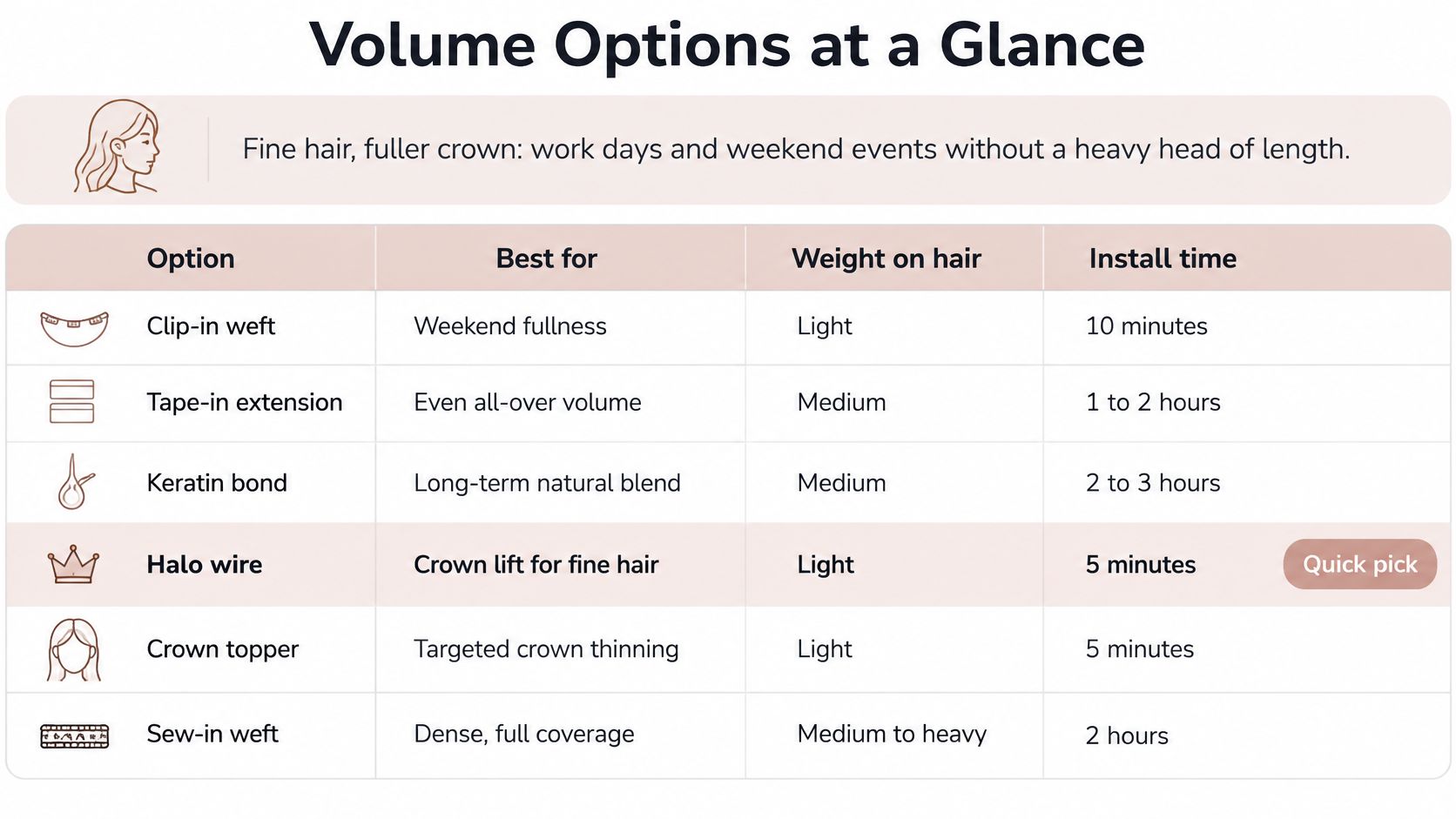
Choose the support before the result
Volume isn't the same as length. A method configured to add considerable length may carry more hair than you need for fuller ends. A fitted topper can provide crown coverage without extending the entire hairstyle, although its clips or base still need secure, healthy support.
Start by ruling out options your natural hair can't comfortably support. Then narrow the remaining choices by where you want fullness, how you wear your hair and whether you want removable or ongoing wear.
- Locate the gap: Check whether you're seeing scalp, sparse mid-lengths or wispy ends.
- Set the shape: Decide whether you want to keep your current length or change it.
- Consider upkeep: Allow for brushing, drying and professional maintenance, not just application.
Choose by how much natural hair you already have, then by the volume you want.
Even a lightweight method needs a consultation, because your natural hair determines how much load it can carry.
How Volume Extensions Create Fullness
A gardener thickens a hedge by filling gaps along its edge and shaping the top, not by piling clippings in one spot. Hair follows a similar visual principle. Added strands need to complete the silhouette rather than form a separate layer underneath it.
Stand behind a mirror and assess the hairstyle from the crown down. Root coverage, mid-length body and the finish at the ends each contribute something different.
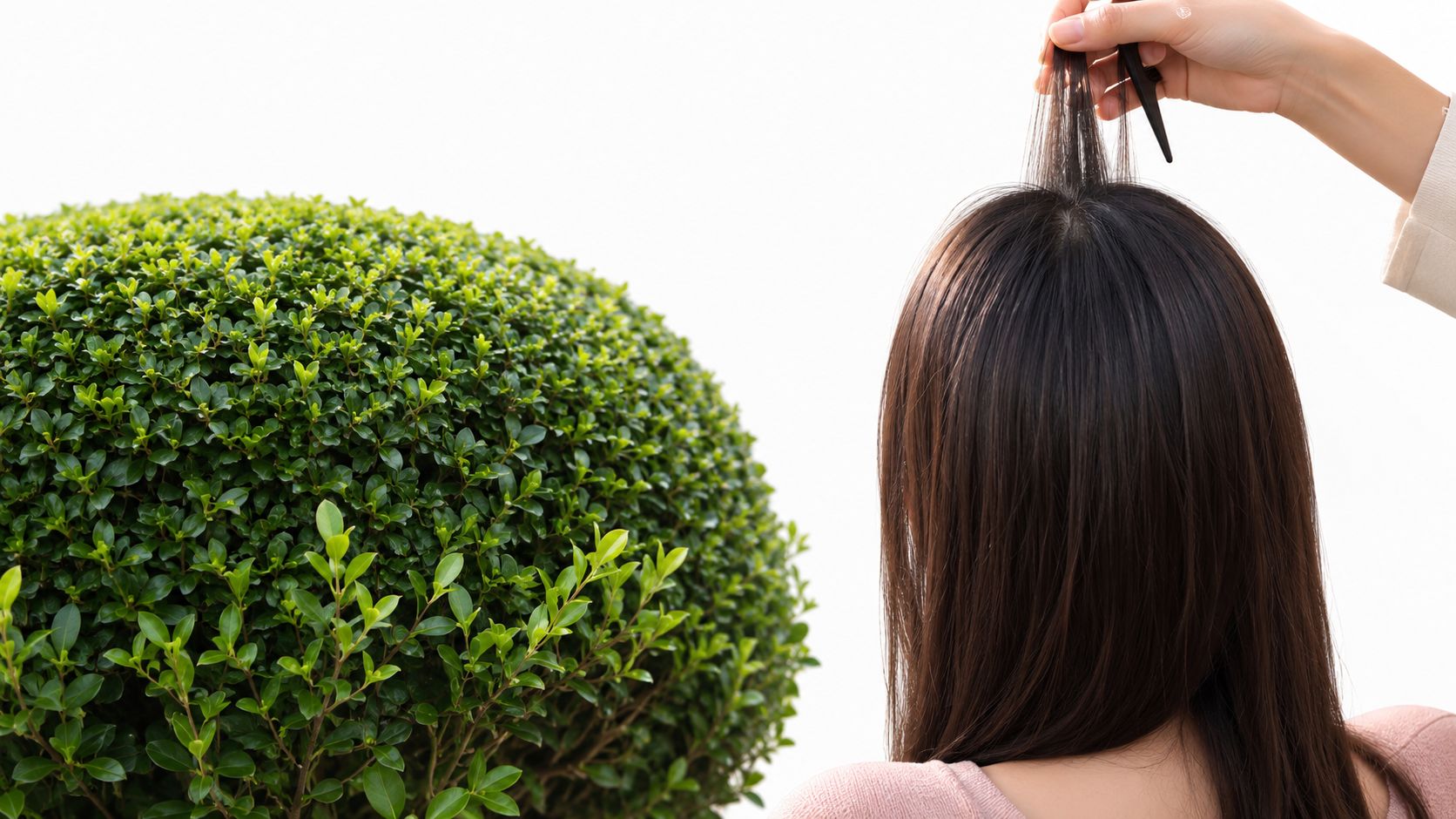
Build the shape from the top down
At the roots, the question is whether the natural hair conceals the attachment and gives the desired coverage. A topper sits over the parting, whereas wefts sit beneath a covering layer of natural hair. Placing a weft directly beneath a sparse parting can leave the track visible rather than create convincing lift.
Through the mid-lengths, rows of weft can fill out the back and sides. Individual beads or bonds allow more selective placement where the supporting hair is suitable. They sit near the roots with enough clearance for movement, not tight against the scalp or directly along fragile edges.
At the ends, the added hair should follow the existing haircut. A dense, blunt extension line beneath fine, feathered natural hair looks like a separate block, even when the colour is close.
Blend for the way you actually wear it
Consider a hypothetical client with crown thinning and slightly sparse ends. A fitted topper could address the visible parting, while a lower-weight weft row could fill the lower shape, provided the supporting hair is suitable. A heavy row alone would add body below the problem without necessarily covering it.
Blending involves more than finding a matching shade:
- Match the colour pattern: Account for root depth, highlights and the colour through the ends.
- Follow the haircut: Shape the added hair so it joins the natural layers rather than hanging below them.
- Check movement: Look at the result straight, loosely waved and in your usual tied-back style.
The final mirror check is practical: can you move your parting, turn your head and gather your hair without exposing an attachment? Test every plan against lift at the root, shared weight and a natural outline, not just the appearance of extra thickness in a still photograph.
Choosing a Method for Fine or Thinning Hair
Jean Hailes reports that 49% of women will experience hair loss at some point during their lifetime, as cited in Abby Health's Australian female hair-loss guide. That makes thinning a common concern, but extensions are cosmetic coverage, not treatment for the cause.
Fine hair and thinning hair also need different conversations. Fine describes strand thickness; thinning describes reduced density. You can have fine strands with good coverage, or coarse strands with a widening parting.
First method by hair situation
| Hair situation | Method to consider first | Why it fits |
|---|---|---|
| Fine hair with a sensitive scalp | Nano bead with light sections, after sensitivity is assessed | Small, discreet attachment without glue or heat |
| Fine hair thinning only at the crown | Crown topper | Adds coverage without loading the whole head |
| Medium density, wants length with fullness | Butterfly weft spread across sections | Flexible construction, with weight shared across rows |
| Dense hair, wants maximum coverage | Invisible weft or keratin bond | A stronger supporting base may carry more added hair |
| Recent or unexplained shedding | Medical assessment before any method | The cause needs assessment before adding tension |
Check the natural base
Before application, assess density, scalp sensitivity and existing breakage. Look at the actual attachment zones, not just the overall ponytail. A client can have enough hair at the back while lacking support near the temples.
For a fine-haired client with a sensitive scalp, lightly loaded nano sections may be worth considering once active irritation has been ruled out. Their discreet size helps concealment, but a small bead doesn't make an overloaded section appropriate. If contact or movement causes discomfort during the assessment, don't proceed just because the attachment is small.
For crown-only thinning, a topper can address the area the client wants covered. Its base should extend to suitable supporting hair, with clips positioned away from fragile strands. A topper isn't automatically suitable if the surrounding hair is also sparse.
For medium-density hair needing length and fullness, butterfly wefts spread across appropriate sections may provide a flexible shape. The application should leave enough natural hair above and around the rows to conceal them during ordinary movement.
Know when to delay application
Previously extended hair with broken sections needs reassessment before another installation. A rest period may be appropriate, followed by a lighter plan only when the hair and scalp are suitable. Replacing the same load immediately doesn't address why those sections broke.
Keratin bonds also need a natural base capable of supporting individual attachments. A polished, invisible blend isn't a reason to put them into weak or actively shedding hair.
Our guide to choosing a hair extension method on the Gold Coast helps compare the practical differences. The deciding question remains what your hair can support, not which method is fashionable.
Placement and Weight Rules That Protect Your Hair
Cumulative tension matters more than the apparent size of the installation. Dermatology literature published in JAMA Dermatology describes traction alopecia from prolonged or repetitive pulling, with the potential for permanent follicular injury if traction continues.
A modest-looking installation can still concentrate too much load on a weak section. Conversely, spreading hair across suitable supporting sections can avoid placing the entire burden at a narrow parting. The rule is spread, not stack, without using distribution as an excuse to add excessive total weight.
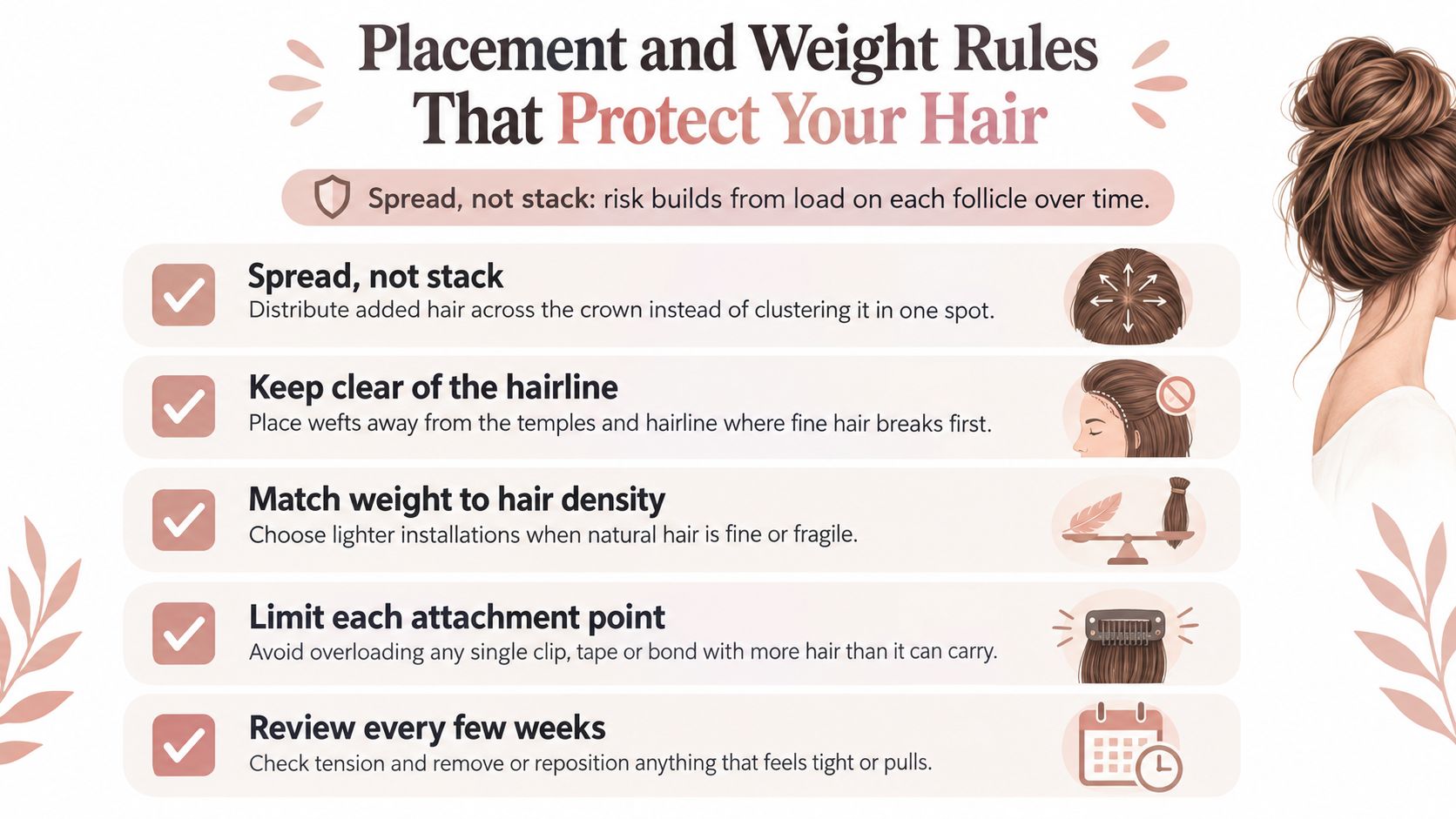
Set boundaries around fragile areas
- Protect the perimeter: Keep attachments clear of fragile hairline and temple hairs, with sufficient natural cover.
- Match section strength: Fine or compromised sections need lighter loads, not smaller attachments carrying the same amount.
- Avoid the thin parting: Don't concentrate bulk beneath an area that lacks enough hair to support or conceal it.
- Allow natural movement: Check the attachment while the client turns their head and gathers their hair.
Say a hypothetical application has too much hair stacked beneath a narrow parting. If the scalp is healthy and there are no warning symptoms, the replacement plan might use a pair of more lightly loaded rows across suitable areas. The colour blend can remain, while the total amount and distribution are reconsidered.
Plan for grow-out
As natural hair grows, attachments sit farther from the scalp. Their angle and grip change, so a refit belongs in the original application plan rather than becoming an optional tidy-up.
A useful fitting checklist includes:
- At application: No pulling, pinching or restricted movement.
- Before leaving: Confirm that attachments avoid fragile edges and that the load is shared.
- At home: Check the scalp and attachment zones early in wear, rather than waiting for visible deterioration.
- Before significant grow-out: Attend the agreed refit so the specialist can inspect support, slippage and tangling.
Practical rule: An attachment should move with your hair, not make you move carefully around it.
Our advice on reducing damage when wearing hair extensions supports conservative application and maintenance. Pain, lingering soreness or headache calls for prompt action, not just a lighter adjustment at a later appointment.
Warning Signs That Mean Stop and Get Checked
No pain doesn't necessarily mean no damage. You may notice that attachments feel different from your natural hair, but don't assume tightness is something you need to tolerate. Pain, lingering soreness or increasing tension isn't an acceptable settling process.
The Australasian College of Dermatologists identifies continuous pulling, including from extensions, as a cause of traction alopecia and warns that untreated traction can lead to permanent loss. Soreness, inflammation and changes around the hairline deserve attention rather than concealment beneath more hair.
Warning signs, causes and actions
| Symptom | What it may indicate | What to do |
|---|---|---|
| Scalp pain or soreness that lingers | Tension at attachment points | Remove or loosen promptly; don't reapply until assessed |
| Small pimples, redness or itching | Scalp irritation, inflammation or product build-up | Arrange removal, check the scalp and see a GP if it persists |
| Short broken hairs at parting or hairline | Traction on fragile strands | Stop reapplying, book assessment and reconsider weight before future wear |
| Thinning at temples or receding edges | Possible traction alopecia | Remove and see a GP or dermatologist |
| Headache that persists after wear | Possible tension across the head | Remove; seek medical advice if it continues |
| Reduced density over time, no pain | Possible gradual traction hidden by volume | Arrange assessment promptly, with density checks at subsequent refits |
Respond before reapplying
- Release the tension: Arrange prompt professional loosening or removal when pain, persistent headache, inflammation or hairline thinning appears. Don't pull bonded or clamped extensions out yourself.
- Pause further application: Leave the affected areas unloaded until the scalp and natural hair have been assessed.
- Seek medical assessment: Take suspected hair loss to a GP or dermatologist. An extension specialist can assess an installation but can't diagnose the cause of shedding.
Gradual changes may appear as shorter broken hairs or a thinner edge without obvious discomfort. Compare the natural hair during removal, not only the finished hairstyle with extensions in place.
A lightweight or discreet appearance isn't a safety guarantee. Attachment tension, added weight, placement, wear duration and existing density all influence suitability. For someone with limited crown thinning, a properly supported topper or reduced application may be preferable to full-head coverage, but active or unexplained loss needs medical assessment first.
Maintenance That Keeps Volume Looking Full
Gold Coast beach days, humid weather and outdoor routines affect the hair you've added as well as your own. Cooper Delivered's seasonal haircare guidance describes UV-related cuticle damage and moisture absorption in humid conditions, which can leave fibres rougher or swollen.
Rough hair tangles more readily and loses the smooth alignment that makes a blended style look full. Wind, salt, chlorine, grooming and heat add further wear, so maintenance needs to fit your actual routine.
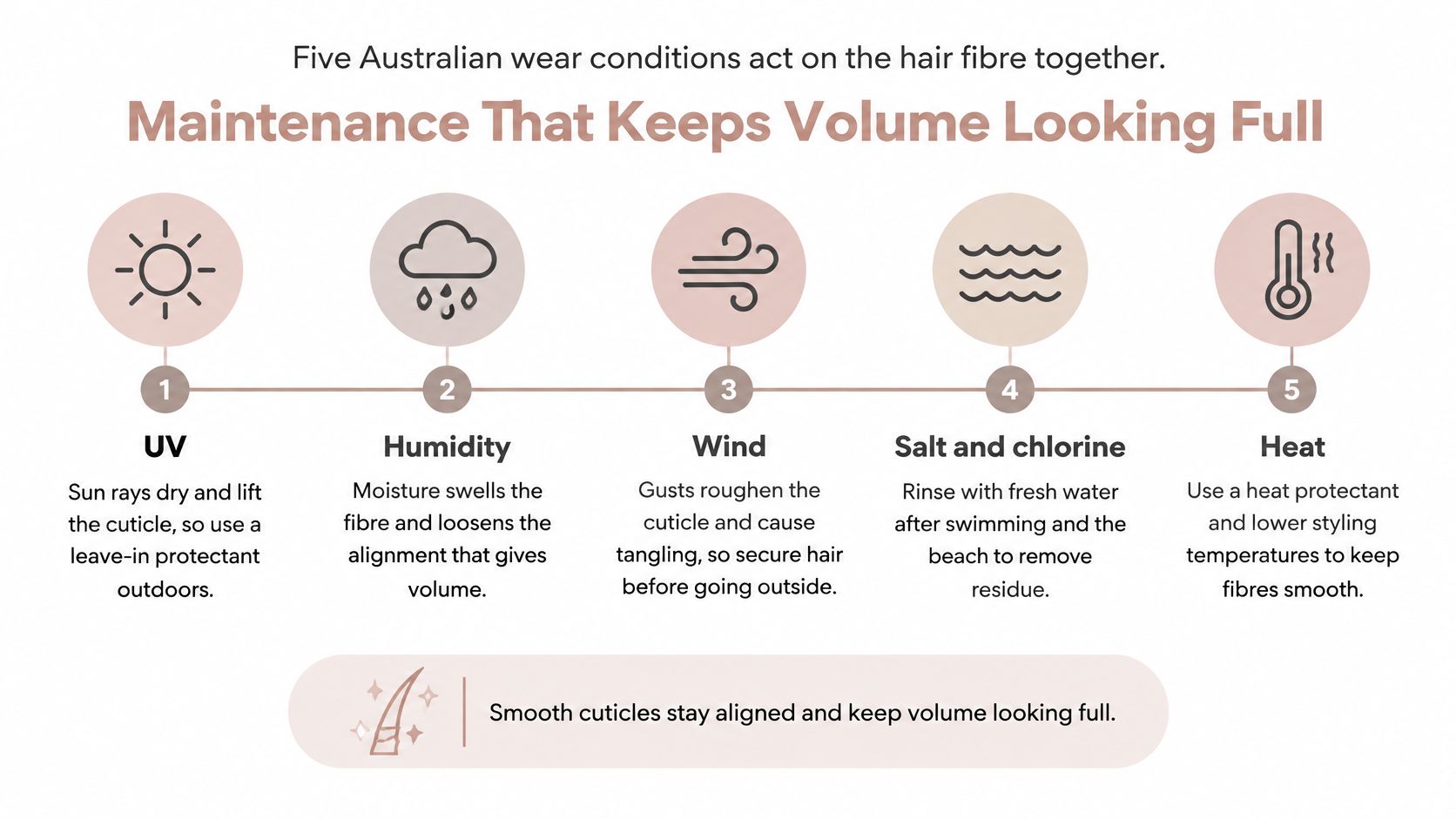
Daily care and beach-day habits
- Detangle from the ends: Use an extension-safe loop brush or suitable soft-bristle brush, supporting the hair above the section so you don't tug on attachments.
- Reduce outdoor exposure: Cover your hair during prolonged sun exposure and secure it loosely in windy conditions.
- Protect before styling: Apply a suitable heat protectant through the lengths and use the lowest effective tool setting.
- Prepare for swimming: Put the hair into a loose plait before entering the water, without tightening the roots.
- Rinse and dry afterwards: Rinse promptly with fresh water after salt or chlorinated water, then dry the attachment area fully to limit matting.
Keep shampooing controlled and directional rather than scrubbing the lengths into a bundle. Our guide to washing hair with extensions explains how to clean around attachments without unnecessary pulling.
Check condition before it affects the finish
During your regular care routine, separate the hair gently and inspect for tangling, roughness, colour change and slippage. Condition the lengths without saturating attachment zones, using products compatible with your method.
Say you swim most weekends. A deliberate check after your weekend wash can reveal a slipping attachment or a small tangle while it's still manageable, rather than after it has formed a visible gap or tight knot.
Book refits according to the application method, growth and attachment condition. There isn't a single interval that suits every installation, and the visit should include inspection of the natural hair as well as repositioning.
Care priority: Preserve the hair you have rather than repeatedly styling over roughness.
If the hair stays rough despite appropriate care, book an earlier review instead of adding more heat or heavy serum. When comparing human hair extensions on the Gold Coast, confirm the hair type during consultation: human hair fibres need protection from UV, humidity and water, but added hair can't biologically repair itself.
Book a Volume Consultation on the Gold Coast
Volume planning starts with a consultation, not a purchase. If you're searching for hair extensions on the Gold Coast, bring a clear description of what bothers you about your current shape. More crown coverage, fuller ends and length with body are different goals, and they don't necessarily need the same application.
At Hair Extensions Full Stop in Ashmore, we assess your hair, discuss your goals and recommend the most suitable extension option. Every installation is customised to your natural hair, lifestyle and desired result.
Bring a useful starting point
- Your preferred result: Bring reference photos, including styles close to your current length.
- Views of your hair: Front, crown and side photos can help explain where you notice gaps.
- Hair history: Note previous extensions, breakage, scalp sensitivity and any recent shedding.
- Your routine: Mention swimming, exercise, heat styling and how you usually tie your hair up.
Our work spans beads, wefts, bonds and toppers, so recommendations aren't tied to a single system. Every service includes personalised colour matching, expert blending and honest advice suited to your hair goals.
Agree on the purpose before application
The ACCC's personal services guide explains that services must be supplied with due care and skill and be reasonably fit for a purpose the client specifies. Write down the result you're seeking, along with any limitations discussed, so expectations are clear.
For hair extension application on the Gold Coast, a useful consultation should leave you understanding the proposed placement, maintenance and realistic coverage. Don't judge the plan solely by how much hair it includes.
If you have scalp pain, persistent shedding or unexplained thinning, see a GP or dermatologist before booking an installation. Once suitability is clear, phone our Ashmore studio to discuss a volume consultation and the result you'd like to achieve.
Hair Extensions Full Stop offers personalised assessment, colour matching and customised application for fuller, natural-looking hair in Ashmore on the Gold Coast. Visit Hair Extensions Full Stop to arrange a consultation or find our contact details and phone the studio about a volume plan suited to your hair.
Recent Articles


